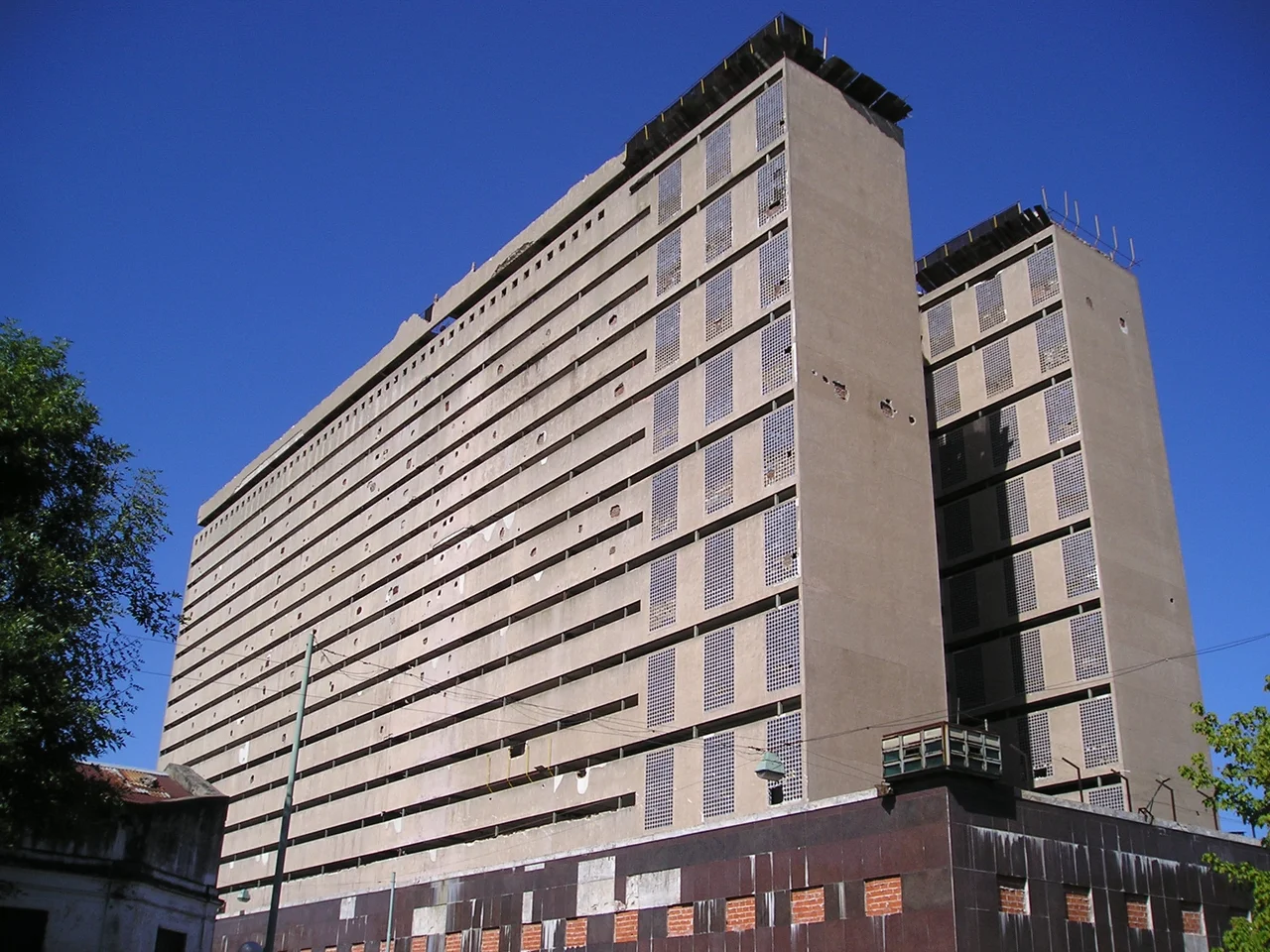

Caseros Prison
The architects made one design decision that tells you everything else. In the Caseros Prison, a twenty-two-story concrete tower that loomed over a residential corner of southern Buenos Aires, the windows were arranged so that direct sunlight could never reach a single prisoner. Human rights groups condemned the building before it ever held an inmate. The dictatorship opened it anyway in 1979, and a government minister stood at the inauguration and compared it to a five-star hotel. For twenty-two years it cast its long shadow over the barrio of Parque Patricios. Then, just as deliberately, the city took it apart.
A Tower Built to Hold the Light Out
Caseros was conceived by the military governments of the 1960s and took almost twenty years to build, finished in 1979 under the junta of Jorge Rafael Videla. Shaped from above like the letter H, it stacked more than 1,500 cells across twenty-two floors, each cell a concrete box of 1.2 by 2.3 meters fitted with a bunk, a toilet, and a table bolted to the floor. It rose in the middle of an ordinary neighborhood, within blocks of two hospitals, a monument to control disguised as modern penology. When the minister of justice praised its design as the latest science of rehabilitation, he was describing a machine built to deny people the sun.
On the Books, and Therefore Alive
Roughly 1,500 political prisoners passed through Caseros, most of them left-wing militants and student leaders arrested by the Perón and Isabel Perón governments in the mid-1970s, before the 1976 coup. There is a bitter logic to why many of them survived. Because they had been formally registered with international human rights organizations, they were harder for the regime to simply murder or "disappear," as it was doing to thousands of others beyond the walls during the Dirty War. When a foreign human rights commission visited in 1979, the junta theatrically moved high-profile detainees into the gleaming new Caseros to display how well it treated its prisoners. The building was, in part, a stage set for the world's benefit.
Palomas in the Air
After democracy returned in 1983 and the political prisoners were freed, Caseros filled with ordinary convicts, often five to a cell built for one. The men fought back against their own architecture. In a 1984 riot they tore out toilets and the glass from visiting booths, and they began knocking holes through the outer walls to reach light, air, and one another. Through those holes they invented a small economy of contact. A prisoner would lower a bundle on a rope braided from mattress fibers, and a wife or mother waiting in the street below would catch it, slip in a note or a photograph of a child or a cigarette, and let it be hauled back up. They called these rope-and-bundle lines palomas, pigeons, and on a busy day seven or eight might be flying down to the pavement at once.
Eighty Thousand Tons, Taken Down by Hand
Caseros closed in 2001, condemned at last. Demolishing it proved nearly as fraught as building it. A planned implosion was blocked by neighbors who feared the dust, the asbestos, and the rats that might pour from the tunnels beneath, so the tower was instead dismantled by hand, floor by floor from the top down, between 2003 and 2008. During that slow unmaking the artist Seth Wulsin worked across its grid of windows, knocking out panes to form forty-eight ghostly faces that appeared and dissolved along the dying facade, a project he called 16 Tons. By 2008 the central tower was gone. All that remains is the base of its perimeter wall and, beside it, the older Caseros prison, a building first raised in the 1880s, fittingly, as an orphanage.
From the Air
Caseros Prison stood in Parque Patricios, in the southern part of the city of Buenos Aires, at approximately 34.63°S, 58.39°W; the tower has been demolished, leaving its base and the older adjacent prison. Recommended viewing altitude is 1,500 to 3,000 feet AGL to read the dense low-rise grid of Parque Patricios and locate the cleared site within it, a few kilometers southwest of the downtown core. Visual landmarks: the green of Parque Patricios itself nearby, the Riachuelo and La Boca to the southeast, and the central Buenos Aires skyline to the north. Nearest airport is Buenos Aires Aeroparque Jorge Newbery (ICAO: SABE), about 9 km north along the riverfront; Ezeiza / Ministro Pistarini International (ICAO: SAEZ) lies roughly 22 km to the southwest. Urban haze commonly softens visibility over the city; clearest viewing is on dry mornings after rain.
Nearby Stories
- Tigre, Buenos Aires 6 km away
- Luján, Buenos Aires 17 km away
- Anchorena National Park 21 km away
- La Plata Museum 22 km away
- Lobos 23 km away
- San Antonio de Areco 43 km away
- Chascomús 82 km away
- Tronador (rocket) 96 km away