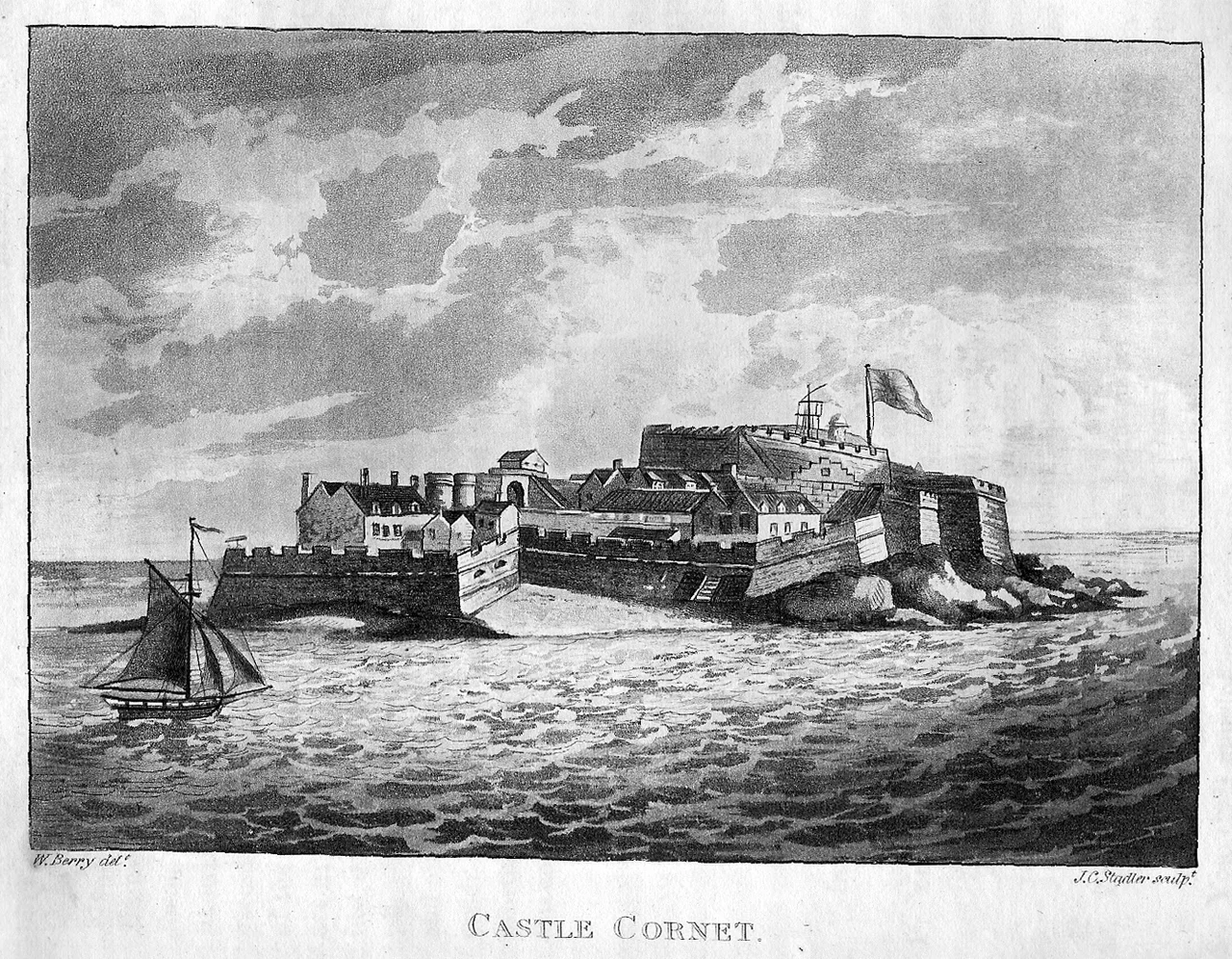

Castle Cornet
For nine years between 1643 and 1651, while the rest of Guernsey declared for Parliament, the soldiers inside Castle Cornet kept the King's flag flying. They were besieged, bombarded, and forgotten. Roughly ten thousand cannonballs were fired at the town of St Peter Port during those years - most of them launched from this small stone island a few hundred meters offshore. Castle Cornet was one of the last Royalist holdouts in the entire English Civil War. It also lost its central keep in 1672 when the gunpowder magazine inside exploded, taking the medieval tower with it. There is a lot of story compressed into two hectares of rock.
A Tidal Island Becomes a Fortress
Castle Cornet sits 600 meters east of Guernsey's coast, a flattened oval of rock 175 meters long and 130 meters wide. Until 1859, when it became part of the breakwater of St Peter Port harbor, it was a true tidal island - cut off twice a day by the rising sea. Fortification began somewhere between 1206 and 1256, in the aftermath of the 1204 split that left Guernsey loyal to England. Over the next 800 years, generation after generation added walls, gateways, batteries, and bastions. There are six gateways now between the harbor and the citadel at the top, and almost no order to how any of it was built. The main gate is hidden from the line of fire from the island. Above it sits the coat of arms of Queen Elizabeth I.
The French Massacre and the Long Recovery
In 1338, in the opening years of what would become the Hundred Years' War, a French force seized Guernsey and besieged Cornet. The castle fell on 8 September. The French then massacred the garrison - eleven men-at-arms and fifty archers, killed after surrender. Guernsey was retaken by English forces in 1340, but the castle itself remained in French hands until August 1345, when an English commander recaptured it and found it, despite everything, strong and well stocked with artillery. The medieval island had absorbed the worst of war and held.
Royalists on a Rock
When the English Civil War broke out in 1642, Guernsey overwhelmingly sided with Parliament. The garrison of Castle Cornet did not. Sir Peter Osborne, the King's governor, refused to surrender. For nine years his small force held out, supplied by sea from Royalist Jersey, while Parliamentary cannon thundered at them from the town and the castle's own guns thundered back. The cannonballs - ten thousand of them by contemporary estimates - fell on St Peter Port itself, where Guernseymen who supported Parliament watched their own neighbors' homes destroyed by their own would-be defenders. Castle Cornet finally surrendered on 17 December 1651, one of the very last Royalist positions in the British Isles to hold out. Its commander, Colonel Roger Burges, walked out with honor intact.
The Keep That Wasn't There Anymore
Then came 1672. On the night of 29 December, lightning struck the powder magazine inside the castle's medieval keep, and the keep itself simply ceased to exist in the explosion that followed. A 1672 engraving made before the disaster shows the tall central tower that had defined the castle's silhouette for four centuries. After the blast, no one rebuilt it. The castle was used as a prison, most notably for Colonel John Lambert, a former Parliamentary general turned political inconvenience, who was held there from 1662 to 1670. The curtain wall around 1570 was later refaced and strengthened. The whole of Castle Cornet was listed as a Protected Monument on 26 March 1938. Today the noonday gun still fires from the battery at noon each day. The boom rolls across the harbor like a slow, low echo of all the cannonballs that once flew the other way.
From the Air
Castle Cornet stands at approximately 49.45°N, 2.53°W, just east of St Peter Port harbor on Guernsey. From above it appears as a small fortified island connected to the mainland by a breakwater - a distinctive comma-shape jutting from the eastern edge of the town. Guernsey Airport (EGJB) is roughly 6 km southwest. The castle is best seen from the east, where the layered walls and bastions become legible. At low altitude the noonday gun's smoke is sometimes visible from the air.
Nearby Stories
- Pallot Steam, Motor & General Museum 29 km away
- HMS Affray 29 km away
- Operation Donnerkeil 29 km away
- German Submarine U-672 35 km away
- Action of 18 June 1793 60 km away
- Mont Saint-Michel: The Abbey That Becomes an Island Twice a Day 78 km away
- Basilica of Sainte-Therese, Lisieux 209 km away
- 1941 Santander Fire 642 km away