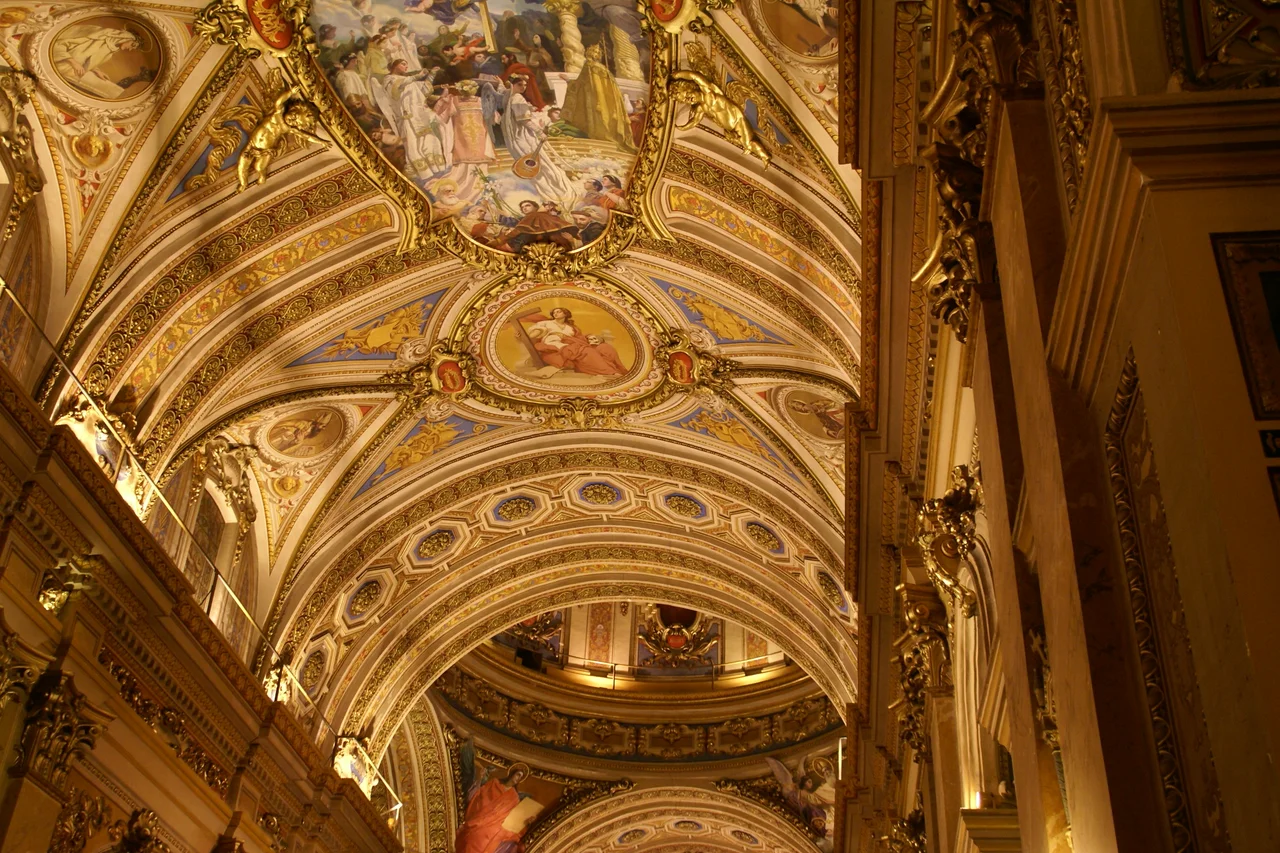

Cathedral of Córdoba, Argentina
Look up at the towers, and the angels are playing trumpets in indigenous dress. It is an odd, wonderful detail on a building that took two centuries to finish: the cathedral of Córdoba began rising in 1582 and would not see its bell towers completed until 1787, by which time master builders, Jesuit architects, a Franciscan friar, and a Granadan draftsman had all left their mark on the same stone. The result is not one style but a conversation among many. This is the oldest church in continuous service anywhere in Argentina, and it has been holding services, more or less, since long before the country existed.
Two Centuries of Hands
No single architect can claim this building. Work began in 1582 under the name it still carries, the Church of Our Lady of the Assumption. In 1598 the master builder Gregorio Ferreira and the stonemason Juan Rodríguez set to work with stone, brick, and lime, durable materials chosen for a structure meant to outlast its makers. A carpenter framed the first roof; another man oversaw the firing of thirty thousand clay tiles. Then the Jesuits arrived with grander ambitions. Giovanni Battista Primoli laid out the floor as a Latin cross, modeled on the Church of the Gesù in Rome. In 1758 the Franciscan friar Vicente Muñoz designed and raised the great dome. The cathedral had been consecrated in 1706, finished in its essentials by 1758, and crowned with bell towers only in 1787. Each generation built atop the last, and the seams still show.
A Stranger's Compass
Churches of this era were supposed to face Jerusalem, the high altar oriented toward the holy city. Córdoba's cathedral quietly breaks the rule. Its main façade looks east-southeast, and the altar points northwest rather than the northeast that tradition demanded, an architectural irregularity that sets it apart from its contemporaries. The building occupies an entire block on the west side of Plaza San Martín, the old Plaza Mayor at the city's heart. A narrow alley called Santa Catalina separates it from the neighboring Cabildo, the colonial town hall. Behind the church lies the small Plazoleta del Fundador, where a bronze statue of Jerónimo Luis de Cabrera, who founded Córdoba in 1573, stands in patinated green. From the air, the cathedral and the Cabildo together mark the precise center of the old city.
Silver from the Mountains, Christ from Paris
Step inside and the eye climbs. A high barrel vault runs the length of the central nave, thick with carved and gilded moldings, much of it in gold leaf. Light falls through deep lunettes set into the curve of the ceiling. The main altar is worked in embossed silver carried down from Upper Peru, colonial Bolivia, where the mines of the Andes fed the wealth of the empire. Statues of saints line the nave, many of them articulated and dressed in real cloth. The great entrance doors and the choir stalls were carved by Jesuit hands from missionary cedar. Later flourishes kept arriving: a tabernacle donated in 1804, frescoes painted in the early twentieth century by Emilio Caraffa and others, and the figure of Christ the Redeemer added to the top of the façade in 1901, cast in a Paris foundry and shipped across the Atlantic to stand above an Argentine plaza.
Who Sleeps Beneath the Floor
The narthex and crypts of the cathedral are a roll call of the people who made Córdoba and the nation around it. General José María Paz, a one-armed soldier of the independence wars, lies here beside his wife Margarita Weild. Nearby rests Dean Gregorio Funes, the priest and politician who chronicled the early republic. In the crypts lie Bishop Hernando de Trejo y Sanabria, who founded the University of Córdoba, the oldest in Argentina, and Friar Mamerto Esquiú, remembered for a famous sermon on the national constitution. To walk past these tombs is to walk past the scaffolding of a country still being assembled. The cathedral's treasury once held crowns set with diamonds and pearls to adorn statues of the Virgin, though part of that collection was looted in the final decades of the twentieth century, a quiet wound the building still carries.
From the Air
The Cathedral of Córdoba sits at 31.42°S, 64.18°W, on the west side of Plaza San Martín in the dense historic core of central Córdoba. From the air, look for the green-domed mass of the church paired with the arcaded Cabildo immediately to its north, separated only by the thin Santa Catalina passage, together marking the geographic center of the old city. The nearest airport is Ingeniero Aeronáutico Ambrosio L.V. Taravella International (ICAO: SACO, also called Pajas Blancas, field elevation 1,604 ft), roughly 9 km north-northwest. Best viewed at lower altitudes in clear conditions; the surrounding grid of colonial streets makes the plaza easy to pick out.
Nearby Stories
- Jesús María, Argentina 16 km away
- Alta Gracia 26 km away
- Pampa de Achala 31 km away
- Mina Clavero 31 km away
- Mar Chiquita Lake 116 km away
- Battle of Quebracho Herrado 135 km away
- Villa San Agustín 271 km away
- Predelta National Park 289 km away