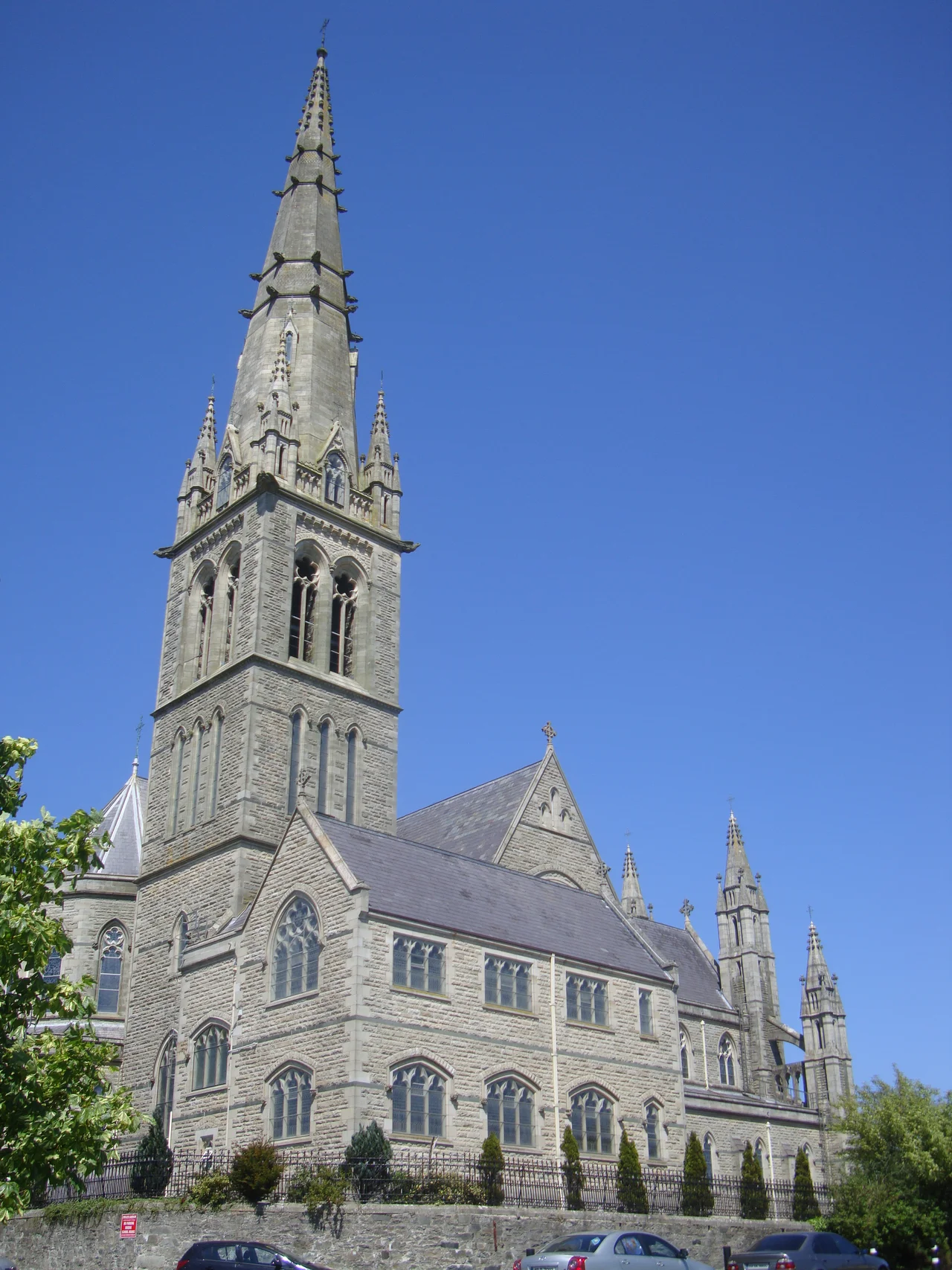

Cathedral of St Eunan and St Columba
Townspeople carried the building up to the hill in buckets. The sandstone came from Mountcharles quarries on the south coast of Donegal, was shipped around the coast and up the River Swilly to Letterkenny port, and from there the people of the town carried it - bucket by bucket - to the ridge above Castle Street where the new cathedral was rising. Construction took ten years, from 1890 to 1900, and cost £300,000 in 1900 money, the equivalent of around £50 million today. It made St Eunan's the most expensive church ever built in Ireland. Walk up the hill into Letterkenny today and the spire is still the first thing you see, rising 240 feet above a town that everyone in Donegal simply calls "the Cathedral Town".
The Youngest Bishop in the World
The cathedral was commissioned by Patrick O'Donnell, who became Bishop of Raphoe in 1888 at the age of thirty-two - making him the youngest bishop in the world at that moment. He had grown up in west Donegal speaking Irish, studied for the priesthood at Maynooth, and returned home to run a diocese that included some of the poorest parishes in Catholic Ireland. He wanted Letterkenny - the diocese's largest market town - to have something proportionate to the church's standing. The site he chose was Castle Street, on the high ground overlooking the town, directly opposite the older Conwal Parish Church (Church of Ireland). The architect he chose was William Hague, a Dublin Gothic Revival specialist who had been a protégé of Augustus Pugin. When Hague died in 1899 before completion, his partner T. F. McNamara finished the work. O'Donnell himself went on to become a cardinal.
Eunan and Columba
The cathedral takes its dedication from two of the most consequential figures in early Irish Christianity. Columba - *Colmcille* in Irish - was the sixth-century Donegal-born monk who founded the monastery at Iona, off the Scottish coast, that became the engine of Celtic Christianity across northern Britain. He died on Iona in 597. A century later, Adomnán - locally called Adhamhnáin and rendered in English as Eunan - became the ninth Abbot of Iona and wrote the *Vita Columbae*, the most important early biography of his predecessor. He was a Donegal man too, and the Diocese of Raphoe claims him as a patron. The Great Arch of the cathedral, painted by the firm of Amici of Rome, illustrates scenes from both their lives - missionaries crossing in tiny boats, monks copying manuscripts, the saints in conversation with the kings and angels of their world.
Willie Pearse's Sculptures
Look closely at some of the sculptures inside St Eunan's and you are looking at the work of a man who would be executed by firing squad sixteen years after the cathedral opened. Willie Pearse - sculptor, theatre director, and younger brother of Patrick Pearse - carved several of the figures here in the years just before the Easter Rising of 1916. Both Pearse brothers took part in the rising. Both were court-martialled by the British and shot at Kilmainham Gaol in May 1916. The Pearse Brothers' firm of Dublin also produced the cathedral's white marble pulpit, depicting the Four Masters - the seventeenth-century Donegal Franciscans who compiled the great annals of Irish history - alongside the Four Evangelists. The Pearse sculptures remain in place, a small detail in a building most visitors notice for its bells, its altar, and its spire.
Twelve Bells, Twelve Saints
The bell chamber holds twelve bells, each cast with the name of a saint of *Tír Conail* - the old Gaelic kingdom that covered most of modern Donegal. Dallan, Conal, Fiacre, Adomnán, Baithen, Barron, Nelis, Mura, Fionán, Davog, Cartha, Caitríona, Taobhóg, Cróna, Ríanach, Ernan, Asica, and Columba between them cover the major Donegal saints, often paired on a single bell. The largest of the twelve weighs more than two tons. On opening day, 16 June 1901, the cathedral organist marked the moment by playing a particular sequence: "O'Donnell Abu" (a war march of the medieval O'Donnell chiefs of Donegal), "St Patrick's Day", "The Last Rose of Summer", "The Wearing of the Green", and "The Bells of Shandon". The choice was a small political statement at the height of the Home Rule era - a Catholic cathedral in a town with a Church of Ireland establishment, opening to Irish patriotic music.
Light from Munich
The thirteen stained-glass windows of the sanctuary and Lady Chapel were made by the Mayer firm of Munich, then one of the most prolific ecclesiastical stained-glass producers in Europe. They depict scenes from the life of Jesus. The marble pulpit by Pearse Brothers, the Amici-painted ceilings from Rome, the silver sanctuary lamp weighing over 1,500 ounces, the carved oak fittings throughout - all of this was paid for out of a £300,000 budget that was extraordinary for any Irish church and astonishing for one in a county as poor as Donegal then was. In 1985 the cathedral was remodelled to suit the new liturgy of Vatican II, but the original carved altarpiece - an Irish carving of Leonardo's *Last Supper* - was preserved and incorporated into the new altar. In 2025 the cathedral underwent a major redecoration, closing on weekdays through August and September, and reopened in October. The town gathered to see the freshly cleaned interior. Then in January 2026, the new Bishop of Raphoe, Niall Coll, was installed as Parish Priest.
From the Air
St Eunan's Cathedral sits at 54.95°N, 7.74°W on a ridge above Letterkenny, the largest town in County Donegal. City of Derry Airport (EGAE) is 14 nm north-northeast; Donegal Airport (EIDL) is 25 nm west. The cathedral's 240-foot pale sandstone spire is the dominant landmark from any direction, visible from over 10 nm in clear weather and rising above the town's surrounding rooftops. The River Swilly snakes north past the town toward Lough Swilly. Best viewed at 2,000-4,000 ft AGL.
Nearby Stories
- Ireland Cricket Team 0.7 km away
- Inishfree 2.7 km away
- Killybegs 3.6 km away
- Rosguill 4.9 km away
- Inishowen 5.5 km away
- St Patrick's Purgatory 7 km away
- Omagh 9.2 km away
- Battle of Tory Island 12 km away