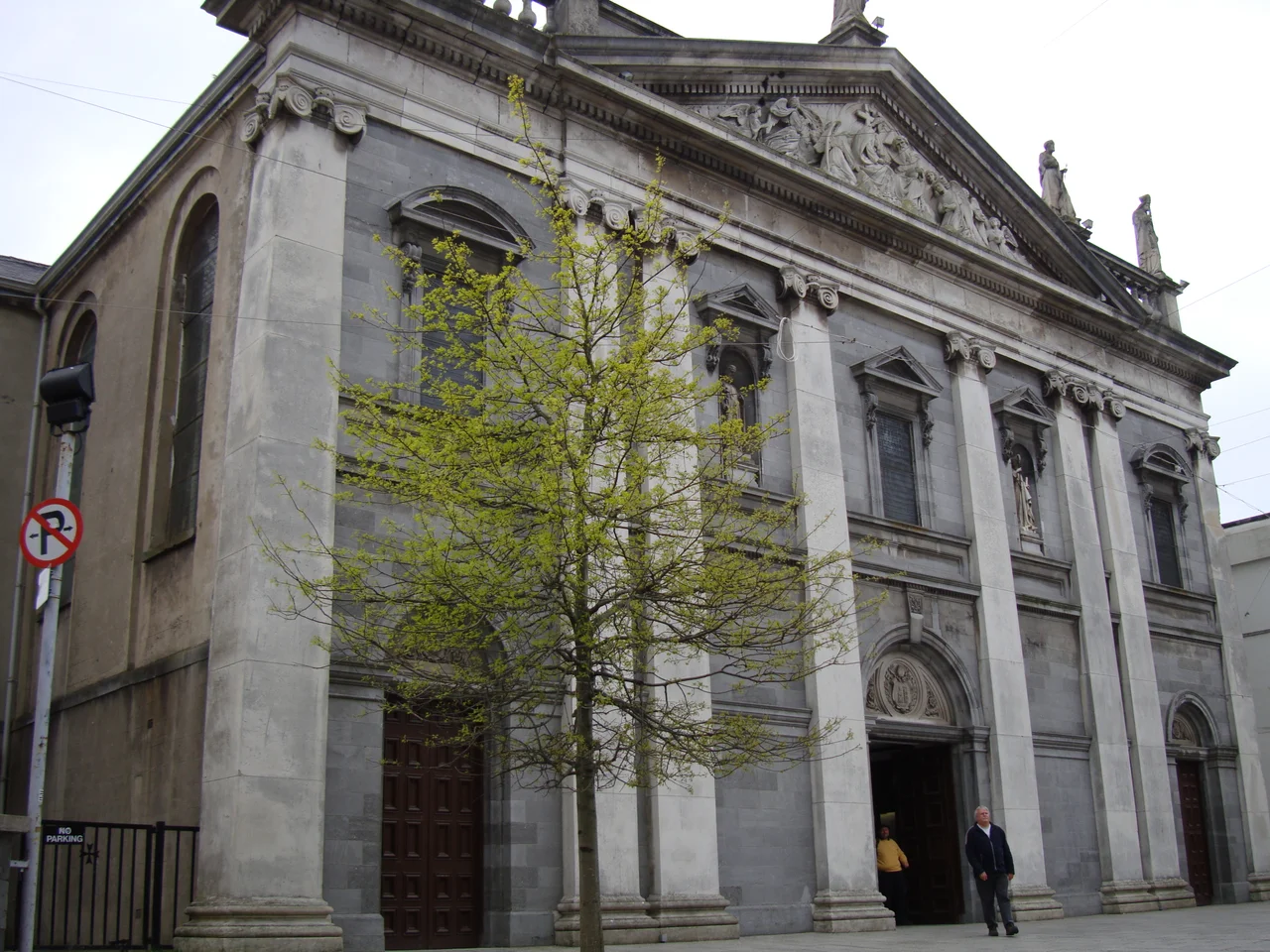

Cathedral of the Most Holy Trinity, Waterford
It is the oldest post-Reformation Catholic cathedral in Ireland, which sounds like an architectural distinction until you stop to think about what those words actually mean. The Cathedral of the Most Holy Trinity, on Barronstrand Street in Waterford, was begun in 1793, thirty-six years before the Roman Catholic Relief Act of 1829 gave Irish Catholics the right to hold civil office. To put up a Catholic cathedral in those years was to bet the building against the law, and to win.
The Big Chapel and the Old Store
Long before the current cathedral existed, a converted warehouse known as the Old Store stood against the northwest city wall, used as a Catholic place of worship after the Stuart Restoration of 1660 brought a measure of respite from religious persecution. In 1693, at the height of the Penal Laws that restricted Catholic worship across Ireland, the local Catholic community asked permission to build something more permanent on the same ground. They got it. The result was a structure Waterford called the Big Chapel, which would serve until the late 18th century when it was replaced by the cathedral that stands today. The fact that any of this was possible in 1693 reflects the strange patchwork of how the Penal Laws were enforced -- harshly in some places, looked past in others, especially in port cities where the Catholic merchant class held real economic power.
Building Against the Law
Construction of the new cathedral began in 1793, more than three decades before Catholic Emancipation. The building was extended and reshaped many times over its history -- initially planned to a square footprint, then expanded eastward and westward. Bishop Abraham oversaw the eastward extension of the sanctuary between 1829 and 1837, and in 1854 Bishop Foran added the apse and installed a new altar. The result is a cathedral that grew in stages with the rights of the community that built it, expanding outward as the legal pressure on Irish Catholicism eased. Since 1810 the cathedral has been a mensal parish, meaning the Bishop of Waterford and Lismore is the official parish priest, with an administrator appointed to handle the daily work.
Mr. Best at the Console
On Sunday, 29 August 1858, William Thomas Best -- one of the most celebrated organists in Victorian Britain -- played the inaugural recital on the cathedral's new pipe organ. Built by William Hill and Sons of London, the instrument had three manuals and 43 speaking stops, and was an example of Hill's German system organ. It was the third organ to serve worship on this ground: the first had been built for the Big Chapel in 1773, presumably transferred to the new cathedral, then replaced in 1826 by a smaller instrument from the Liverpool organbuilding family known by the alternative spelling Dreaper. The Hill organ was conservatively rebuilt in 1901, with the action changed to tubular pneumatic. In 1965 the Irish Organ Company gave it a major rebuild, converting it to electro-pneumatic action and extending the compass.
Barronstrand Street Today
The cathedral sits among the streets of Waterford's medieval core, its facade looking out onto Barronstrand Street much as it did when the surrounding city was a tenth the size. Inside, the painted ceiling decorations and the Hill organ in its console still recall the Victorian era when Waterford was a confident provincial capital. The list of cathedral administrators reaches back to Reverend Garrett Connolly in 1810 and continues today, an unbroken chain of priests-in-charge that runs through Famine, Independence, and the modern Irish Republic. From the air, the cathedral reads as one of the larger ecclesiastical buildings in Waterford's compact urban core, its long nave and apse oriented within the medieval street grid that the Vikings first laid out in the tenth century.
From the Air
Located at 52.26 degrees N, 7.11 degrees W on Barronstrand Street in Waterford city, Ireland. The cathedral appears from altitude as a large rectangular ecclesiastical building within Waterford's tightly packed medieval core, its long axis running east-west. Nearest airports: Waterford (EIWF) approximately 9 km south of the city; Cork (EICK) approximately 110 km west. Best viewed below 2,500 ft AGL. The cathedral is active and open to visitors.
Nearby Stories
- Siege of Kilkenny 4 km away
- 2008 Irish Pork Crisis 9.4 km away
- Liam Lynch (Irish republican) 9.6 km away
- Raymond FitzGerald 11 km away
- Johnstown Castle 12 km away
- Holy Cross Abbey 13 km away
- SS Folia (1907) 29 km away
- Ramsey Island 94 km away