
Raymond FitzGerald
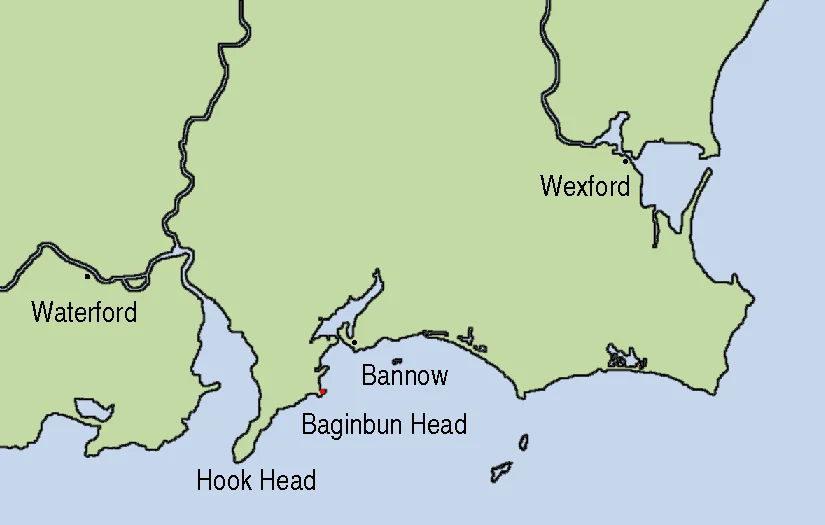
He won his first Irish battle with cows. In May 1170, Raymond FitzGerald - nicknamed Le Gros, "the Large," because he was visibly stout - had landed at Baginbun Head on the Hook Peninsula with about a hundred Cambro-Norman knights and infantry. The local Irish and Hiberno-Norse defenders besieged him in his earthworks. His cousin Gerald of Wales put the enemy numbers at three thousand. Raymond, vastly outnumbered, did the unexpected thing his men had been least trained for: he rounded up a herd of cattle his foragers had taken, and drove them at the oncoming line. The stampede broke the formation. Approximately a thousand of the combined Gaelic and Hiberno-Norse force were either killed or captured. The Norman invasion of Ireland had its first famous victory.
Welsh Beginnings
Raymond was a grandson of Princess Nest ferch Rhys, daughter of Rhys ap Tewdwr, the last independent Prince of South Wales. His father, William FitzGerald, was Lord of Carew - one of the Cambro-Norman warlords whose Welsh-Norman families had spent generations carving up the Welsh Marches. The FitzGeralds, the Barrys, the FitzStephens, and the Carews were all cousins by blood or marriage, and they all looked east toward an Ireland that had just begun, in 1167, to ask for outside military help. Diarmait Mac Murchada, the deposed King of Leinster, had appealed to Henry II for soldiers; Henry's vassal Richard de Clare - Strongbow, 2nd Earl of Pembroke - had taken up the offer. Strongbow sent Raymond ahead in 1170 to secure a bridgehead. The cow stampede at Baginbun did exactly that.
Soldier, Not Statesman
Raymond was Strongbow's second in command for the operations that followed. He had the chief share in the capture of Waterford that summer, and in the successful assault on Dublin shortly afterwards. Strongbow sent him to Aquitaine to formally hand over his Irish conquests to Henry II - the kind of diplomatic mission a Norman commander could not duck. By July 1171 he was back in Dublin, leading sallies out of the city against besieging Irish forces. Then came a personal break: Raymond asked for the hand of Strongbow's sister Basilia de Clare, recently widowed. Strongbow refused. Raymond left for Wales in a fury. Hervey de Mountmaurice replaced him as constable. The conquest's most effective field commander walked away from the conquest.
Recalled, Married, Reinstated
Three years later, in 1174, the conquest was in trouble. A general Irish rebellion against Strongbow had erupted, and the Norman position was wobbling. Raymond agreed to return - on condition that the marriage to Basilia was now offered. He sailed back with about 450 men and broke the siege of Waterford where Strongbow was trapped. The wedding took place in Wexford directly afterwards. As constable again, he scored a series of military successes including the capture of Limerick city in October 1175. When Mountmaurice tried to get him recalled on the grounds that his power threatened royal authority, Strongbow's troops simply refused to march without him. After Strongbow's death, Raymond acted as governor of the Norman territories until William FitzAldelm arrived to take over. In 1182 he relieved his half-uncle Robert Fitz-Stephen, besieged in Cork. Wherever the conquest tipped, Raymond was sent to right it.
What Gerald of Wales Saw
His cousin Gerald of Wales - the most prolific writer of his era - left a physical description of Raymond that survives almost word for word. "Very stout, and a little above the middle height; his hair was yellow and curly, and he had large, grey round eyes. His nose was rather prominent, his countenance high-coloured, cheerful, and pleasant; and, although he was somewhat corpulent, he was so lively and active that the incumbrance was not a blemish or inconvenience." Gerald continued: "Such was his care of his troops that he passed whole nights without sleep, going the rounds of the guards himself, and challenging the sentinels to keep them on the alert. He was prudent and temperate, not effeminate in either his food or his dress. He was a liberal, kind, and circumspect man; and although a daring soldier and consummate general, even in military affairs prudence was his highest quality." Raymond, the verdict ran, was the soldier of the conquest. Strongbow was its statesman.
A Quiet Death and a Lost Grave
Nobody is sure when Raymond died. He was certainly alive in 1185 when John of England came to Ireland; Gerald of Wales finished his Expugnatio Hibernica in 1189 without recording the death of his famous cousin. Basilia remarried sometime between 1198 and 1201, which gives the latest possible window. Tradition says Raymond was buried at Molana Abbey on the Munster Blackwater, the monastery he had patronised in his retirement, although the 19th-century memorial plaque there is in the wrong location. Songs in old Norman French were composed for him, naming him a brave baron and constable of Leinster, recruiting knights and archers to shame the king's enemies in Ireland. Eight and a half centuries on, the cows are gone from the strategic textbooks. The cousin's description survives. The grave does not.
From the Air
Raymond's life crossed many points on the Irish south and east coasts. Baginbun Head (52.18°N, 6.84°W) on the Hook Peninsula, where he landed in 1170, lies about 5 km south of Fethard-on-Sea, County Wexford. Molana Abbey (52.00°N, 7.88°W), his traditional burial place, is just upriver from Youghal on the Munster Blackwater. Best viewed from 2,500-4,500 ft AGL. Waterford and Dublin, both taken under his command, remain the obvious aerial landmarks for retracing his military career. Nearest airports along the route: Waterford (EIWF), Cork (EICK), Dublin (EIDW). The compact size of his theatre of operations - a roughly 200 km arc from Cork to Dublin - makes a single GA flight a workable way to trace the whole Norman conquest of southeastern Ireland.
Nearby Stories
- The Glen, Cork 3.8 km away
- Liam Lynch (Irish republican) 6.1 km away
- All Together Now (festival) 9.4 km away
- Castle Oliver 14 km away
- Kilbrittain 17 km away
- 1999 Tramore helicopter crash 30 km away
- Walter Siepmann 37 km away
- SM U-27 107 km away