.JPG)
Cauberg
It is 1,200 metres long with a maximum gradient of 12 percent, and on the second Sunday of April every spring, a few hundred professional cyclists will burn their legs raw on it. The Cauberg climbs out of the centre of Valkenburg aan de Geul in a single straight ramp, paved with asphalt since 1969 (and cobblestones for the thirty-five years before that). For most of the year it is just a road out of a small Limburg town. For the Amstel Gold Race, for five UCI Road World Championships, and for three Grand Tour stages, it has been a stage on which careers are made.
An Old Way Out of Town
The name is older than the racing. Linguists trace 'Cau' to a Celtic word for height, and 'berg' is Germanic for hill - a doubled-up etymology that says, in essence, hill-hill. For centuries unmotorized traffic actually avoided it. The grade was too steep for carts, so wagons and walkers took the longer route along the Geul river. The road was paved in cobblestones only in 1934, then resurfaced in asphalt in 1969. There is a darker mark on the climb too. On 29 September 1954, a Belgian coach carrying miners home from a day trip to Valkenburg zoo lost its brakes on the descent. It smashed into a limestone monument at the foot of the hill and then into the gable of a hotel on Grendelplein. Eighteen passengers and a bystander were killed.
How a Hill Became a Resort
In the 19th century, Valkenburg invented itself as one of the Netherlands' first tourist towns - and the Cauberg, with its honey-coloured limestone quarries, was the centrepiece. The architect Pierre Cuypers, who lived in Valkenburg for years, helped lay out Rotspark on the hill's northeastern slope, with a viewing tower (1898, since demolished) and an open-air theatre (1916). After the Second World War, a zoo and an 'aquarium grotto' joined them. By the 1960s and 70s the Europacamping on top of the Cauberg was one of the largest campsites in the country, full of teenagers. A kart-racing circuit ran nearby. Today the same slopes hold the pyramidal Thermae 2000 spa (opened 1989), a Holland Casino with a sweeping view of the Geul valley, and a Landal holiday village built to look like an idealized Limburg village.
Sacred and Remembered
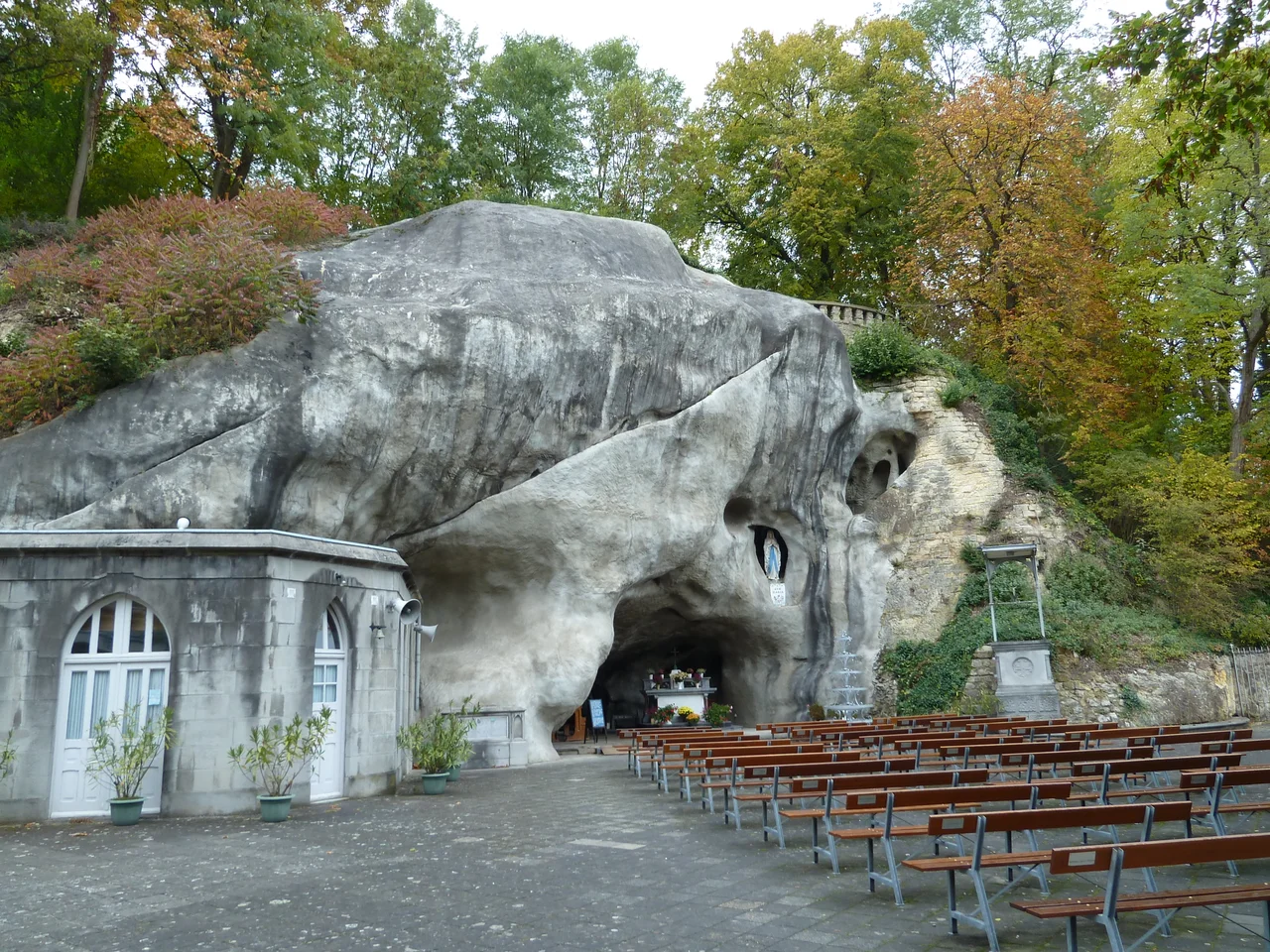
Walk up the hill and the religious and civic memory comes at you in layers. Near the bottom, just outside the old Grendelpoort gate, is the entrance to the Gemeentegrot, an abandoned chalk quarry now toured as a labyrinth of man-made caves with an underground lake, limestone sculptures of prehistoric animals, and charcoal drawings of Limburg history. Higher up is a 1926 copy of the grotto at Lourdes, complete with an open-air chapel. A few yards further sits a small memorial chapel with a carillon, dedicated to the Limburg members of the Dutch resistance killed in the Second World War. Two of them, Sjeng Coenen and Joep Francotte, were murdered on this hill on 5 September 1944, days before Valkenburg was liberated. Opposite is a hillside cemetery with terraced graves - unusual in the Netherlands - and a Gothic Revival chapel designed by Cuypers.
Mister Cauberg
The race history reads like a roll-call of Dutch and Belgian cycling. The UCI Road World Championships came to the Cauberg five times: 1938 (won by Marcel Kint), 1948 (Briek Schotte), 1979 (the home crowd cheering Jan Raas), 1998 (Oscar Camenzind), and 2012 - when Philippe Gilbert attacked on the final ascent in front of his own Belgian fans and rode away to the rainbow jersey. The Amstel Gold Race finished on or near the Cauberg from 2003 to 2016; the route now crosses the climb three times for the men and five for the women before finishing a couple of kilometres further on. Grand Tours have visited too: the 1992 and 2006 Tours de France, the 2009 Vuelta. Since 2011 there has been a cyclo-cross race here as well, including the 2018 World Championships won by Wout van Aert and Sanne Cant. Red Bull even built ice tracks down it for Crashed Ice events in 2011 and 2012.
What the Climb Feels Like
A professional rides the Cauberg in about three minutes. Anyone else takes longer, and the legs start to argue about halfway up, where the gradient hits 12 percent. The trick is that the climb is short enough to look manageable and steep enough to wreck you if you start it too fast - which is exactly why race tacticians love it. Stand at the top during the Amstel Gold finale and you can hear riders coming before you see them: the click of derailleurs, the breath, the crowd roaring along the barriers, then a streak of colour and they are gone, around the curve toward Vilt. The road is just a road. The hill is just a hill. It is what people do on them that makes the Cauberg the Cauberg.
From the Air
The Cauberg rises from Valkenburg aan de Geul at 50.86 N, 5.82 E, in the rolling chalk country of South Limburg about 12 km east of Maastricht. The hill itself tops out around 130 m above the Geul valley floor; the surrounding plateau sits near 180 m AMSL. Useful visual landmarks: the pyramid roof of Thermae 2000, the white Landal village on the summit, and the meandering Geul river south of town. Nearest airport: Maastricht Aachen (EHBK), 10 km northwest. Liege (EBLG) is 25 km southwest. Class G airspace below 1,500 ft AGL in most of the area; mind the rising terrain on a westerly approach.
Nearby Stories
- Siege of Julich (1621-1622) 4.6 km away
- Wessem-Nederweert Canal 6.7 km away
- Monchengladbach 9 km away
- County of Duras 10 km away
- SCK CEN 15 km away
- Belgium 56 km away
- Marcinelle Mining Disaster 100 km away
- Marmoutier Abbey 228 km away