
Cavendish Square
The South Sea Bubble of 1720 ruined thousands of investors, but among its less catastrophic consequences was the stalling of a London development project. The 2nd Earl of Oxford had begun laying out a grand new square on his estate in Marylebone in 1717, naming it after his wife Henrietta Cavendish-Holles. When the Bubble burst and credit collapsed, work stopped. The square sat half-finished for years, its potential residents spooked by financial disaster. It eventually recovered and filled with nobles, doctors, and people of consequence — but the gap between ambition and completion set a pattern that the square has been repeating, in various ways, ever since.
The Earl's Square and Its Residents
Once it was built, Cavendish Square attracted the kind of tenants a Georgian aristocrat would have wanted. Princess Amelia, daughter of George II, lived there and died in her house on the square. James Brydges, the 1st Duke of Chandos, secured a plot but never completed his planned mansion. The heir to the Portland dukedom lived his London life here. Later, H.H. Asquith — Prime Minister from 1908 to 1916 — occupied Number 20, commemorated now by a blue plaque installed in 1951. Quintin Hogg, who founded what eventually became the University of Westminster, lived nearby; the university's flagship building backs onto the site of his family home. The square's connection to medicine developed through proximity to Harley Street, with grand townhouses housing practices including that of the celebrated surgeon James Paget.
The Sculptor and the Nuns
Numbers 11, 12, and 13 on the northern range had become a convent by the 19th century, connected by a tunnel under Dean's Mews. The Blitz damaged the buildings, and the nuns commissioned architect Louis Osman to restore them and build a bridge between the two parts. Osman approached Jacob Epstein to create a bronze Virgin and Child that would appear to levitate above the arch. He specified that it should be cast in lead — plentiful from bombed rooftops across London. What Osman did not tell the mother superior was that Epstein was Jewish, which may have been an objection among some Catholics at the time. The Arts Council congratulated her on her innovative choice of artist. Epstein's work was unveiled in 1953, and the structure is now Grade II* listed.
Statues and the Shifting of Opinion
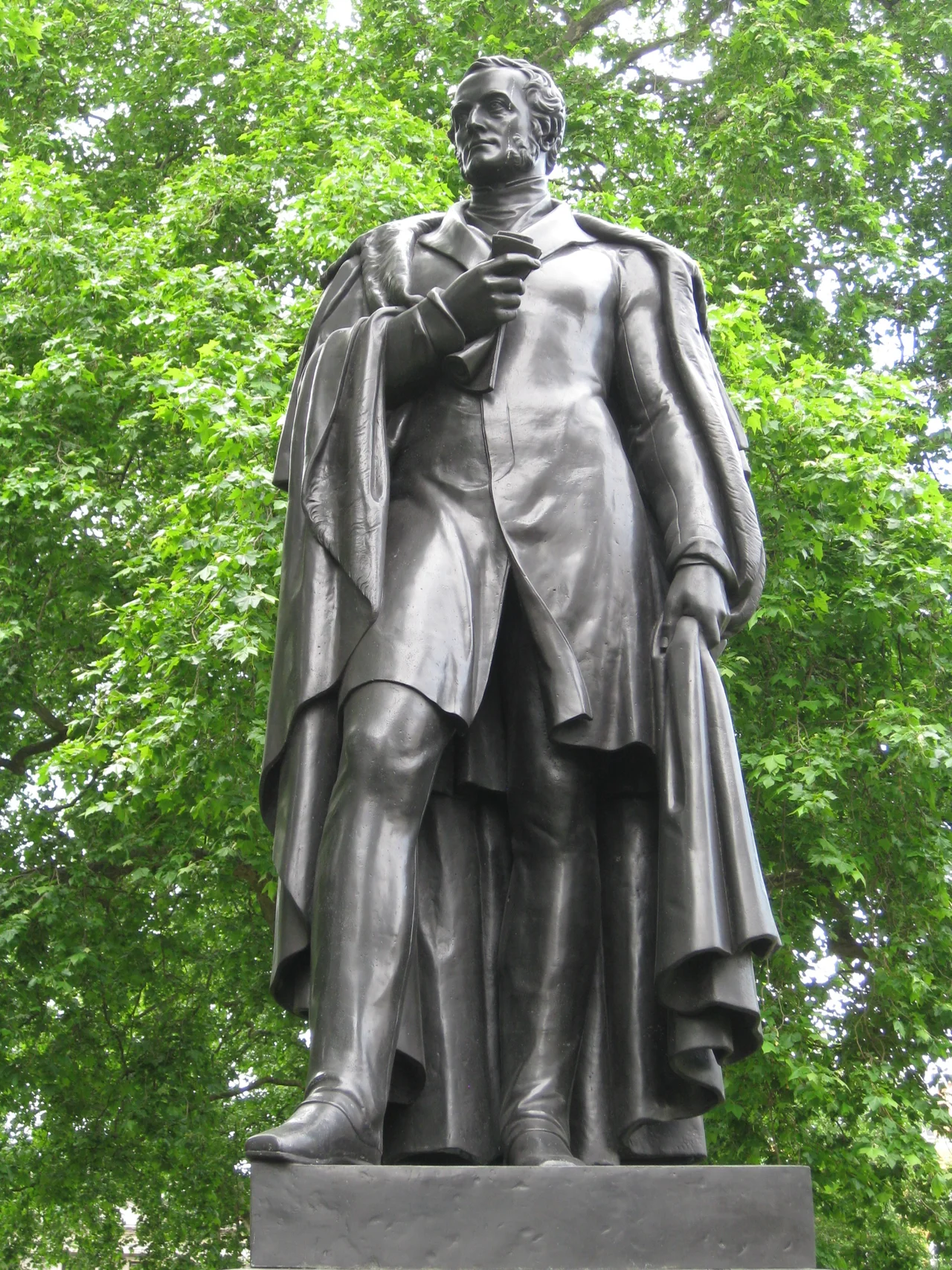
The square's southern edge hosts a bronze statue of Lord George Bentinck, the 19th-century MP for King's Lynn, sculpted by Thomas Campbell and erected in 1851. A more complicated presence once stood nearby: a statue of Prince William, Duke of Cumberland, erected in 1770 to mark his defeat of Charles Edward Stuart at Culloden in 1746. By the 1860s, public opinion of the Duke had turned sharply — he was blamed for the brutal suppression of the Highland clans after Culloden — and the statue was removed. The plinth stood empty for over a century and a half before a temporary artwork occupied it in 2012, a sculpture made in soap that gradually eroded away and was removed in 2016. The square features in Robert Louis Stevenson's Dr Jekyll and Mr Hyde as the address of Dr Lanyon.
What Lies Beneath
Underground, Cavendish Square contains something distinctly unexpected: a 521-space car park shaped as a double helix. Vehicles descend on a continuously spiralling right-hand ramp, park on either side, and at the bottom cross diametrically to find the ascending left-hand helix. The excavation was originally dug in the 1960s as an access shaft for construction of the Victoria Line, with a horizontal tunnel stretching toward Oxford Circus station. When the Underground work was done, the hole was repurposed for parking. By 2022, a pedestrian lift had been added, rising to an exit on the square's south side. Above ground, just 150 metres to the southeast, Oxford Street and Regent Street meet at Oxford Circus. The square sits at the centre of all this commercial gravity, quietly holding its Georgian ground.
From the Air
Located at 51.517°N, 0.145°W in Marylebone, central London. Oxford Circus is visible 150 metres to the southeast. The square's garden is identifiable in satellite view. Nearest major airports are London City (EGLC) and Heathrow (EGLL).
Nearby Stories
- Stevenage 5.7 km away
- Malling Abbey 5.7 km away
- 1952 Farnborough Airshow Crash 7.7 km away
- Ingatestone Hall 8.2 km away
- Hellfire Caves 9.1 km away
- The Carrington Event: The Solar Storm That Could Happen Again 9.8 km away
- Bletchley Park 16 km away
- Castle Hedingham 23 km away