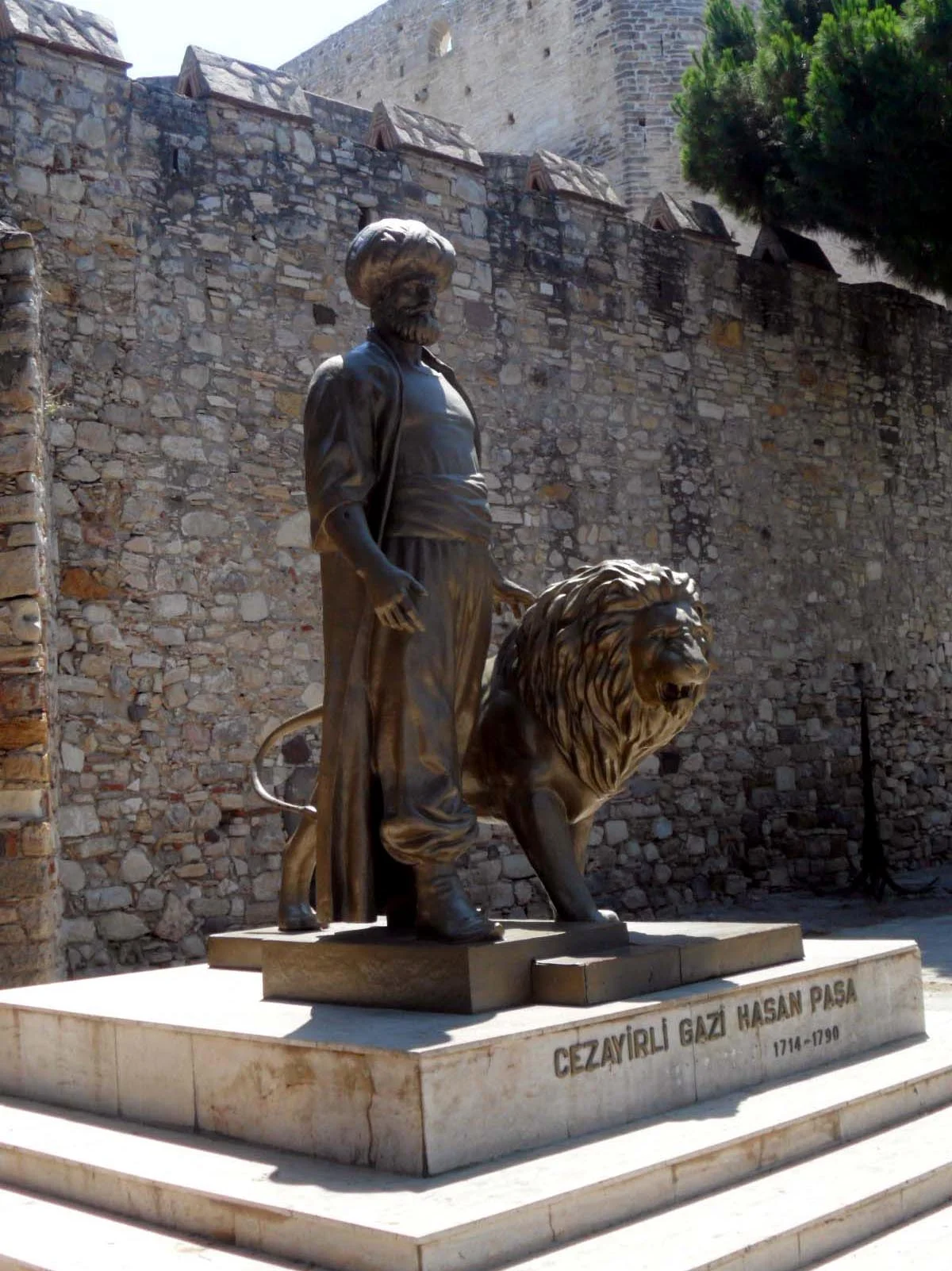

Cezayirli Gazi Hasan Pasha Monument
There is a lion beside the admiral, cast in bronze and entirely calm, and it is not a flourish - it is biography. Cezayirli Gazi Hasan Pasha really did keep a domesticated lion, brought back from his years in North Africa, and the animal is said to have followed him everywhere. The statue in front of Çeşme Castle remembers him exactly as his contemporaries did: a sailor who survived a catastrophe, with a lion at his side.
The Man Behind the Bronze
Cezayirli Gazi Hasan Pasha lived from 1713 to 1790, and his life ran the full length of the eighteenth-century Ottoman world. Sold into slavery as a young man, he was raised in Tekirdağ as a near son of the household that bought him, then rose through the military and spent years among the corsairs of the Barbary Coast based in Algiers - which is where his name comes from, Cezayirli meaning 'from Algiers.' From those beginnings he climbed to the very top of the empire, serving as its grand admiral for two decades and, at the end of his life, as grand vizier. The lion he domesticated in Africa became his signature, and it is why the sculptor gave it to him in stone.
The Defeat He Survived
The reason the monument stands in Çeşme, of all places, is a battle the Ottomans lost. In July 1770 a Russian fleet trapped the Ottoman navy in the bay here and destroyed it in a single night of fire, one of the worst naval disasters in the empire's history. Hasan Pasha was in the thick of it, commanding aboard the warship Real Mustafa, and amid the general ruin he distinguished himself as a capable and steady seaman, extracting men and salvaging what he could from the chaos. The supreme commander, Hüsamettin Pasha, was blamed for the defeat. Hasan Pasha, by contrast, was promoted. Çeşme, the scene of the disaster he rose above, is a fitting place to honor him.
The Monument Today
The statue was created in 1974 by the sculptor Haluk Tezonar, who lived from 1942 to 1995 and taught at the State Academy of Fine Arts. He depicted the admiral standing in command, the lion at his heel, planted in the heart of downtown Çeşme directly in front of the historic castle and its museum. Generations of visitors have posed beside the bronze lion without always knowing the story it carries - a man bought as a slave who ended as grand vizier, a sailor who turned a famous defeat into a famous career, and a soldier so attached to a wild animal that three centuries later he is unimaginable without it. It is, in the end, a monument as much to survival and reinvention as to war.
From the Air
The Cezayirli Gazi Hasan Pasha Monument stands in downtown Çeşme at roughly 38.32°N, 26.30°E, directly in front of Çeşme Castle on the western tip of the Çeşme peninsula in İzmir Province, Turkey. The statue itself is small from the air, but its setting - the open square before the rectangular fortress, beside the harbor - is an easy landmark at lower altitudes. Nearest airports are Chios Island National Airport (LGHI) about 12 nm west across the channel, and İzmir Adnan Menderes (LTBJ / ADB) about 45 nm east. Best viewed from below 4,000 feet in clear conditions to make out the castle and the square.
Nearby Stories
- Psara 18 km away
- Battle of the Oinousses Islands 28 km away
- St. Helena Church 35 km away
- Battle of Corycus 35 km away
- Greek Islands 60 km away
- Temple of Artemis at Ephesus 61 km away
- Adramyttium 94 km away
- Skyros 101 km away