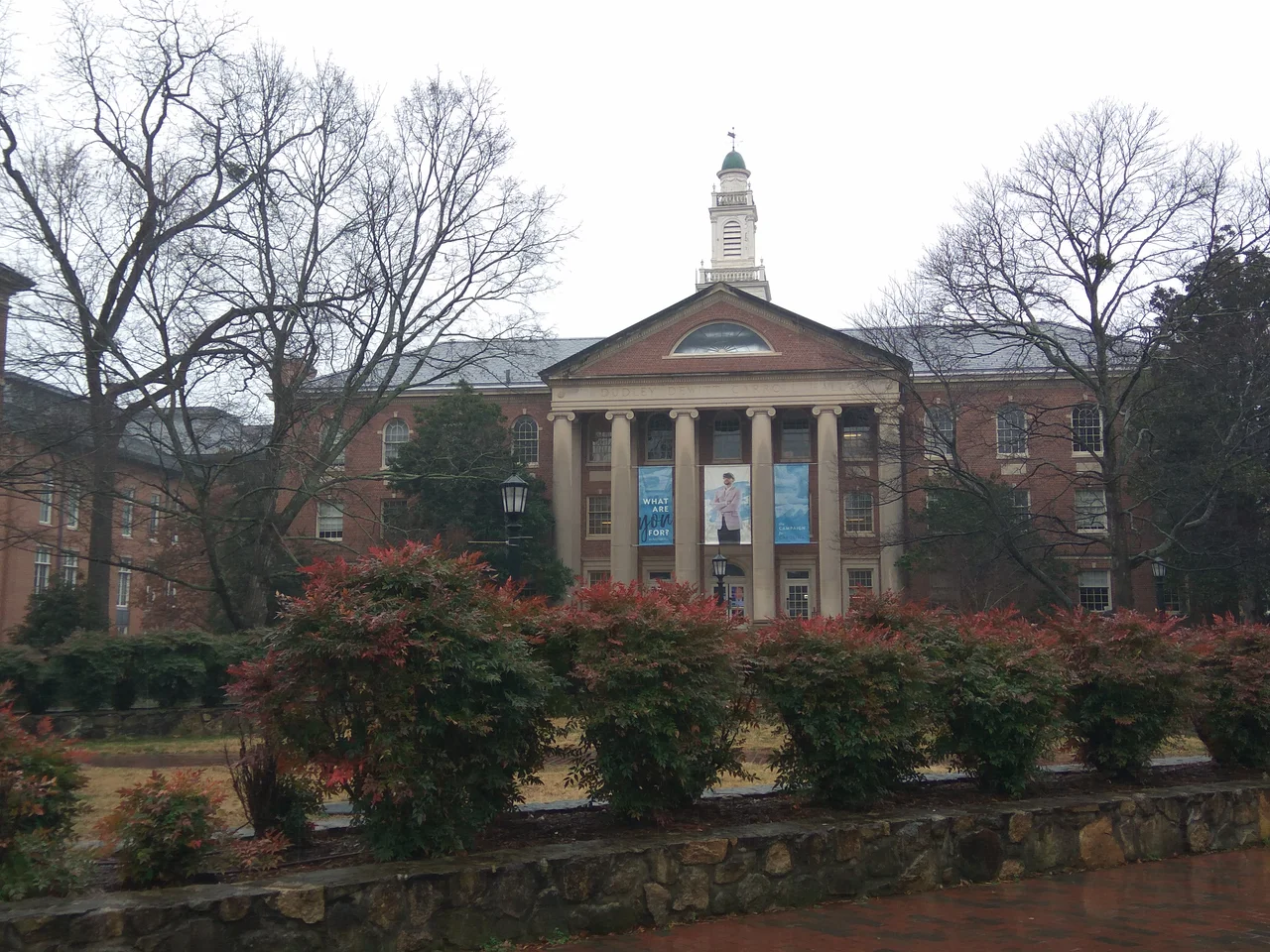

Chapel Hill, North Carolina
On October 12, 1793, trustees of the new state university laid the cornerstone of Old East, a plain brick dormitory on a wooded hill in Orange County, marking the founding moment of the first public university in the United States. The school had been chartered in 1789, opened to students in February 1795, and the small village around it would eventually take the name Chapel Hill from an Anglican chapel that had stood on the same ridge. Two centuries and change later, the median age in Chapel Hill is 25.8 years, the lowest of any municipality in North Carolina. The town has, in a strict statistical sense, never grown up.
A College Town and Its Numbers
Chapel Hill's demographics are the demographics of a university that has refused to be subsumed by its town. As of 2023, the population was 59,889. The median household income, $85,825, runs about 25 percent higher than the state average. The poverty rate, 19.6 percent, also runs higher than the state's 13.2. Both numbers are true at once because students count as residents and most students have little personal income. Seventy-three percent of adults over 25 hold at least a bachelor's degree, making this the best-educated municipality in North Carolina by proportion. Nearly half of UNC graduates stay in the same metro area. Sixty-eight percent stay in the state. The town feeds the Triangle, then gets refilled the following autumn.
The First Planetarium on a Campus
The Morehead Planetarium and Science Center opened in 1949, the first planetarium built on a U.S. college campus and one of only six in the country at the time. It became one of NASA's primary astronaut training sites during the Mercury, Gemini, and Apollo programs, teaching star navigation to crews who would need to find their way home if their spacecraft instruments failed. The giant sundial in the green square in front of the planetarium is one of the town's hallmark features. The Varsity Theatre on Franklin Street has shown movies in the same building since 1927. Chapel Hill's fire engines, numbers 31 through 35, are painted Carolina blue and decorated with UNC decals, including a firefighter Rameses, the school's ram mascot.
A Music Town That Pretends Not to Be
James Taylor grew up here. So did Ben Folds Five, Superchunk, Archers of Loaf, Polvo, and more recently Porter Robinson. Merge Records was founded in Chapel Hill before moving to Durham. The town has been a center for the modern revival of bluegrass and old-time music, with composer Elizabeth Cotten and bands like Watchhouse, Steep Canyon Rangers, and Mipso all working out of the area. U2 played the first American date of their 1983 War Tour at Kenan Memorial Stadium, where Bono climbed to the top of the stage in pouring rain and held up a white flag for peace. Bruce Springsteen has played Kenan three times. WXYC, the student-run UNC radio station, became the first radio station in the world to broadcast over the internet in 1994.
Howard Lee and the Long Civil Rights
Howard Lee became Chapel Hill's mayor in 1969, the first Black mayor of a predominantly white municipality anywhere in the South. He had moved to the Colony Woods neighborhood two years before, where neighbors initially circulated petitions to keep his family out. He served three terms. Floyd Council, a Black blues singer from Chapel Hill, gave Pink Floyd half its name when Syd Barrett combined Council's first name with Pink Anderson's. George Moses Horton, an enslaved poet who taught himself to write, sold love poems to UNC students in the early 19th century and was called "the black bard of Chapel Hill." Mark Kleinschmidt, elected in 2009, was the first openly gay mayor of the town. The history is uneven, sometimes ugly, sometimes ahead of its region by decades.
Tobacco Road
Sports culture in Chapel Hill is shaped by the Tobacco Road rivalry among the four ACC schools in central North Carolina: UNC, Duke, NC State, and Wake Forest. The Dean E. Smith Center, named for the coach who held the all-time Division I wins record when he retired in 1997, holds 21,750 fans for men's basketball games. Kenan Memorial Stadium hosts football. Carmichael Arena, the previous basketball home, now serves the women's team. The Carolina-Duke rivalry, eight miles down US 15-501, is the rivalry that makes the rest possible. When Carolina wins, students rush Franklin Street and police block traffic ahead of tip-off in anticipation. Bonfires sometimes use Duke gear as fuel.
From the Air
Chapel Hill sits at 35.91 N, 79.05 W in Orange County, North Carolina, anchoring the western corner of the Research Triangle. From altitude the town is recognizable by the wooded buffer of the UNC campus, the bowl of Kenan Memorial Stadium, and the dome of the Dean Smith Center to the south. Nearest airport: Raleigh-Durham International (KRDU) about 18 nautical miles east; Horace Williams Field (KIGX) within the town itself. Recommended viewing altitude 3,000 to 6,000 ft AGL.
Nearby Stories
- Orange County Speedway 3.7 km away
- Tobacco Road 8.7 km away
- Haw River 15 km away
- Johnston County, North Carolina 18 km away
- Soul City, North Carolina 25 km away
- Chinqua Penn Plantation 29 km away
- North Carolina Aviation Museum 40 km away
- Cherry Hill Plantation 45 km away