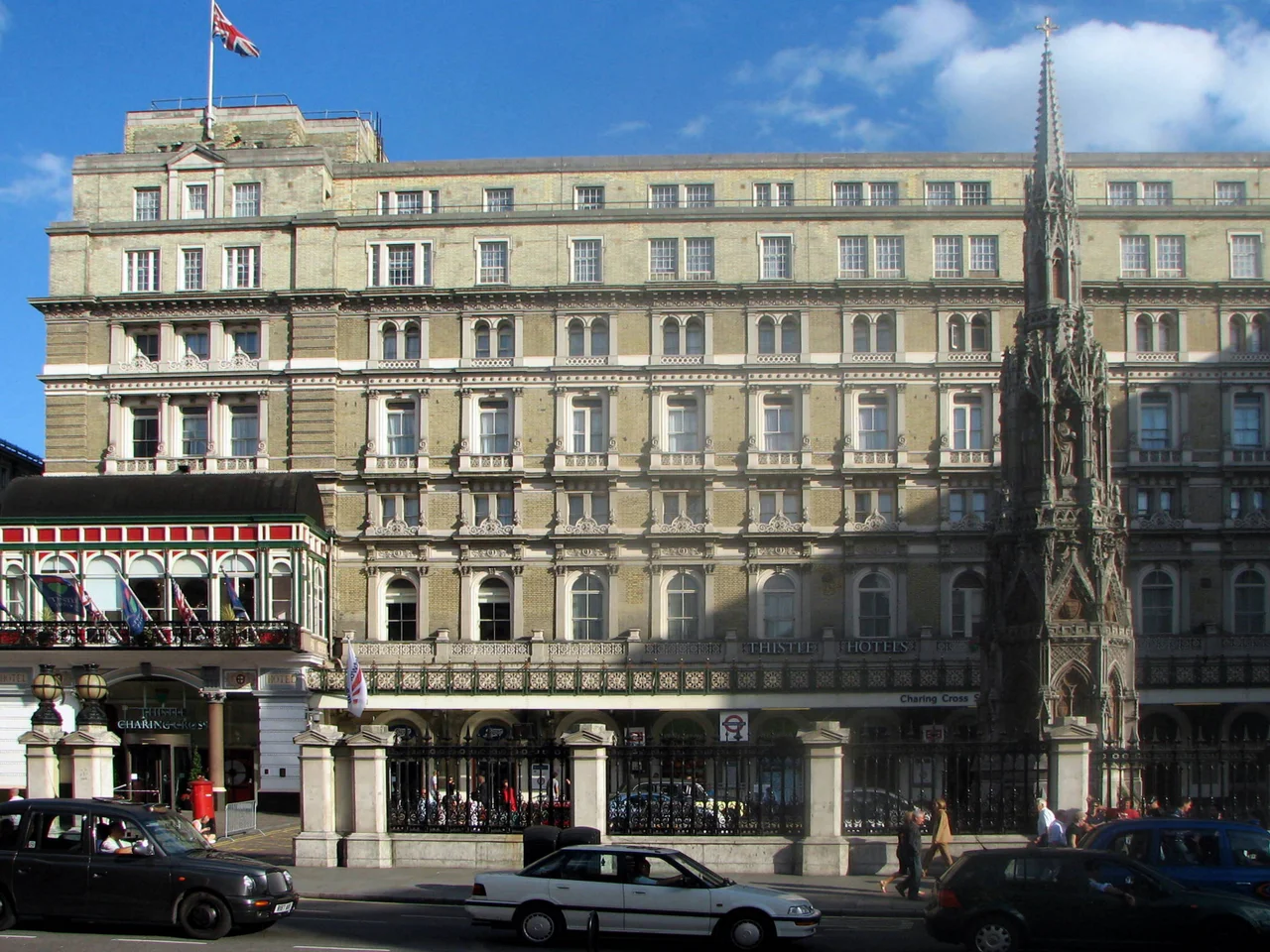

Charing Cross railway station
By 1913 you could leave Charing Cross at breakfast and reach Paris by tea. The boat-train service that connected this West End terminus to Dover, and Dover to Calais, made the journey in six and a half hours - extraordinary by Edwardian standards. Percy Fitzgerald called Charing Cross "the Gates of the World." Thomas Cook ran a travel office on the corner of the forecourt. Diplomatic dispatches passed through here; royal visits departed from these platforms; the wounded came home through these platforms during the First World War. And distances in London - all of them, measured to this day - count from a spot just outside the front door, where an equestrian statue of Charles I marks the original site of the medieval Eleanor Cross.
Building a Terminus Over a Market
The South Eastern Railway had wanted a West End terminus for years. The company secretary Samuel Smiles - yes, the same Samuel Smiles who would later write Self-Help, the Victorian bestseller about industrious self-improvement - chose the site of the old Hungerford Market on the Strand. The line would cross the Thames on a new Hungerford Bridge, replacing Isambard Kingdom Brunel's 1845 suspension bridge that previously carried only pedestrians. Sir John Hawkshaw designed the station. Its single-span wrought iron arched roof was 510 feet long, 164 feet wide, and 31 metres high at its crown - one of the largest engineered spaces in Victorian London. Construction by Lucas Brothers took three years on a heavily built-up site. The station opened on 11 January 1864. The Charing Cross Hotel by Edward Middleton Barry followed in 1865, with 250 bedrooms across seven floors and an ornate French Renaissance frontage stretching along the Strand and Villiers Street. The hotel was a hit - profitable enough that a 90-bedroom annexe opened on the opposite side of Villiers Street in 1878, joined to the original by a bridge over the road.
The Gates of the World
Once open, Charing Cross became London's main terminus for continental boat-trains. The Sevenoaks diversion in 1868 made it the shortest route from London to Dover. Edward VII's intermittent rendezvous with continental Europe departed from these platforms; so did the Orient Express passengers who joined the route at Dover. The station carried the symbolic weight of an empire that conducted much of its diplomatic business by rail and steamer. When the First World War began, the boat-train service was suspended on 3 August 1914, and Charing Cross transformed into a military terminus. Over the next four years, 283 troop and government journeys departed from these platforms toward the Western Front. The return trains carried the sick and wounded back to hospitals across Britain. On 26 December 1918, six weeks after the armistice, US President Woodrow Wilson met King George V here. Commercial cross-Channel services resumed - to Ostend on 18 January 1919, to Boulogne on 3 February, to Calais on 8 January 1920 - but by then Victoria station had absorbed most of the customs and immigration infrastructure that wartime restrictions had created. Charing Cross's days as the main international gate were quietly over.
The Roof That Fell
On the afternoon of 5 December 1905, a 70-foot section of Hawkshaw's great wrought-iron roof collapsed. The first warning came at about 3:45 p.m., when a main tie rod broke with a loud noise and people noticed it hanging down. The roof began to sag; the western wall cracked. For twelve crucial minutes the staff held back incoming trains and evacuated those on the platforms - then the structure failed completely at 3:57 p.m. Girders and debris fell across four passenger trains. Part of the western wall punched through into the neighbouring Royal Avenue Theatre on Northumberland Avenue, which happened to be undergoing reconstruction at the time. Six people died: two roof workers, a W.H. Smith bookstall vendor, and three workmen on the theatre site. The Board of Trade inquiry attributed the failure to a faulty weld in a tie rod, but the design itself was questioned. The South Eastern and Chatham Railway decided not to repair the original roof - it replaced it entirely with a utilitarian post-and-girder ridge-and-furrow structure. The curve of the original arch can still be traced today in the brickwork of the side walls. The station partially reopened on 19 March 1906.
The Trunk in the Cloakroom
In May 1927, an unaccompanied trunk was deposited in the Charing Cross station cloakroom. Inside, when staff eventually checked, were the five severed body parts of a woman. She was identified as Minnie Alice Bonati, who had been murdered in Rochester Row by John Robinson, a furniture remover. The case became known as the Charing Cross Trunk Murder. Robinson was tried, convicted, and executed. The crime gripped London partly because of its banality - a station cloakroom, a left-luggage label, the routine machinery of a railway terminus turned briefly into the disposal mechanism of a killing. Charing Cross sustained further horrors in the next war. On 16-17 April 1941, the hotel was hit by fire and explosives, four trains caught fire on the platforms, and a 28-long-cwt parachute mine landed beside platform 4. The station closed while the mine was defused. Another raid on 10-11 May 1941 closed it again. On 18 June 1944, a flying bomb took out a span of Hungerford Bridge; the station did not return to normal operation until 4 December. The hotel was repaired in 1951 with a plain neo-Georgian mansard roof replacing the lost upper floors.
Embankment Place and the Cross That Remains
By the late 1980s the post-collapse roof was tired. Architect Terry Farrell and his partners began the redevelopment in 1986 - a postmodern office and shopping complex called Embankment Place that effectively built over the platforms while keeping them operational. The 1906 roof was replaced again, except for two rear spans retained as an enlarged waiting area, and the original Victorian retaining side walls survived almost intact. The works were completed in November 1990. In the forecourt outside, the 1865 replica Eleanor Cross by Edward Middleton Barry continued to deteriorate. It was based on the medieval Whitehall Cross built in 1291 to mark one of the resting places of Queen Eleanor of Castile's funeral procession, demolished by Parliament in 1647. By 2008 it was on the Heritage At Risk Register. A ten-month restoration project finished in August 2010, recreating nearly 100 missing ornamental features - heraldic shields, an angel, pinnacles, crockets, finials - and pinning the weak masonry with stainless steel rods. Today it stands where it has always stood, with passengers streaming past it on their way to suburban trains, neither knowing nor needing to know that distances in London are measured not from this cross but from the spot a few yards away where Charles I's statue marks the original. Six and a half hours to Paris, still measured from here. The trains, as always, keep going.
From the Air
Charing Cross railway station sits between the Strand and Hungerford Bridge at 51.508°N, 0.124°W in the City of Westminster, with station code CHX. From the air, look for the Terry Farrell-designed Embankment Place office and shopping complex straddling the platforms, immediately north of the Hungerford Bridge and Golden Jubilee footbridges crossing the Thames. Trafalgar Square is just north; Whitehall runs south. Nearest airport for general aviation is London City (EGLC) about 6 nm east-southeast; London Heathrow (EGLL) is 13 nm west-southwest. This is central London Class A airspace.
Nearby Stories
- Stevenage 5.7 km away
- Malling Abbey 5.7 km away
- 1952 Farnborough Airshow Crash 7.7 km away
- Ingatestone Hall 8.2 km away
- Hellfire Caves 9.1 km away
- The Carrington Event: The Solar Storm That Could Happen Again 9.8 km away
- Bletchley Park 16 km away
- Castle Hedingham 23 km away