.jpg)
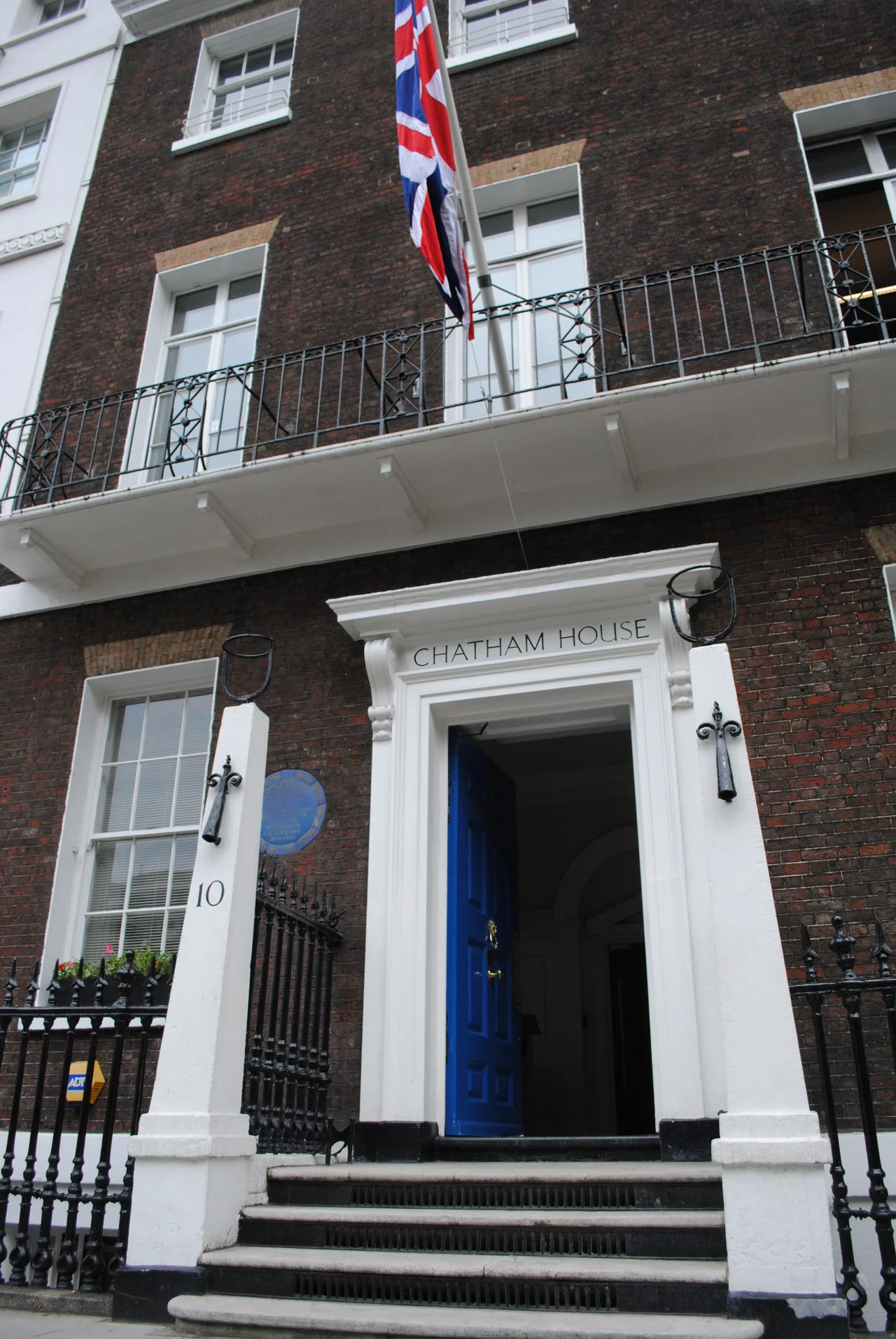
Chatham House
On 20 October 1931, 750 people crowded into the meeting hall at 10 St James's Square to listen to a small man in a white shawl talk about India's future. Mahatma Gandhi had come to London for the Round Table Conference on Indian constitutional reform. His talk at the Royal Institute of International Affairs - already informally known as Chatham House - was the largest meeting the institute had ever held. The space could barely contain the audience. It was the kind of room where things were said that mattered: a Georgian mansion full of senior diplomats, retired ministers, foreign press correspondents, and the quiet machinery of British foreign policy thinking. That a Hindu lawyer who challenged the British Empire could fill it to capacity in 1931 was itself a measure of how much the world had changed since the institute opened its doors a decade earlier.
The Idea After Paris
The Royal Institute of International Affairs began in a Paris hotel room on 30 May 1919. American and British delegates to the Paris Peace Conference, exhausted by the negotiations that were producing the Versailles Treaty, met informally to discuss how the work of expert analysis on international affairs might continue once they returned home. Lionel Curtis, a member of the British delegation, had been thinking about this for years. He argued that the close exchange of information during the conference had value worth preserving in some permanent form. The Americans went home and founded the Council on Foreign Relations in New York. The British held their inaugural meeting on 5 July 1920, chaired by Robert Cecil, with the former Foreign Secretary Edward Grey moving the resolution: "That an Institute be constituted for the study of International Questions, to be called the British Institute of International Affairs." Grey, Cecil, Arthur Balfour, and John R. Clynes became the first presidents - a quartet that bridged both major parties and several governments. By 1926 the institute had received its royal charter and become the Royal Institute of International Affairs. Its journal International Affairs, launched in 1922, became what one historian called "the characteristic external expression of Chatham House research: a pioneer in method and a model for scholarship."
Three Prime Ministers, One House
The building itself has its own story. Number 10 St James's Square is an 18th-century Grade I listed townhouse designed in part by Henry Flitcroft. Three British prime ministers occupied it at various points - William Pitt the Elder (1st Earl of Chatham), the Earl of Derby, and William Gladstone. Pitt the Elder is the one who gave the house its current name; Chatham was his title, and the house took it with him. In 1923 the Canadian philanthropists Lieutenant-Colonel Reuben Wells Leonard and his wife Kate Rowlands Leonard bought the property and donated it to the fledgling institute as its permanent headquarters. The name stuck. Today "Chatham House" is used as a metonym for the institute itself. The director Ivison Macadam, appointed in 1929, spent the next quarter-century expanding the physical campus around it - acquiring 6 Duke of York Street through the generosity of Waldorf Astor and others, then 9 St James's Square (the former Portland Club) in 1943 through Henry Price, and connecting them all into a single working complex. Each addition came through specific named donations, in the small-scale philanthropic style that defined inter-war British civic institutions.
Keynes and the Gold Standard
In 1929 the institute set up a special study group on the international gold problem. The group included John Maynard Keynes, then in the early stages of the thinking that would lead to The General Theory in 1936. Over three years the group examined the economic strains the post-war monetary settlement had created - the impossible adjustments demanded of war-debtor and reparations-payer nations, the contradiction of a gold-backed system trying to operate in an economy that could no longer support it. The group's research anticipated, almost exactly, Britain's decision in September 1931 to abandon the gold standard. That kind of work - quiet, expert, slightly ahead of the policy curve - became the Chatham House signature. Reports rather than headlines; meetings rather than press releases; the slow accumulation of expertise on a region or a problem until the institute became the place anyone needing serious analysis would consult first. In 1933 it organised the first Commonwealth Relations Conference in Toronto, a forum that recurred roughly every five years to give the Empire's increasingly autonomous dominions a place to coordinate foreign policy.
The War Years
When the Second World War broke out, the staff dispersed for security. Most moved to Balliol College, Oxford, where the institute's Foreign Press and Research Service - directed by the historian Arnold J. Toynbee - worked closely with the Foreign Office. The FPRS provided intelligence reports on foreign press, the historical and political background of the enemy nations, and a hundred other topics. Nineteen national divisions employed experts on specific countries. In 1943 the FPRS moved formally to the Foreign Office and stayed there until 1946. Chatham House itself reopened to in-person meetings on 28 October 1943, addressed by Major-General John C.H. Lee, the American commanding general of US Army logistics forces in the European Theatre. Allied officers took courses in international affairs at the institute as part of preparing for post-war reconstruction. Refugee academics from occupied Europe found research facilities. The National Institute of Economic and Social Research and the Polish Research Centre, both bombed out of their own premises, relocated to St James's Square.
The Chatham House Rule
The institute's most widely known contribution to public life is probably its Rule. First formulated in 1927 and last revised in 2002, the Chatham House Rule reads: "When a meeting, or part thereof, is held under the Chatham House Rule, participants are free to use the information received, but neither the identity nor the affiliation of the speaker(s), nor that of any other participant, may be revealed." It is now used by think tanks, governments, corporate boards and academic gatherings worldwide. The Rule's value is that it lets people say things they could not otherwise say - a serving diplomat may speak candidly about a foreign government; an economist can dismiss a colleague's argument without burning a friendship; a defector can describe a regime in detail without endangering anyone. The Rule allowed Che Guevara, then Cuba's Minister of Industry, to publish in International Affairs in 1964 on the Cuban economy. It allowed the 1975 Anglo-Soviet round-table at Chatham House to function as one of the early examples of two-track diplomacy during the Cold War. In April 2022, Russia returned the favour by designating Chatham House an "undesirable organisation." Some critics argue the institution has been too close to British establishment foreign policy positions, too elitist in its membership, too opaque about funding (in 2024 the transparency monitor Who Funds You? gave it a B grade). Others point out that the Rule that bears its name has, more than any single report, shaped how serious international conversation actually happens. The mansion in St James's Square still hosts those conversations. The Rule still holds. People still leave the meetings able to act on what they heard, and unable to say who said it.
From the Air
Chatham House sits at 10 St James's Square in the City of Westminster at 51.508°N, 0.136°W, a few hundred metres south of Piccadilly and west of Trafalgar Square. From the air, look for the elegant 18th-century townhouse facing the small square gardens, just east of St James's Palace and Green Park. Nearest airport for general aviation is London City (EGLC) about 7 nm east; London Heathrow (EGLL) is 12 nm west-southwest. Central London Class A airspace.
Nearby Stories
- Stevenage 5.7 km away
- Malling Abbey 5.7 km away
- 1952 Farnborough Airshow Crash 7.7 km away
- Ingatestone Hall 8.2 km away
- Hellfire Caves 9.1 km away
- The Carrington Event: The Solar Storm That Could Happen Again 9.8 km away
- Bletchley Park 16 km away
- Castle Hedingham 23 km away