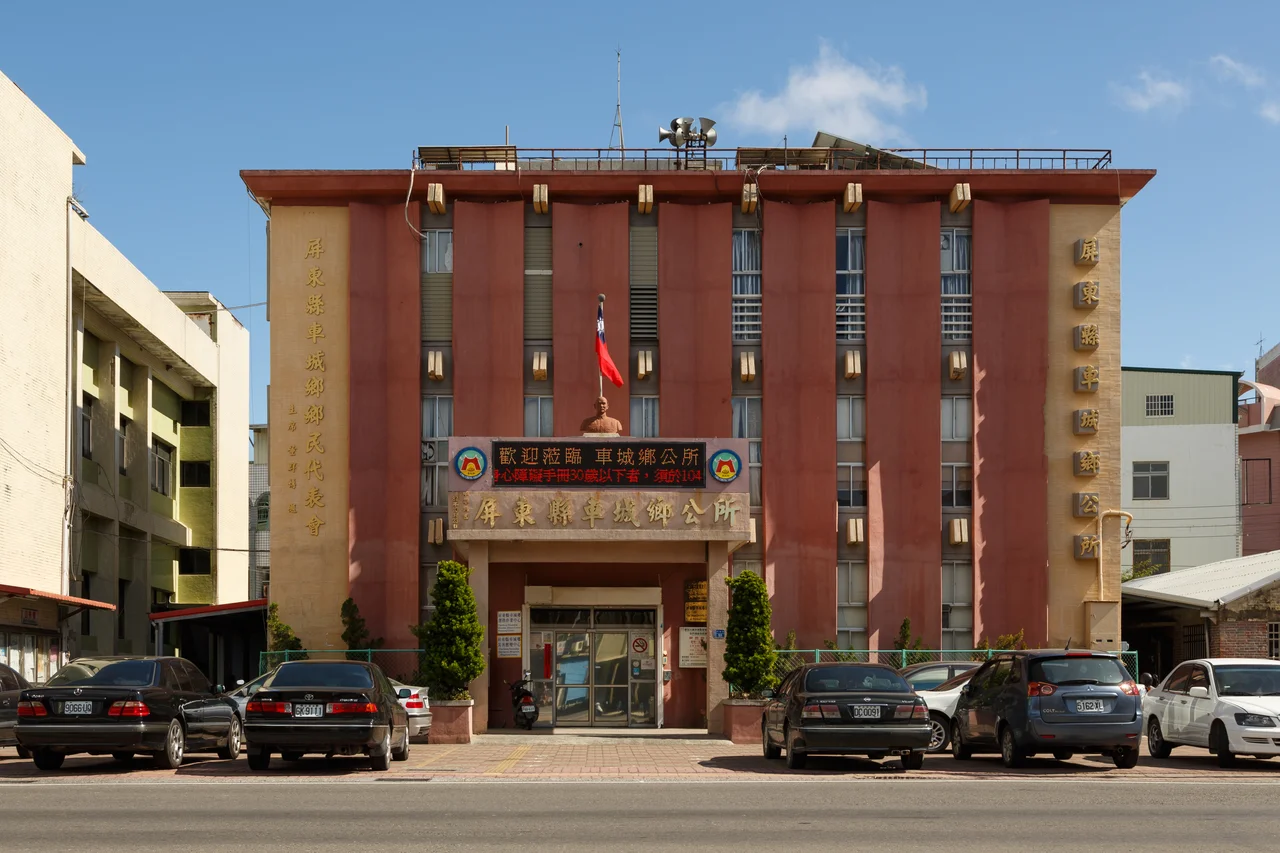

Checheng
Five names in four centuries. That is the story of Checheng before you even ask what it looks like. The Paiwan people called this settlement on Taiwan's southern coast Kabeyawan. Chinese settlers transliterated that into Hokkien. Then came troops loyal to Koxinga's son, and the name changed again. Then Manchu soldiers, and another. Then — depending on who you ask — either a mispronunciation of the old name or a memory of oxcarts lined up as a wall against approaching warriors. Every name that has ever stuck to this township tells you something about who held power and who was adapting to survive.
The Name That Keeps Changing
When Zheng Jing — son and successor of the famous Ming loyalist Koxinga — stationed a battalion-level commander here in the 17th century, the settlement earned a name reflecting that military presence: Thóng-léng-po͘, or "commander's plain." It was a practical label for a place that was rapidly becoming a garrison town on the frontier of Chinese-settled Taiwan.
After the Qing Dynasty consolidated control, Chinese settlers worried about raids from indigenous communities and built a wooden palisade around the town. This gave rise to Chhâ-siâⁿ — "stockade" or "wood-walled town" — a name that captured the anxiety of a community fortifying itself at the edge of known territory.
In 1788, Manchu general Fuk'anggan landed troops here while suppressing the Lin Shuangwen rebellion. The grateful town (or at least the officials who recorded such things) renamed itself Hok-an-chng: "pacified hamlet," borrowing the first character of Fuk'anggan's name. The commemoration was efficient, if a little flattering.
Oxcarts or Mispronunciation?
The current name, Checheng, is itself the subject of a minor historical dispute. Japanese anthropologist Inō Kanori, who conducted fieldwork in Taiwan in the late 19th century, believed the name simply drifted from Chhâ-siâⁿ through phonetic drift — the sounds for "wood" (chhâ) and "cart" (chhia) are similar enough in both Hokkien and Hakka that a generation of speakers could easily blur them.
The competing story is more vivid: when an indigenous army approached, residents reportedly lined up dozens of oxcarts loaded with charcoal as an improvised defensive barrier. The carts — che — became the town's identity.
Hokkien-speaking residents still pronounce the township name the old way, Chhâ-siâⁿ, even while the written form settled on 車城 (Checheng). The spoken and written forms quietly preserve both versions of the past simultaneously.
At the Edge of the Peninsula
Checheng sits in Pingtung County, covering about 49.85 square kilometers, with a population of around 8,000 as of early 2024. It is a rural township and it feels like one — eleven villages spread across terrain that transitions quickly from flat coastal ground to the rugged interior of the Hengchun Peninsula.
The Checheng Fu'an Temple anchors the community's religious life, one of those temple complexes that have served as community centers, debate halls, and festival grounds across southern Taiwan for generations. Beyond the town proper, the township edges into Kenting National Park, Taiwan's first national park, where coral reefs and subtropical forest meet. The National Museum of Marine Biology and Aquarium draws visitors from across the island.
Sichongxi Hot Springs and the Dongyuan Forest Recreation Area offer the kind of quiet that isn't easy to find at the busier Kenting resorts to the south. The township is a place to pass through on the way to something — but it rewards the traveler who stops.
Layers Pressed Together
What makes Checheng interesting is precisely what gets lost in a quick read of its Wikipedia entry: the place is a palimpsest. The Paiwan were here first, and their name for it — Kabeyawan — survives only as an archaeological trace buried under five subsequent names. Each wave of settlers, soldiers, and administrators left a name that partially erased and partially preserved what came before.
The Shihmen Battlefield nearby, where Qing forces clashed with Paiwan defenders in 1874, is now a memorial park. The Mudan Incident Memorial in the same area marks the conflict that prompted the Qing to finally build proper fortifications at Hengchun. History in Checheng is not distant; it is embedded in the landscape, visible in a temple name, a battle site, a spelling disagreement still ongoing among locals.
From the Air
Checheng Township lies at approximately 22.08°N, 120.75°E on Taiwan's Hengchun Peninsula — the southernmost settled area of the island. At cruising altitude approaching from the north, the peninsula's narrow silhouette is clearly visible, flanked by the Taiwan Strait to the west and the Pacific Ocean to the east. Descend toward 3,000 feet to distinguish the township's coastal flatlands from the hillier terrain of Kenting National Park further south. The nearest major airport is RCKH (Kaohsiung International), approximately 65 kilometers to the north. Cape Eluanbi lighthouse at Taiwan's southern tip is a useful visual landmark for orientation.
Nearby Stories
- Fangliao 18 km away
- Orchid Island 25 km away
- Zhaori Hot Spring 41 km away
- Ten Drum Rende Creative Park 69 km away
- Barclay Memorial Park 102 km away
- Mavulis Island 102 km away
- 1991 Eruption of Mount Pinatubo 741 km away
- Scarborough Shoal 780 km away