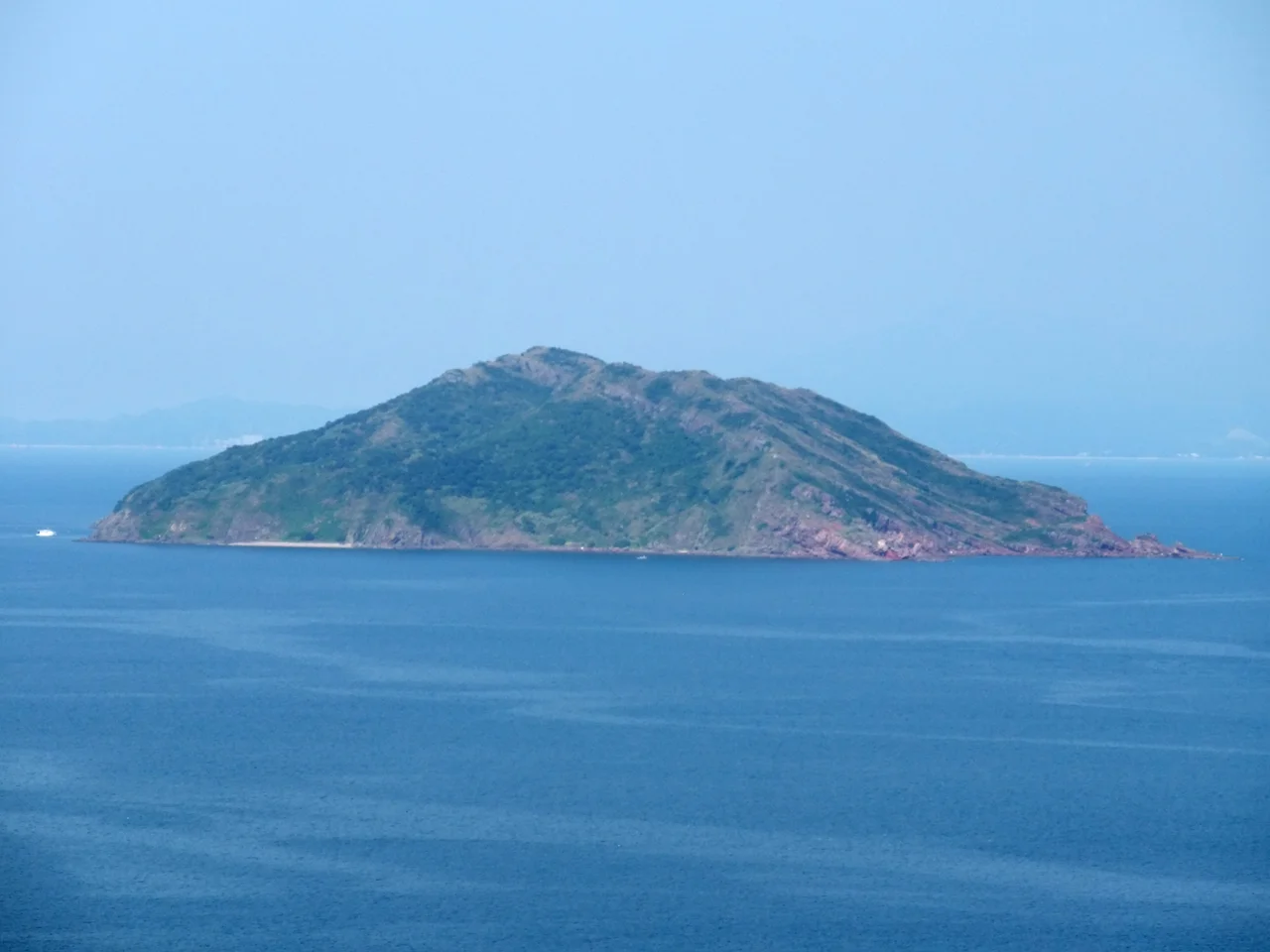

Chek Chau
In 2013, someone noticed bones in the rocks of Chek Chau. The island had been a protected scientific site since 1979 — designated for its birds, not its geology — but the sedimentary layers here run deep, and what lay inside them turned out to be older than anyone had expected. The Agriculture, Fisheries and Conservation Department was informed. Then, for eleven years, the fossils waited. It was not until October 2024 that the Development Bureau publicly announced what experts had confirmed: the bones belonged to a dinosaur from the Cretaceous period, making Chek Chau the site of the first dinosaur fossil discovery in Hong Kong's history.
The Colour of the Island
Chek Chau's name is straightforward: it means Red Island in Cantonese. The colour comes from the geology itself. The island is formed from sedimentary rocks rich in iron, and where the sea cuts against the cliffs and the light falls at the right angle, the stone takes on warm reddish and orange tones characteristic of the Danxia landform type found across parts of southern China. This kind of rock formation, shaped by tectonic uplift and erosion over tens of millions of years, gives Chek Chau a visual character quite different from the volcanic rocks that dominate much of Hong Kong's landscape. The island sits in the Tolo Channel in the northeastern New Territories, administered by Tai Po District, and its distinctive colouring has made it a recognizable landmark from the water.
Ancient Bones, Slow Discovery
The fossils found on Chek Chau are estimated to date from the Cretaceous period — somewhere between 145 million and 66 million years ago. According to the expert assessment announced in 2024, the dinosaur likely died and was buried under sand and gravel, was later exposed by floodwaters, then became buried again at a different location, which is where the remains were eventually found. Palaeontological finds of this kind in densely urbanized regions are rare enough to attract serious scientific attention. That makes the eleven-year gap between the initial find in 2013 and the 2024 public announcement all the more striking. The Agriculture, Fisheries and Conservation Department later acknowledged that the fossils had been sitting in identification limbo since 2013 because other priorities had taken precedence. The bones waited in the rock for over 65 million years. Then they waited a little longer.
A Bird Sanctuary with Deep Time Beneath
Long before the dinosaur discovery, Chek Chau had earned scientific recognition for its living inhabitants rather than its ancient ones. The island has been designated a Site of Special Scientific Interest since 1979, with the original designation based on ornithological interest — the bird populations that use the island and its surrounding waters. The Tolo Channel is a productive feeding ground, and the relative quiet of an uninhabited island like Chek Chau makes it valuable habitat. The combination of protected status for birds above and Cretaceous fossils below places the island in an unusual position: a site where the deep history of life in this part of the world can be read in layers, from the ancient sediments at the waterline to the species moving through the air above.
Inside the Hong Kong Geopark
Chek Chau is part of the Hong Kong National Geopark, a UNESCO-recognized network of geological sites distributed across the northeastern New Territories and the Sai Kung Peninsula. The geopark was established to protect and interpret Hong Kong's exceptional geodiversity, which ranges from ancient volcanic hexagonal rock columns to the Danxia-type sedimentary formations found on islands like Chek Chau and Ping Chau. For visitors approaching by water, the island presents its red-tinged cliffs and the quiet of an undeveloped shore. The geopark designation ensures that the landscape — and whatever secrets the sedimentary layers still hold — will not be disturbed by development.
From the Air
Chek Chau lies at approximately 22.50°N, 114.36°E in the Tolo Channel, northeast of Hong Kong's urban core and southwest of Mirs Bay. From the air, the island's reddish rock coloring may be visible in good light, distinguishing it from the greener volcanic islands to the south. Nearest major airport is Hong Kong International (VHHH), approximately 50 kilometres to the southwest. The island is uninhabited and has no aviation facilities. Tolo Channel is a navigable waterway and activity in the channel below is normally visible from cruising altitude in clear conditions.
Nearby Stories
- Basalt Island 7.1 km away
- Ngong Ping 360 7.5 km away
- China Southern Airlines Flight 3456 11 km away
- Huizhou (Guangdong) 27 km away
- Dongguan 27 km away
- Battle of Penghu 471 km away
- Penghu Air Raids 477 km away
- Checheng Fu'an Temple 593 km away