
Chepstow War Memorial
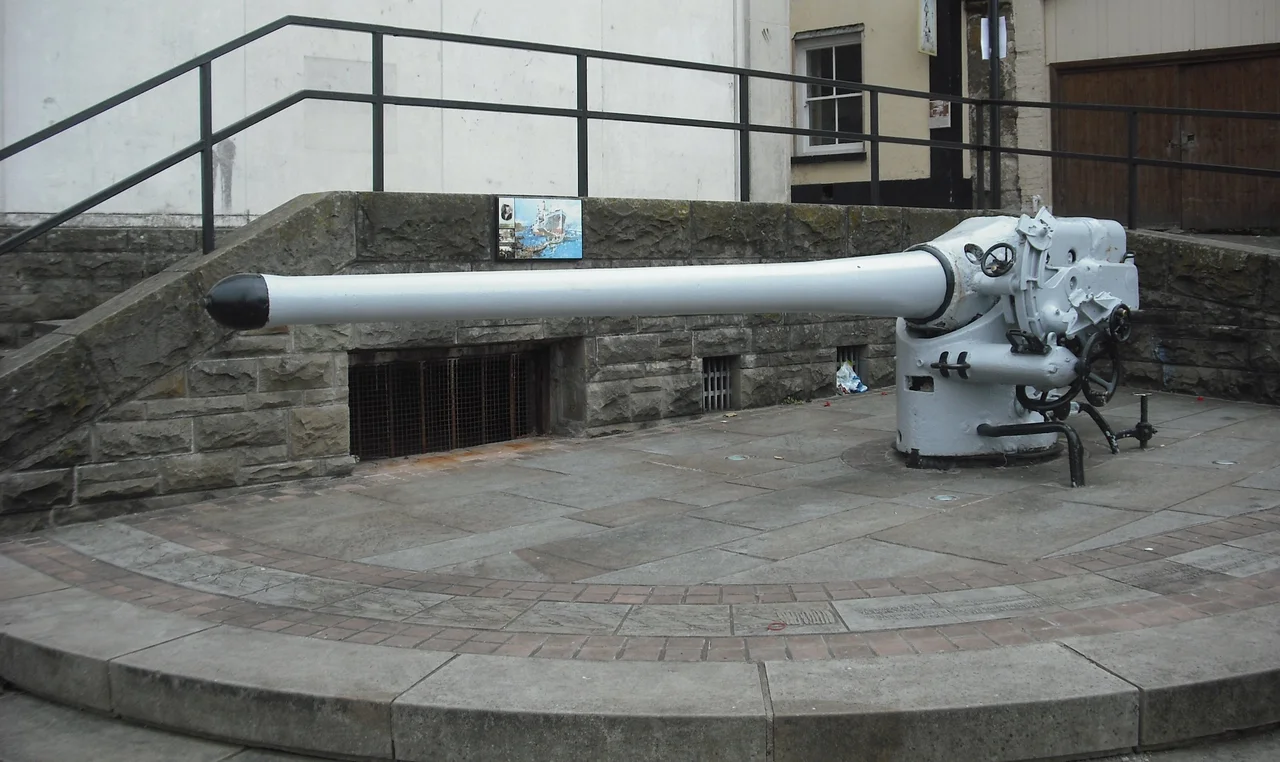
The cannon does not belong here. Beside the elegant Neoclassical column in Beaufort Square, a heavy iron deck gun sits low to the ground, its dull metal at odds with the dressed stone and the gentle Welsh light. It was lifted off a German U-boat, SM UB-91, in 1918, and George V himself ordered it sent to this small Monmouthshire town. Not as a trophy. As a thank-you, of a sort - because a sailor from Chepstow had done something the British Empire had decided was unforgettable, and the king wanted Chepstow to remember.
A Sailor Named Williams
Able Seaman William Charles Williams grew up in Chepstow. On 25 April 1915, he was aboard the converted collier SS River Clyde as it ran ashore at V Beach, Gallipoli, under withering Ottoman machine-gun fire. The plan called for lighters to be lashed together as a bridge from ship to shore. Under fire, the lighters drifted apart. Williams waded into the water and, with Commander Edward Unwin beside him, held the lines by hand to keep the makeshift pier in place so the soldiers could land. He stood there in the cold sea, holding the rope, until he was killed. The Victoria Cross awarded to him after his death was the first ever given to a sailor for an act on land. He has no known grave.
A Column for the Town
Eric Francis, son of a Chepstow solicitor, came home to design the memorial. He had trained under Guy Dawber and Detmar Blow, two of the most respected Arts and Crafts architects of the day, and what he produced for his hometown was unusual: a two-stage stone column topped by an urn, all in a strict eighteenth-century Neoclassical idiom. Most British war memorials of the 1920s reached for Celtic crosses or Gothic shapes, the visual language of mourning. Francis chose the language of dignity. The architectural historian John Newman, surveying the Buildings of Wales, called it "the pivotal feature of Beaufort Square." Three faces of the column carry the names of the dead - two panels for the First World War, one for the Second. Wales lost some thirty-five thousand men in the first war alone. Towns the size of Chepstow built thousands of memorials like this one. Few got a U-boat's gun.
Unveiling Day
On 8 January 1922, the town gathered in Beaufort Square. Lieutenant Colonel Charles Ariel Evill, a local solicitor who had commanded the 1/1st Monmouthshire Regiment in France, unveiled the column. The deck gun was unveiled by Williams's sister, Frances Smith, with Captain Edward Unwin VC - the same Unwin who had stood beside her brother in the water at V Beach - standing alongside her. It was a small ceremony in a small Welsh town, but for the families whose sons and brothers were named on the bronze plaques, it was the closest thing they would ever have to a grave. The memorial site sits on a raised platform between Bank Street and High Street, a flight of stone steps lifting it above the everyday traffic of the town.
The Gun That Almost Was Lost
By the centenary of the Armistice in 2018, the German naval gun was in poor shape. Decades of Welsh weather had rusted its iron and chipped its paint, and the local press took the town council to task. Restoration followed. The gun is back to a respectable condition now, the column was Grade II listed in 1975, and the War Memorials Trust judges the whole site to be in good repair. It is an odd object to keep in a town square - a piece of enemy weaponry, gifted by a king, tied to a death at Gallipoli more than a century ago. But that is rather the point. Williams's family never had a body to bury. So instead the town keeps his gun.
From the Air
Chepstow War Memorial sits in Beaufort Square in the centre of Chepstow, southeast Wales (51.6420 N, 2.6750 W), on the north bank of the tidal River Wye and just upstream from its confluence with the Severn. From the air, look for the stone column on a raised platform between Bank Street and High Street, with the M48 Severn Bridge prominent to the southeast. The nearest airfield is Gloucestershire Airport (EGBJ), about 30 nm to the northeast; Bristol Airport (EGGD) lies 17 nm southwest across the Severn. Best viewed from low altitudes in clear conditions.
Nearby Stories
- Malmesbury Abbey 1.1 km away
- Cheltenham 5 km away
- Hengoed Viaduct 7.4 km away
- Treago Castle 9.6 km away
- Cheddar Gorge 10 km away
- Fforest Fawr Geopark 14 km away
- Watchet Lifeboat Station 20 km away
- Stonehenge Cursus 25 km away