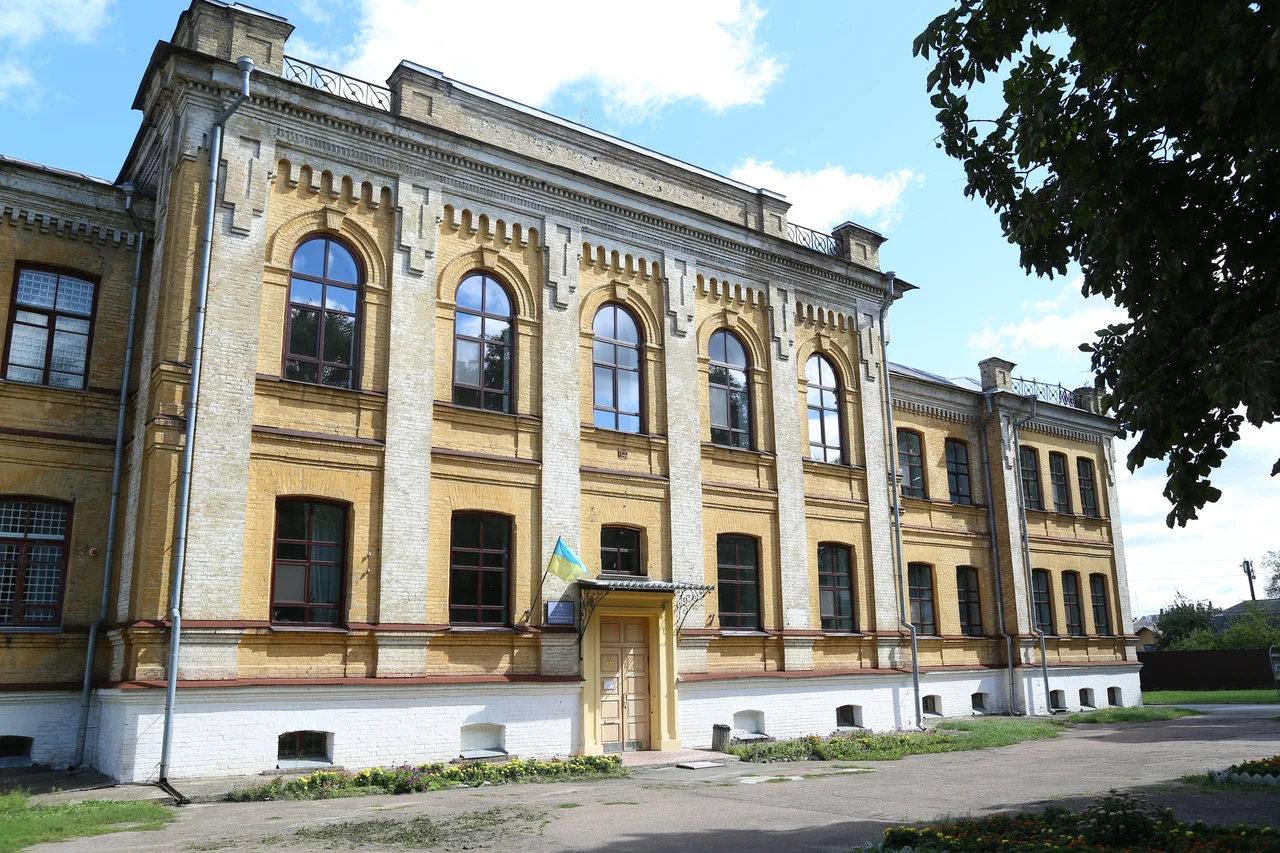

Chernihiv Regional Art Museum
A Dutch musician tunes his lute in candlelight, frozen mid-gesture on a canvas painted in 1626. He hangs a few thousand kilometres and four centuries from where Hendrick ter Brugghen lifted his brush, in a red-brick schoolhouse on a hill above the Desna River. This is Chernihiv, one of the oldest cities in Ukraine, and the building was once a gymnasium for the daughters of the local gentry. Today it holds a collection that runs from folk icons of the Virgin to a bust of Marie Antoinette, gathered under one roof on the very ground where princes once ruled.
A Schoolhouse Full of Saints
The museum occupies a 19th-century monument in Dytynets Park, the fortified core of the ancient princely city, so the setting itself carries the imprint of time. Step inside and the collection opens with icons - mostly Ukrainian, including a canonical Archangel Michael and an array of images of the Mother of God, some rendered in a peculiar, deeply personal folk manner. There is a two-sided panel joining the Protection of the Mother of God with a Crucifix. These are not museum-neutral objects but working devotional images pulled from a living Orthodox tradition, and they anchor the galleries in the iconographic heritage of the Ukrainian Baroque. More than sixteen thousand works fill the storerooms, from the 16th century to the present, a scale that surprises visitors expecting a modest provincial gallery.
The Galagan Inheritance and Two Centuries of Faces
At the heart of the museum sits a collection assembled by the Galagan family, a wealthy Cossack dynasty whose gathered treasures now belong to Chernihiv. Around it hangs one of the museum's quiet glories: a run of Ukrainian portraits that follows the genre from the end of the 17th century into the early 20th, face after face, generation after generation. Beside the local work is a small but genuine cabinet of European painting - Italian canvases of the 17th and 18th centuries, Dutch and Flemish battle scenes and still lifes, French names like Hubert Robert and Jean-Baptiste Greuze. The centrepiece remains ter Brugghen's Concert, a Utrecht painter's homage to the followers of Caravaggio, its warm shadows and lamplit faces holding their own in a room far from Amsterdam.
A Building Under Fire
In 2022, during the Russian invasion of Ukraine, the museum's building was partially damaged. The collection that survived Soviet rule, world wars, and centuries of upheaval suddenly faced a new threat, and Chernihiv's cultural workers found themselves protecting sixteen thousand fragile objects while the city itself was under bombardment. The story of this museum is, in a sense, the story of Chernihiv - a place that has been burned and rebuilt so many times that endurance has become its defining trait. That a lute-player painted in 1626 still hangs here, in a former girls' school on the walls of a thousand-year-old fortress, is itself a small act of defiance against everything that has tried to erase this city.
From the Air
The museum sits at 51.4902 N, 31.3098 E within Dytynets Park on the high right bank of the Desna River. From roughly 2,500 to 4,000 feet, look for the cluster of golden church domes and the earthwork ramparts that mark the old citadel; the museum's brick building stands among them. Nearest airport is Chernihiv Shestovytsia (UKRR) to the southwest; Kyiv's fields, Boryspil (UKBB) and Zhuliany (UKKK), lie about 130 km south.
Nearby Stories
- Principality of Chernigov 9.4 km away
- Battle of Listven 10 km away
- Kruty Heroes Memorial 14 km away
- Slavutych 17 km away
- Liubech 19 km away
- Oster 23 km away
- Nizhyn 31 km away
- Mezine 76 km away