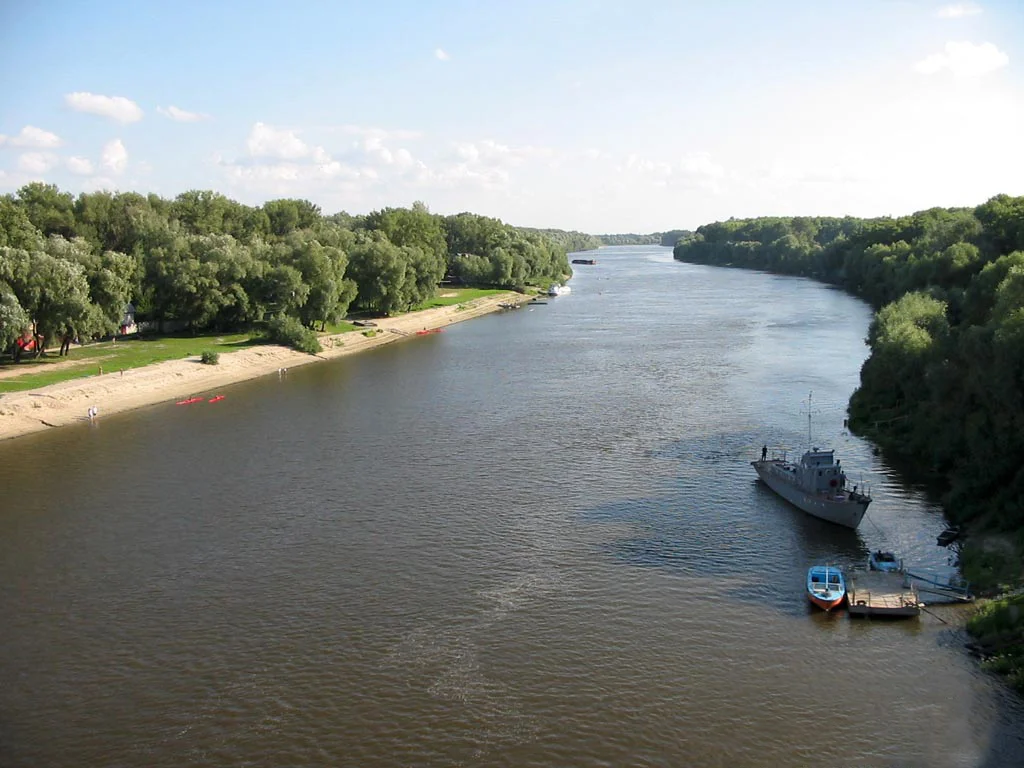

Chernihiv
Chernihiv is older than Russia. It was first mentioned in writing in the year 907, in a Rus'-Byzantine treaty, but the archaeology says it had been a city already by the ninth century. The Black Grave, one of the largest royal burial mounds in Eastern Europe, was excavated here in the nineteenth century. By the twelfth century Chernihiv was the second wealthiest city in the southern Kievan Rus', with a population of 25,000, and the seat of a powerful principality whose rulers regularly fought their cousins in Kyiv for primacy. In February and March of 2022, the same city, by then with about 280,000 people, was nearly encircled by Russian armor and pounded for 38 days. Roughly 700 civilians were killed. Much of what eleven centuries had built was damaged or destroyed in five weeks.
City of the Black God
The name Chernihiv begins with the Slavic root cherni-, meaning black. Some scholars, including Martin Dimnik of the University of Toronto, link the name to Chernobog, the black god of pre-Christian Slavic mythology. The city's roots reach into that pre-Christian world. By the late tenth century it had its own local rulers. From the eleventh century, the Principality of Chernihiv stretched far beyond the city itself, controlling not just the Severian towns but distant territories including Murom, Ryazan, and Tmutarakan on the Sea of Azov. The Cathedral of the Transfiguration, the oldest surviving church in Ukraine, was commissioned in the early 1030s by Mstislav the Bold and finished by his brother Yaroslav the Wise. It still stands. The city's golden age ended sharply in 1239 when Batu Khan's Mongol horde sacked it, killed most of its population, and reduced what remained to a provincial town. From that day, the population would not approach 25,000 again for centuries.
Five Centuries of Borderland
Chernihiv passed between empires for the next four hundred years. The Grand Duchy of Lithuania annexed the area in 1353. Crimean Tatar khan Mengli I Giray burned the city in 1482 and again in 1497. From the fifteenth through seventeenth centuries it changed hands among Lithuania, Muscovy, and the Polish-Lithuanian Commonwealth. In 1623 the Commonwealth granted Chernihiv Magdeburg rights, and in 1635 made it the seat of the Chernihiv Voivodeship. The Khmelnytsky Uprising of 1648 swept it into the Ukrainian Cossack Hetmanate. The 1667 Treaty of Andrusovo handed legal sovereignty to the Tsardom of Russia, though Chernihiv remained an autonomous Cossack center for decades. After the Hetmanate was abolished by Catherine the Great, Chernihiv became an ordinary administrative center of the Russian Empire, capital of various provincial divisions called governorates. In 1897 the city had a population of 27,006, of whom roughly 11,000, or 41 percent, were Jewish.
The Architecture That Survived Everything
Chernihiv's architectural inheritance comes from two great periods. The first is the era of Kievan Rus', the eleventh and twelfth centuries. The Transfiguration Cathedral from the 1030s remains the oldest church in Ukraine. The Cathedral of Saints Boris and Gleb, built in the mid-twelfth century, was rebuilt many times before twentieth-century restoration brought it back to its original shape. The Piatnytska Church of Saint Paraskevi, completed around the year 1200, was severely damaged in the Second World War; the architect Pyotr Baranovsky designed its restoration to its medieval form. The second great period is the late seventeenth and early eighteenth centuries, the Cossack Hetmanate and its distinctive Cossack Baroque style. The exquisite Trinity Cathedral was built between 1679 and 1689. The cave monasteries at Yeletskyi and Anthony's Caves survive at the city's edge; the Yeletskyi caves are said by tradition to predate even the famous Caves Lavra in Kyiv. Chernihiv's historic center has been on UNESCO's tentative list for World Heritage status since 1989.
The Twentieth Century
The German army occupied Chernihiv from September 9, 1941 to September 21, 1943. The Germans operated a Nazi prison and a forced labor battalion for Jewish residents in the city. Most of Chernihiv's pre-war Jewish community, descendants of the families that had made up 41 percent of the city's population in 1897, were murdered in the Holocaust. The city was rebuilt under Soviet rule. The Cheksil textile complex, one of the largest in the Ukrainian SSR, opened in 1963. The city's population grew toward 300,000. The Statue of Lenin on Myru Avenue was toppled in February 2014 as part of the post-Maidan removal of Soviet monuments across Ukraine. By the 2017 surveys, Russian was still the dominant home language, used by 53 percent of residents; only 18 percent spoke Ukrainian only at home. By 2023, after the war began, those numbers had inverted significantly: 53 percent of Chernihiv residents now spoke Ukrainian at home and 41 percent Russian.
Hero City
On February 24, 2022, Russian forces crossed the Belarusian border and drove south toward Kyiv along several axes. Chernihiv sat directly on one of those axes. The siege began on the war's first day. By March 10, Mayor Vladyslav Atroshenko reported the city was completely encircled. For 38 days the city was shelled, bombed from the air, and cut off from supplies. Estimates of civilian deaths during the siege run from 700 to over 1,000. Several hospitals were hit. Whole apartment blocks in the residential districts of Bobrovytsia and Masany collapsed. The Tarnovsky House, the Chernihiv Stadium, the Military History Museum, the Drama Theatre, and many other cultural and civic buildings were damaged. On April 5, 2022, Chernihiv Oblast governor Vyacheslav Chaus announced that Russian forces had withdrawn, leaving extensive minefields behind. The city was named a Hero City of Ukraine by President Zelenskyy. Russian missile strikes have continued; on August 19, 2023, a strike killed seven people near the central square; on April 17, 2024, another strike killed around 18. Reconstruction began before the war ended, because Chernihiv has been here since at least 907 and is not going anywhere.
From the Air
Chernihiv sits at 51.49N, 31.29E in northern Ukraine on the Desna River, about 145 km north of Kyiv. The closest international airport is Kyiv Boryspil (UKBB) to the south. The city's own former airport, Chernihiv-Shestovytsia (UKKL), lies about 12 km southwest and was historically a Soviet air base. Chernihiv lies roughly 75 km from the Belarusian border and 230 km from the Russian border, the proximity that made it a primary axis of attack in 2022. From the air, the city is built in a tight cluster on the right bank of the Desna, with the older religious complex of golden domes (the Transfiguration Cathedral, Saints Boris and Gleb, the Yeletskyi monastery) clearly visible at the historic core. As of 2026 Ukrainian airspace remains restricted because of the ongoing war with Russia.
Nearby Stories
- Principality of Chernigov 9.4 km away
- Battle of Listven 10 km away
- Kruty Heroes Memorial 14 km away
- Slavutych 17 km away
- Liubech 19 km away
- Oster 23 km away
- Nizhyn 31 km away
- Mezine 76 km away