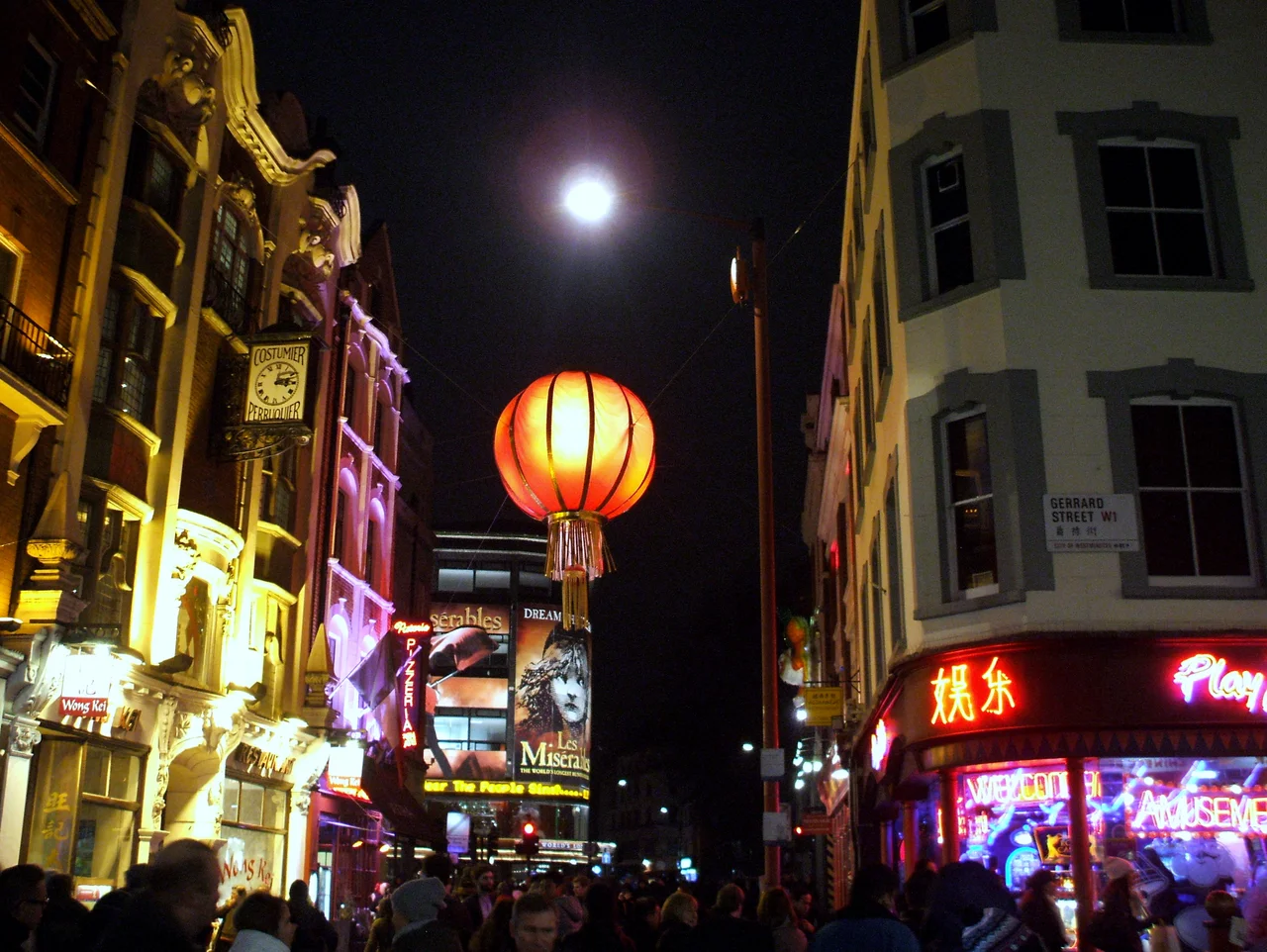

Chinatown, London
Warren Zevon's 1978 hit song 'Werewolves of London' sends its protagonist to Lee Ho Fook's restaurant on Gerrard Street to get a big dish of beef chow mein. It's a comic line, but it marks a moment: by 1978, Gerrard Street was already recognizable enough to name-drop in a rock song, already established enough to work as shorthand for London's Chinese community. That transformation had happened in less than a decade. Before the mid-1970s, Gerrard Street was simply a run-down Soho thoroughfare, home to a post office, a tailor's shop, a few brothels, and no particular identity at all.
The First Chinatown
London's original Chinese community settled in Limehouse, in the East End, at the start of the 20th century. Chinese sailors who worked the Docklands trade routes established shops and businesses there, and the area developed into a recognizable enclave. It became notorious in ways that reflected the anxieties of the time more than the reality of the neighbourhood: lurid reports of opium dens and slum conditions, drawn from fiction and tabloid imagination, gave Limehouse a reputation for danger. The Blitz damaged much of the area. After the war, the growing British taste for Chinese food — and a significant influx of immigrants from Hong Kong — meant that Chinese restaurants were opening across the city, not just in the old dockside community.
Gerrard Street Transformed
The present Chinatown did not begin taking shape until the early 1970s. Gerrard Street was its anchor — a short, shabby block off Shaftesbury Avenue that the Chinese community gradually claimed, restaurant by restaurant, starting with the first openings on parallel Lisle Street. The Tailor and Cutter, which had occupied numbers 43 and 44, finally closed around 1974. By then the character of the area was changing rapidly. Today the neighbourhood holds more than 80 restaurants along with bakeries, supermarkets, and souvenir shops, bounded roughly by Gerrard Street, Wardour Street, Rupert Street, and Shaftesbury Avenue. The gate on Wardour Street, built by Chinese artisans in the style of the Qing dynasty and opened in 2016, marks the entrance with the kind of visual declaration that makes a place legible from a distance.
A Meeting Place More Than a Home
The streets here carry 17th-century history embedded in their names: Gerrard Street was named for Charles Gerard, the 1st Earl of Macclesfield, who owned the land in the 1680s. Rupert Court and Rupert Street bear the name of Prince Rupert of the Rhine, First Lord of the Admiralty when the street was built in 1676. These aristocratic origins sit strangely alongside the dragon gates and bilingual street signs. As of the late 1990s, relatively few people of Chinese ancestry actually lived in Chinatown — it functioned mainly as a social and commercial meeting point for a community spread across London and beyond. The London Chinatown Community Centre, founded in 1980, has assisted more than 40,000 people since its establishment, working from the neighbourhood it helped to create.
Resistance and Resilience
Chinatown has not been without conflict. In 2005, a property developer proposed redeveloping the eastern portion of the area, and businesses pushed back hard, arguing that the changes would displace traditional Chinese retail and change the neighbourhood's character fundamentally. The proposal was dropped. In 2013 and again in 2018, Chinatown organised one-day shutdowns to protest what the community described as aggressive tactics by immigration enforcement officers from the Home Office. The shutdowns drew national attention. Whatever pressures have come — from redevelopment, from gentrification, from the kind of aggressive officialdom that treats a neighbourhood as a target — Gerrard Street has remained Chinese London's centre of gravity for more than fifty years.
From the Air
Located at 51.511°N, 0.131°W in central London, off Shaftesbury Avenue. Leicester Square tube station is the closest Underground stop. The area is dense and urban, most identifiable from the distinctive gate structures. London City Airport (EGLC) is approximately 9 miles east.
Nearby Stories
- Stevenage 5.7 km away
- Malling Abbey 5.7 km away
- 1952 Farnborough Airshow Crash 7.7 km away
- Ingatestone Hall 8.2 km away
- Hellfire Caves 9.1 km away
- The Carrington Event: The Solar Storm That Could Happen Again 9.8 km away
- Bletchley Park 16 km away
- Castle Hedingham 23 km away