
Chios expedition
Charles Nicolas Fabvier was a French colonel who had fought for Napoleon and then thrown in his lot with the Greeks, and in the autumn of 1827 he was handed an almost impossible assignment: take back Chios. Five years had passed since the Ottoman reprisal had emptied the island of most of its people, and as Greek independence finally came into view, Chian refugees scattered across the Aegean begged the new government not to let their homeland be left outside the borders of the coming nation. The expedition that answered them would last barely four months and end in failure, but it was an attempt to reclaim a place that had already been lost.
A Cause Worth a Long Shot
By late 1827 the Greek rebels were racing the clock. Independence was near, but they feared that any territory still under Ottoman control when the borders were drawn, even land that had revolted and bled, would be excluded from the new state. So they launched simultaneous operations across the Aegean: in the Peloponnese, in Crete, and on Chios. Chian merchants living on Syros wrote to the government pleading for a campaign, and the Chian Committee turned to the great scholar Adamantios Korais, himself of Chian descent, for help finding even the basics of water and food. The task of recovering the island fell to Fabvier, who at first hesitated, then began assembling a force out of almost nothing.
A Force Held Together by Will
What Fabvier scraped together was modest and uneven: six or seven hundred men from the regular army, a handful of field guns, siege guns, and mortars, and over a thousand irregulars from central Greece alongside Chian refugees fighting for their own homes. Two hundred cavalry were promised, though fewer than a quarter of them actually had horses, and they did not arrive until November. The expedition gathered at Psara, a small island that the Ottomans had themselves ravaged in 1824, so that the staging ground for the rescue was itself a ruin. From there, on 17 October, the force landed on Chios and faced an Ottoman garrison of 2,000 men holding the medieval castle.
The Siege That Could Not Close
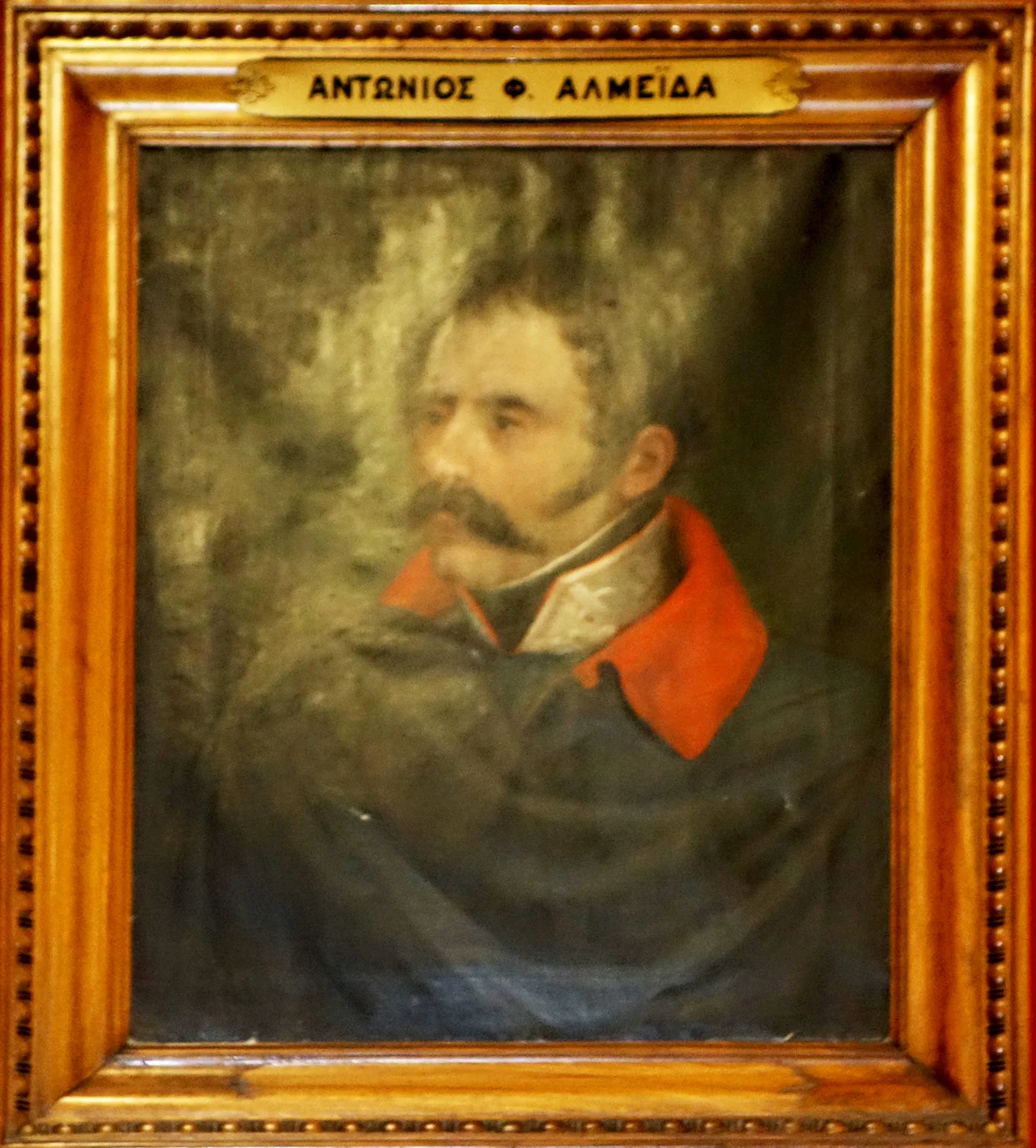
Fabvier brushed aside the first Ottoman troops and drove them inside the Castle of Chios, then settled in to besiege it. But his siege had a fatal flaw: he had no fleet to seal the fortress from the sea, so it could always be resupplied and reinforced. He was reinforced himself by a Portuguese philhellene, Colonel Antonio Figueira d'Almeida, who took command of the cavalry, and by the celebrated mine-digger Konstantinos Lagoumitzis, who came to tunnel beneath the walls. Fabvier even raided the Anatolian coast and planned a fireship strike on the harbor of Cesme in concert with Konstantinos Kanaris, the same captain who had avenged the 1822 massacre. Strong winds wrecked the plan. The French admiral Henri de Rigny ordered him to abandon the whole enterprise; Fabvier replied that he took orders only from the Greek government.
Withdrawal
On 12 January 1828 the Ottoman garrison sortied against a weak point in the Greek lines and nearly broke through, until irregulars under a captain named Gekas held long enough for the regulars to counterattack and Fabvier himself led a battalion to retake the lost ground. The Turks suffered heavy losses, but the victory settled nothing, because the blockade still leaked. Worse, the Chian Committee stopped paying and supplying the troops, and the irregulars' demands on the local population poisoned relations with the very people the expedition had come to free. The end came from the sea: on 27 February an Ottoman squadron drove off the Greek ships, and the next day ferried 3,000 fresh troops across from Cesme into the fortress. The island's surviving population lost heart and many fled once more. Fabvier lifted the siege, and in early March he and his men were evacuated.
The Border That Bypassed Chios
The expedition's failure had a lasting consequence. When the borders of independent Greece were settled, Chios was left outside them, just as the refugees had feared. The island would remain under Ottoman rule until 1912, almost a century after the catastrophe of 1822 and more than eighty years after Fabvier's men were pulled off its shores. The campaign is remembered less for any battle than for what it represented: a doomed, stubborn attempt to undo a loss that could not be undone, fought by exiles trying to win back a home that had already been taken from them.
From the Air
The 1827-28 expedition centered on the Castle of Chios in the main town, near 38.40 N, 26.02 E on the island's east coast, with the staging island of Psara to the northwest and the Ottoman supply port of Cesme on the Anatolian coast just across the strait to the east. Chios lies in the northern Aegean; its airport is LGHI. From altitude, the harbor and old castle of the main town are visible on the east coast, with the narrow Chios Strait separating the island from Turkey, the same waters that allowed the Ottoman fleet to keep the besieged fortress resupplied.
Nearby Stories
- Psara 18 km away
- Battle of the Oinousses Islands 28 km away
- St. Helena Church 35 km away
- Battle of Corycus 35 km away
- Greek Islands 60 km away
- Temple of Artemis at Ephesus 61 km away
- Adramyttium 94 km away
- Skyros 101 km away