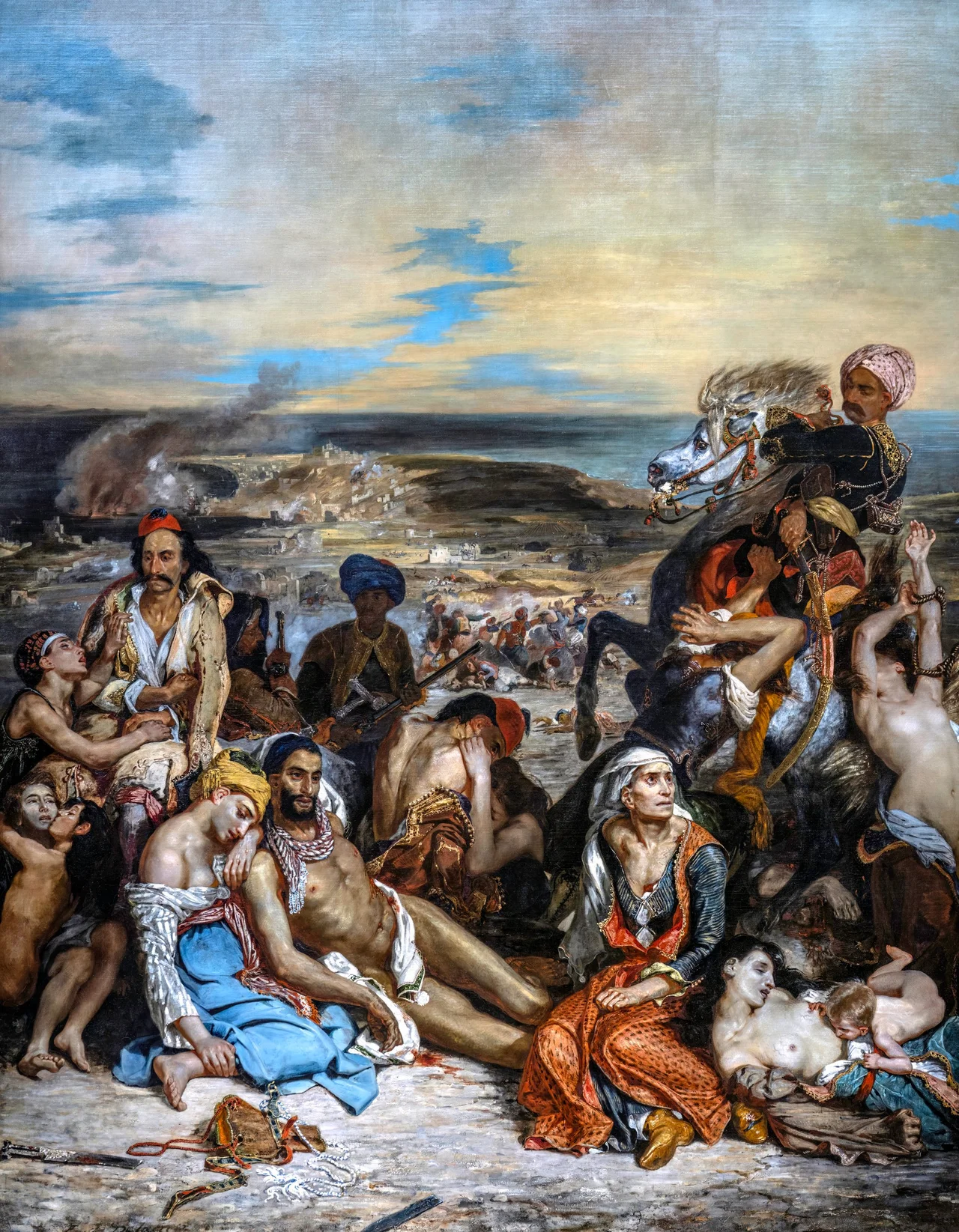

Chios massacre
Before the spring of 1822, Chios was home to perhaps 100,000 to 120,000 people: merchants and shipowners whose families had traded across the Black Sea and the Mediterranean for centuries, scholars, mastic farmers, priests, and the children of a wealthy and cosmopolitan island. Within a few months, roughly four-fifths of them were dead, enslaved, or in flight. Whole villages were emptied. The catastrophe that destroyed this community is remembered now as the Chios massacre, and what follows is an account of the people it consumed.
An Island That Did Not Want War
When the Greek War of Independence broke out in 1821, the leaders of Chios were reluctant to join it. They had reason to be. The island lay only a few miles off the Anatolian coast, well within reach of the Ottoman heartland, and its prosperity depended on the careful autonomy the Ottomans granted in exchange for mastic and trade. The Chiots understood their exposure better than anyone. But in March 1822, several hundred armed Greeks from neighboring Samos landed on the island, proclaimed the revolution, and attacked the Turkish positions. The islanders were swept into a rebellion many of them had wanted no part of, and the consequence fell on everyone.
The Reprisal
An Ottoman fleet under the admiral Nasuhzade Ali Pasha arrived on 22 March and began to pillage the town. Over the following four months, an estimated 30,000 troops landed on the island. The order was given to burn the settlements, and the violence moved through the countryside, reaching even the mastic villages in the south whose resin had made the island rich. The toll is recorded in ranges no source can make precise, because the dead were too many to count: tens of thousands killed, with estimates of those slaughtered running upward of 50,000, and a roughly equal number enslaved. Of the island's prewar population, only a few thousand are thought to have remained when it was over.
The Enslaved and the Scattered
Behind those numbers were people whose lives did not end with the killing. Tens of thousands of survivors were carried off to slave markets or fled across the Aegean, scattering into a diaspora that reached deep into Europe. Some of the enslaved were children. A boy named Georgios Stravelakis was sold into slavery at the age of five; carried far from home and converted to Islam, he eventually rose, under the name Mustapha Khaznadar, to serve as prime minister of Tunis from 1855 to 1873. His story was extraordinary precisely because it was so rare, a single thread followed out of tens of thousands of severed lives. Most of the enslaved left no name in any record at all.
The World Looks Away, and Then Cannot
On 7 May, the British warship HMS Seringapatam passed the burning island and received signals from Greek ships pleading for help. Under orders to observe strict neutrality, the ship gave no assistance and sailed on. But Europe could not look away for long. The French painter Eugene Delacroix rendered the suffering in The Massacre at Chios, an enormous canvas of 1824 in which every figure in the foreground, the dying, the despairing, the woman being dragged toward the slave market, is painted as an individual person. Bought for the Louvre, it became one of the most famous images of the century. Victor Hugo devoted a poem, 'L'Enfant,' to a child of Chios; Byron's voice swelled the same chorus. The massacre helped turn European opinion decisively toward the Greek cause.
Remembrance
The dead of Chios have been mourned for two centuries. In Nea Moni, the island's great Byzantine monastery, human remains from the massacre are still kept, a physical reminder that resists abstraction. In 2021, the Orthodox Church of Greece formally recognized Metropolitan Plato of Chios and forty-three others, priests, deacons, and monks killed on Holy Friday in 1822, as martyrs to be commemorated each year. The names that could be recovered are spoken; the far greater number that could not are remembered in the gap they left. Chios, once among the most prosperous islands in the Aegean, never regained the commercial prominence it had held before that spring.
From the Air
The massacre engulfed the whole of Chios, centered on the main town and harbor near 38.36 N, 26.06 E on the island's east coast, with the violence reaching the mastic villages of the arid south. Chios lies in the northern Aegean just off the Anatolian coast; the island's airport is LGHI. From altitude the island's crescent form and ridged spine are clear against the surrounding sea. The hilltop village of Anavatos, abandoned after the massacre, and the Nea Moni monastery in the interior are quiet landmarks of the catastrophe.
Nearby Stories
- Psara 18 km away
- Battle of the Oinousses Islands 28 km away
- St. Helena Church 35 km away
- Battle of Corycus 35 km away
- Greek Islands 60 km away
- Temple of Artemis at Ephesus 61 km away
- Adramyttium 94 km away
- Skyros 101 km away