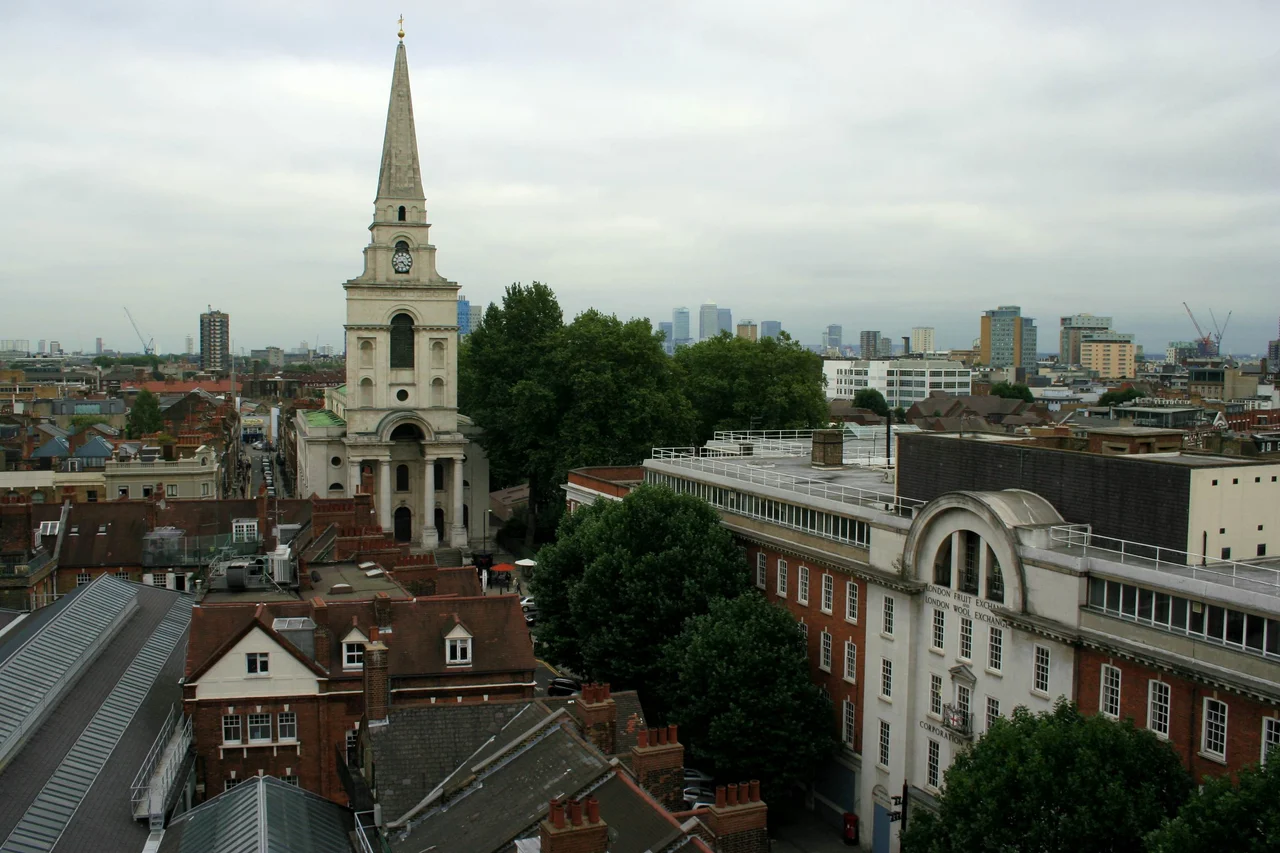

Christ Church, Spitalfields
Parliament passed the act in 1711, the brief was audacious — fifty new churches for London's expanding settlements — and of the twelve that were actually built, six were designed by Nicholas Hawksmoor. Christ Church Spitalfields, completed in 1729 after fifteen years of work, is widely considered the greatest of them. Its commission was also openly political: the parish had been carved from the old Stepney parish to serve an area dominated by Huguenot refugees, French Protestants who had fled Catholic persecution and established their own plain chapels here. Christ Church's bombastic English Baroque was a statement of Anglican power in a neighbourhood that had chosen, rather pointedly, not to belong to the Church of England.
Hawksmoor's Abruptness
The great architectural critic Robert Venturi wrote that Hawksmoor's tower at Christ Church is 'a manifestation of both-and at the scale of the city.' It is both wall and tower. At the bottom, the structure extends outward into buttress-like wings that terminate the view down the approaching street; at the top, it resolves into a spire visible from all sides. This quality of controlled contradiction runs through the whole building. The nave is a plain rectangular box surmounted by a Gothic steeple that does not quite match the classical vocabulary of the rest. The magnificent western portico, with its semicircular pediment and Tuscan columns, is attached bluntly to the front — possibly added late to reinforce the tower's foundations. Inside, elliptical barrel vaults over the aisles sit on raised Composite columns, and the flat ceiling above the central space is richly decorated. The Portland stone facade, when cleaned during the restoration, revealed a whiteness that the city's pollution quickly obscures again.
The Organ of England
In 1735, organ builder Richard Bridge installed the instrument that would become, for over a century, the largest organ in England. With more than two thousand pipes, it was built at a moment when the church was still new, its Huguenot neighbourhood still maintaining its French identity. Remarkably, much of Bridge's original work survives — the case, largely walnut, remains mostly intact. By 1960 the organ had fallen silent, the building nearly derelict, and the instrument was disassembled and stored for safekeeping. A scheme of conservative restoration, prepared by organ builder William Drake, resulted in the reinstalled instrument being heard in public again in 2014. It speaks now in a building that has recovered something close to Hawksmoor's original design.
The Long Rescue
By 1960, Christ Church was close to ruin. Services had moved to a former Huguenot chapel on Hanbury Street while the roof was declared unsafe. The then Bishop of Stepney, Trevor Huddleston, proposed wholesale demolition. The Hawksmoor Committee stopped him, and the roof was rebuilt using funds from the sale of the bombed shell of St John's Smith Square. In 1976, the Friends of Christ Church Spitalfields was established as an independent charity to manage the restoration. Church services returned to the partially restored building in 1987. The full restoration took until 2004 — a process spanning more than 25 years, during which archaeologists excavated nearly 1,000 burial vaults beneath the church, identifying around 390 individuals from their coffin plates. The work documented Victorian mortuary practices and health conditions in this working-class neighbourhood with unusual precision.
Spitalfields as It Was and Is
Standing on Commercial Street today, with the market behind you and the Hawksmoor tower ahead, it is possible to feel the layering of this neighbourhood's history. The Huguenots who built their plain chapels here in the 18th century eventually assimilated into English life. Their buildings passed to other immigrant communities — Jewish communities in the 19th and early 20th centuries, Bangladeshi communities from the 1970s onward. The church itself drifted from use to near-ruin and back. Painter Leon Kossoff began making paintings of Christ Church in 1987, returning to it repeatedly, capturing the way the Portland stone holds light differently at different times of day. The building that Parliament tried to impose on a dissenting neighbourhood has become, against all odds, one of the things that neighbourhood is most proud of.
From the Air
Located at 51.519°N, 0.074°W on Commercial Street in Spitalfields, Tower Hamlets. The distinctive tower and white Portland stone facade are visible from low altitude. Nearest airports are London City (EGLC) approximately 6 miles east.
Nearby Stories
- Stevenage 5.7 km away
- Malling Abbey 5.7 km away
- 1952 Farnborough Airshow Crash 7.7 km away
- Ingatestone Hall 8.2 km away
- Hellfire Caves 9.1 km away
- The Carrington Event: The Solar Storm That Could Happen Again 9.8 km away
- Bletchley Park 16 km away
- Castle Hedingham 23 km away