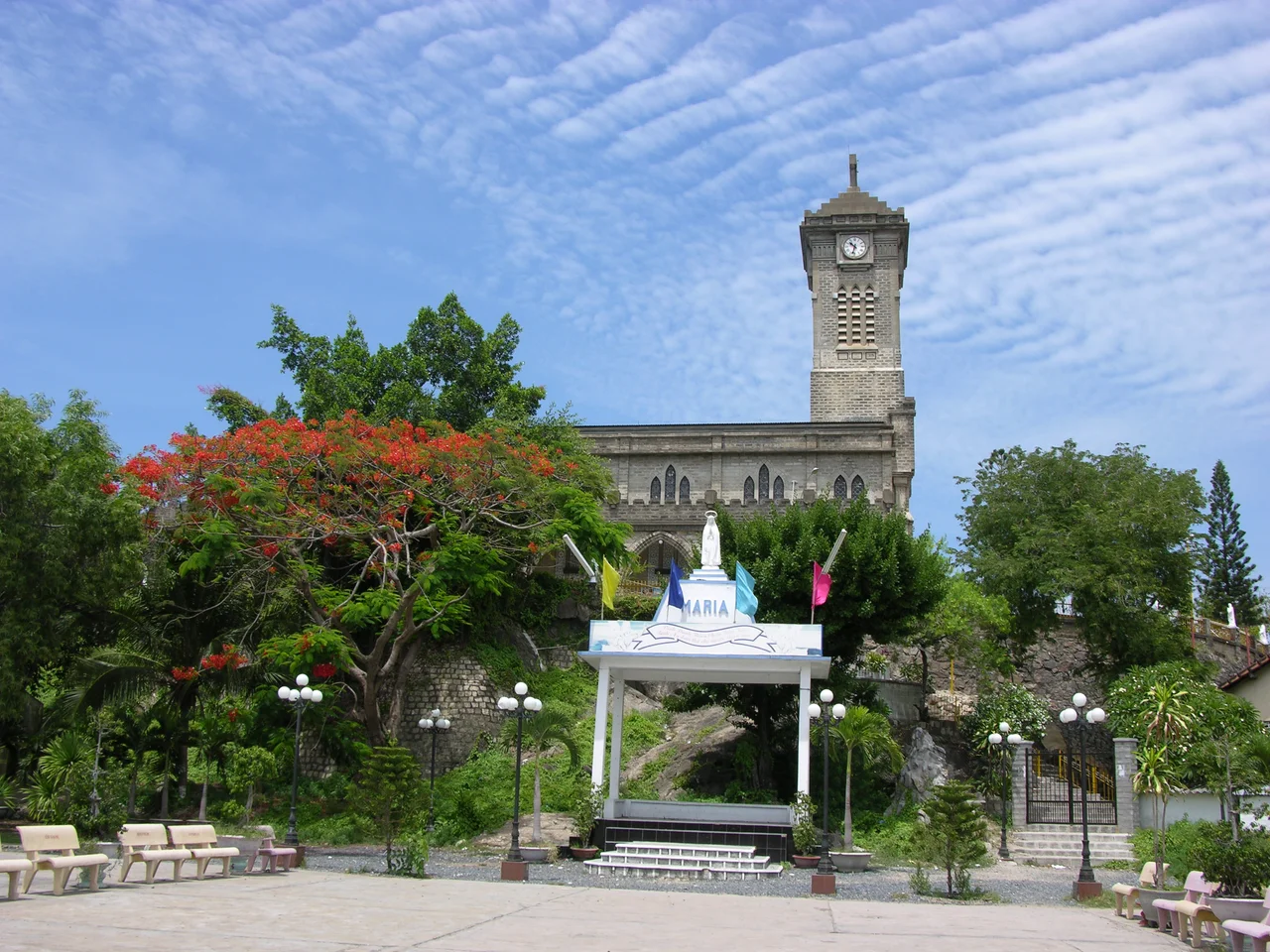

Christ the King Cathedral, Nha Trang
French missionaries arrived in Khánh Hòa in 1886 without a church worthy of the parish they intended to build. It took them forty-two years to get one. When the Gothic Revival cathedral finally rose on a granite outcrop above the city in 1928, its grey stone towers were visible from the sea — a deliberate statement in a coastal city that had never seen a flying buttress before.
Stone on a Hill
The cathedral earns its popular name — Nhà Thờ Núi, the Mountain Church — honestly. It sits on a rocky promontory above the Nha Trang railway station, reached by a staircase that climbs past bougainvillea and frangipani. The architect designed in the Gothic Revival idiom: pointed arches, soaring nave, a bell tower that completed in December 1935 after the main building had been consecrated two years earlier. The grey stone exterior gives the building a cool, almost European gravity that contrasts sharply with the tropical heat at the foot of the hill. Inside, light filters through stained glass windows depicting saints — several French ones among them, including Joan of Arc and John Vianney — as well as scenes from the life of Jesus. The effect is simultaneously a European parish church and something entirely of this place, where Vietnamese and foreign congregants have worshipped together for nearly a century.
A Priest Who Stayed
On 14 May 1933, the cathedral was consecrated under the title of Christ the King. The priest who presided over its early decades was Louis Vallet, born in France in 1869 and sent to Indochina by the Foreign Missions of Paris. Vallet spent his life in this parish — not as a visitor, not as a diplomat of the faith, but as a pastor to the people of Nha Trang. When he died in 1945 at the age of seventy-six, he was buried on the cathedral grounds, a few metres from the altar where he had celebrated thousands of Masses. His tomb remains there still, a quiet presence amid the incense and the tourist visits, marking the spot where a man chose a place and stayed.
Diocese and Bell
The cathedral's institutional status rose through the second half of the twentieth century in step with the reorganization of the Vietnamese church. Pope Pius XII erected the Apostolic Vicariate of Nha Trang in 1957 through his constitution Crescit Laetissimo. Three years later, in 1960, the Diocese of Nha Trang was formally created, with Paul Raymond Marie Marcel Piquet of the Foreign Missions of Paris as its first bishop. The Mountain Church became the mother church of the new diocese. A detail that predates all of this: on 29 July 1934, Archbishop Colomban Dreyer, the Apostolic Delegate to Indochina, blessed the cathedral's bell — a gift from a Catholic parishioner in Saigon, carried north along the coast to hang in a tower that would not be finished for another eighteen months.
The City Below
Standing at the cathedral's iron gate and looking south, the logic of the site becomes clear. Nha Trang spreads along a crescent bay of startling blue — one of the most praised stretches of coastline in Vietnam. The railway station sits just downhill, its platforms a reminder that the French colonial infrastructure that brought missionaries here also brought trade and administration. Today the cathedral draws a steady stream of visitors alongside its regular worshippers: people who climb the steps for the architecture, for the history, for a few minutes of cool shade inside a nave that smells of candle wax and old stone. Mass is still celebrated here regularly, the congregation filling the pews that Louis Vallet once knew, in a church that has outlasted the empire that built it.
From the Air
Christ the King Cathedral sits at approximately 12.247°N, 109.188°E on a granite hill in central Nha Trang, Khánh Hòa Province, Vietnam. At 1,000 feet AGL the twin stone towers are clearly visible against the urban grid, roughly 500 metres north-northwest of Nha Trang railway station. The nearest active commercial airport is Cam Ranh International (VVCR), approximately 30 km to the south-southeast. Nha Trang Air Base (VVNT), the former military field on the city's southern edge, is approximately 3 km to the south. The bay stretching east provides an excellent visual reference: approach from the coast heading west and the rocky hill with the cathedral is the first prominent landmark before the station.
Nearby Stories
- Cam Ranh 5.1 km away
- Linh Phước Temple 15 km away
- Đà Lạt Plateau 25 km away
- Chư Yang Sin National Park 49 km away
- Vũng Rô Bay 52 km away
- South-East Asian Theatre of World War II 220 km away
- Kashmir Princess 361 km away
- Battle of the Paracel Islands 494 km away