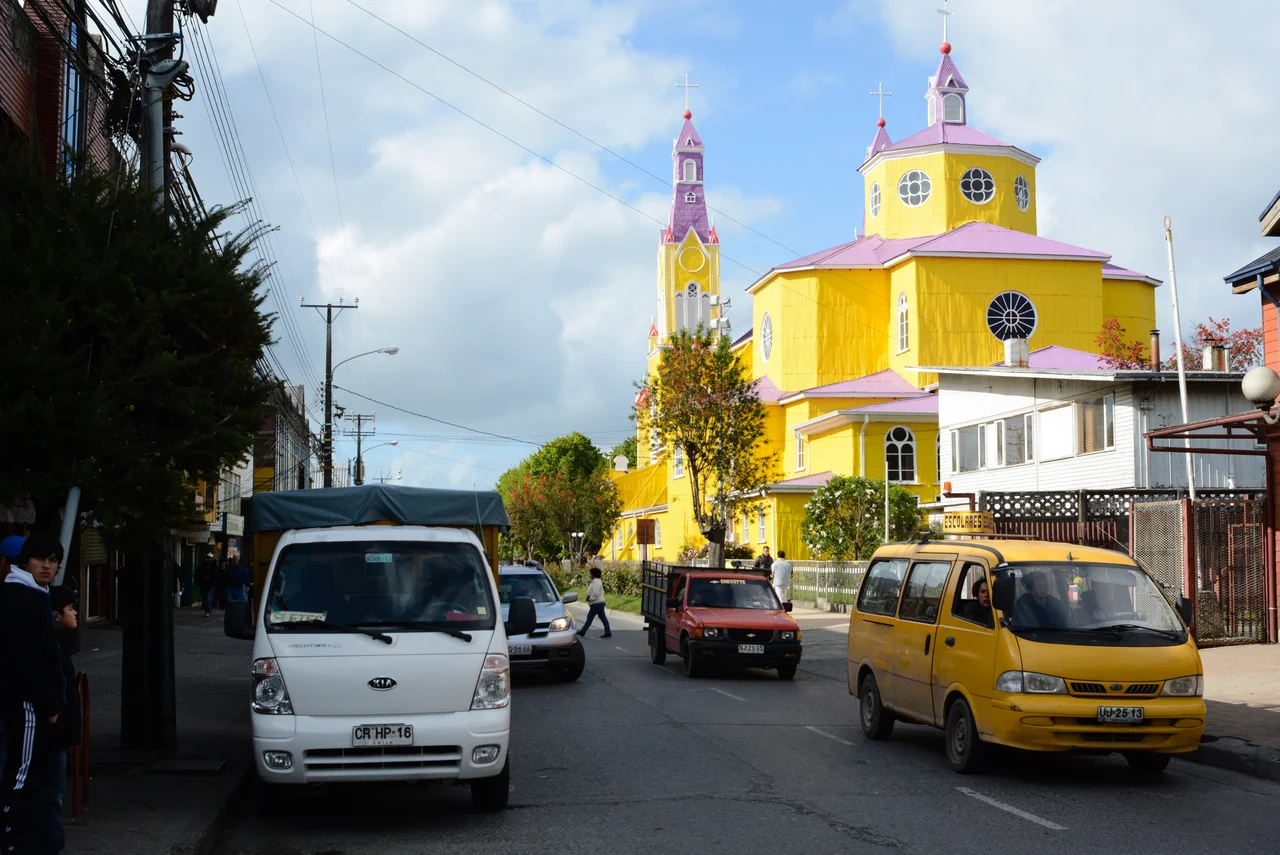

Church of San Francisco, Castro
Travelers argue about the color before they say anything else. The Church of San Francisco rises over the Plaza de Armas in Castro painted a loud mustard yellow, trimmed with lavender, a scheme that looks less like a Catholic church than a giant child's toy. Some find it joyful. Some find it garish. Almost nobody finds it forgettable. Step inside, though, and the argument falls silent: the entire vast interior is warm, varnished native wood, vaulted overhead like the upturned hull of a ship, and you remember that beneath the iron skin and the bright paint, this is one of the great timber buildings of the Americas.
The Largest of Its Kind
Among the wooden churches of Chiloé, San Francisco is the giant. It covers 1,404 square meters, stretches 52 meters wide, and rises 27 meters at the nave. The dome above the presbytery reaches 32 meters, and the twin towers climb to 42, tall enough to dominate Castro's low skyline from the harbor below. Locals often call it the cathedral, but they are wrong by a technicality: the actual cathedral of the diocese sits in Ancud, to the north. San Francisco simply looks the part. It is the most monumental member of the family of Chilote churches, and the easiest to find, anchoring one whole side of the city's central square.
Four Centuries of Fire and Rebuilding
A church has stood on or near this spot since the year Castro was founded, 1567, when the Spanish raised a chapel to Saint James to convert the island's indigenous people. Wood and weather are unkind to one another, and the building burned and rose again repeatedly across the centuries, with a notable reconstruction completed around 1771 under the Franciscans, who had taken over from the expelled Jesuits four years earlier, and another after a fire in 1902. What stands today is the version completed between 1910 and 1912. Each rebuilding was an act of stubborn faith, the community gathering its carpenters and its timber and starting over, again and again, on the same windswept square.
An Italian Drawing, Chilote Hands
The current design came from an unlikely source: the Italian architect Eduardo Provasoli, who gave the church its neo-Gothic silhouette rather than the simpler lines of its island cousins. But the building of it was pure Chiloé. Local carpenters, working under master builder Salvador Sierpe, raised the whole structure in native timber, the same craftsmen and the same skills that produced the island's fishing boats. They used alerce, cypress, and coigüe in the frame, and lined the interior in rauli beech and olivillo. The pointed European arches were translated into the warm grain of southern Chilean forest. The result is a hybrid: a cathedral of the imagination built by men who knew boats.
Sheathed in Iron
There is a practical reason the wooden interior has survived. The facade, roof, and outer walls are not wood at all but sheets of galvanized iron, a metal jacket pulled over the timber frame to shield it from Chiloé's relentless rain. It is the iron that takes the bright paint, and the iron that has spared the soft native wood beneath from a century of weather that would otherwise have rotted it. The combination is deeply Chilote: a wooden soul in a metal coat, dressed in colors no committee would ever have approved, standing up to one of the wettest climates in the Americas.
A World Heritage Centerpiece
Recognition came in stages. Chile named the church a National Monument in 1979, and on November 30, 2000, UNESCO inscribed it as part of the World Heritage Site that protects sixteen of the island's wooden churches. San Francisco leads one of the twenty-four parishes of the Diocese of San Carlos de Ancud, and it remains a working church, not a museum, with Mass said beneath its vaulted ceiling and the doors open onto the plaza. For most visitors it is the first and most memorable of the Chiloé churches, the one that makes the case, in mustard yellow and lavender, that the architecture of this island is unlike anything else on the continent.
From the Air
The Church of San Francisco stands on the Plaza de Armas of Castro at approximately 42.48°S, 73.76°W, a few hundred meters uphill from the palafitos on the estuary. Its 42-meter twin towers and 32-meter dome make it the dominant vertical landmark of central Castro and an easy visual fix from the air. Mocopulli Airport (ICAO SCPQ) near Dalcahue lies roughly 20 km to the northeast; Puerto Montt's El Tepual (SCTE) is the main regional gateway on the mainland. Low cloud and rain are common year-round over Chiloé, so plan any clear-weather overflight for the drier austral summer.
Nearby Stories
- Ancud 38 km away
- Chaitén Volcano 41 km away
- Pumalín Douglas Tompkins National Park 54 km away
- Parque Tantauco 55 km away
- Puerto Montt 81 km away
- Los Alerces National Park 144 km away
- 1687 Peru Earthquake 3004 km away
- The Nazca Lines: Art Made for the Sky 3083 km away