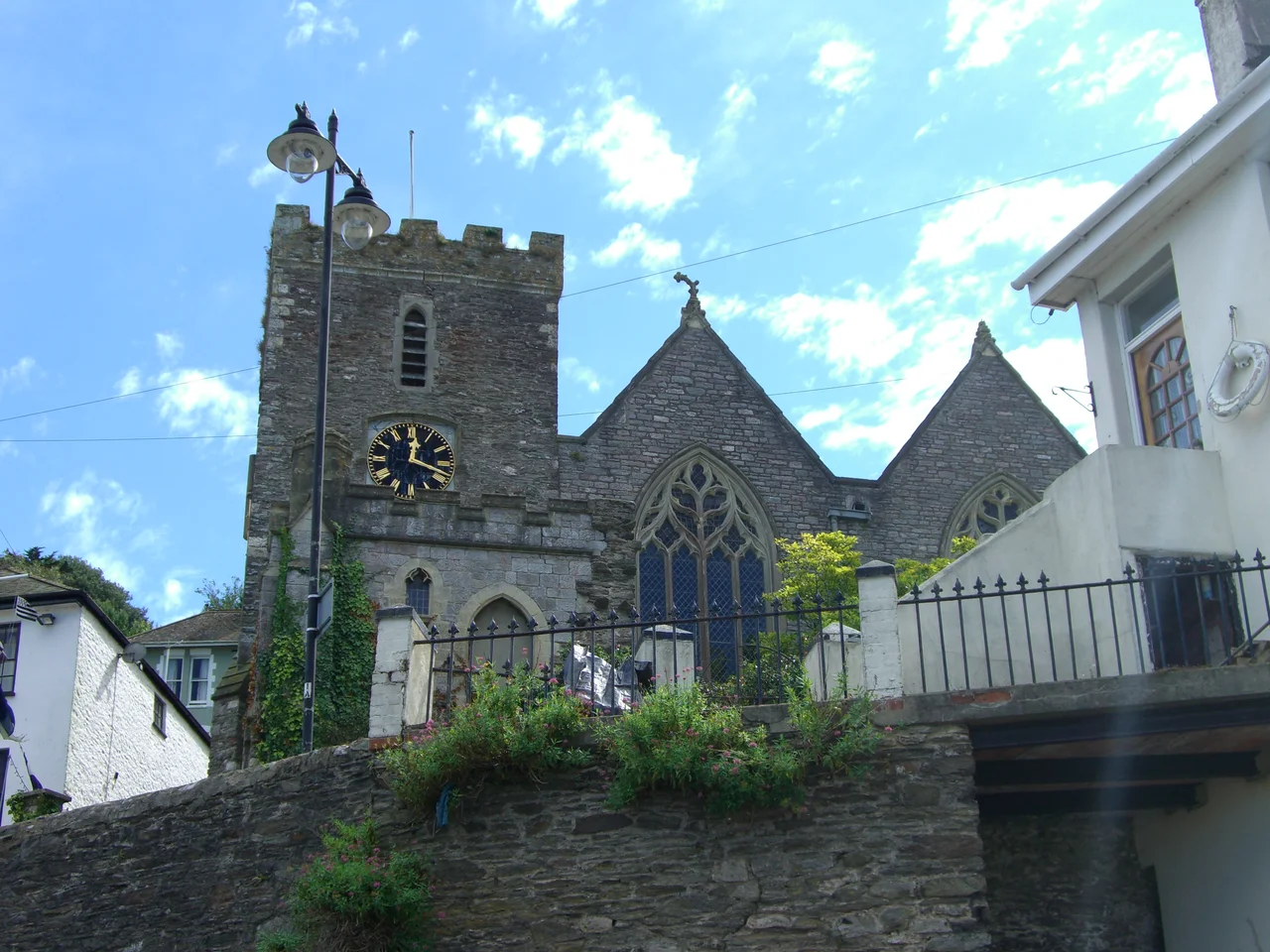

Church of St Thomas of Canterbury, Kingswear
On 29 December 1170, four knights of King Henry II walked into Canterbury Cathedral and hacked Archbishop Thomas Becket to death at the foot of the steps to the choir. The shock travelled across Europe and ignited an extraordinary wave of popular piety. The dead archbishop was canonised in 1173, his shrine became the most visited in England, and across the country new churches and chapels were dedicated to him. One of them was at Kingswear, on a steep hillside above the River Dart, where a chapel went up on land owned by the de Vasci family since the Norman Conquest. The tower of that chapel still stands. Some local historians think it was built to do two jobs, holding bells and stopping raiders, and looking at its narrow staircase and chimney flue you can see why.
A Becket Chapel
The earliest deeds for the church are kept in the records of Totnes Priory and date to about 1173, three years after the murder and the same year Becket was made a saint. In one of them, William de Vasci and his wife Juliana gave half the land of "Kingeswere" to a deacon named Richard and his successors, for the maintenance of "a chapel founded in honour of the Blessed Thomas the Martyr." The signatures and seals around the document name twelfth-century witnesses in their full medieval spellings: Michael de Spichewiche, Garinus de Morcell, Willelmus Daggevile, Robertus le Bastard. The chapel was placed under Totnes Priory, and the priests serving Kingswear were drawn from the priory monks. In 1196, Walter de Vasci, William's son, gave the rest of the family's Kingswear lands to a brand-new house, Torre Abbey, founded that year by William de Brewer. By 1253, Torre Abbey owned the church outright, along with seven other manors and churches in south Devon.
The Murderer's Descendant
There is a coffin lid in the church with a story attached. In 1280, a Brother Philip is recorded as a witness on a local deed. He is thought to have been Philip Fitzurse, a descendant of Reginald Fitzurse, one of the four knights who had murdered Thomas Becket in 1170. That a Fitzurse descendant would end his life as a brother associated with a church dedicated to Becket is a piece of medieval moral history worth pausing on. The original inscription around the stone, recorded in 1755 by the antiquary Jeremiah Milles, read: "You who pray here for the soul of Philip shall have thirty days pardon as a reward." During a Victorian rebuilding of the church between 1845 and 1847 the stone was turned out into the churchyard, where it lay among weeds at the east end for nearly a century, weathering. By 1939 its condition worried local people, and the Reverend F. H. Keyworth, vicar from 1935 to 1955, brought it back inside. It now rests on the left of the Lady Chapel, the lettering barely legible.
Henry VIII and the Plague
When Henry VIII broke with Rome and the 1534 Act of Supremacy gave him authority to dissolve the monasteries, the Kingswear lands held by Torre Abbey became Crown property. Torre Abbey was dissolved in 1539, and Kingswear Church was placed under the parish of Brixham. A parchment dated 22 February 1544, kept by the Feoffees of Crediton, records the grant by Henry VIII to one Thomas Gale of the manor of Kyngeswere, formerly held by the dissolved abbey, for the price of ninety-three pounds and twenty pence, along with rights of court, the assize of bread, wine, and beer, tolls from fairs, and "liberty of warren." The arrangement made Kingswear a chapel of ease for Brixham, and Brixham's vicar was responsible for supplying a priest. The records thin from there. The dark exception is 1604, when plague swept the village. One hundred and forty-five people died, each marked in the parish register with the letter P, a fearful, repetitive scratch of ink across the page.
The Tower That Might Be a Keep
When the church was rebuilt in 1845-47, the old tower was kept. It dates from about 1173, the chapel's original century, and it has features that go beyond ordinary medieval bell-tower design. According to the antiquary Charles Cox, Norman church towers in counties that suffered border raids sometimes carried a defensive role: a winding stair around a central newel, a portcullis, upper chambers with a fireplace and a flue, all designed to let villagers shelter inside if raiders appeared. The Kingswear tower has the circular stone staircase, taking two full turns to the first floor. Earlier accounts describe a fireplace on that first floor with a flue rising to the roof. The flue is still there, running from the ground floor to the top of the tower. The de Vasci family had held extensive land in Northumberland from 1093, including the barony of Alnwick, where defensive church towers were familiar. South Devon, then as later, had a long history of raids from the sea: Vikings, French, Irish. Kingswear, sitting at the mouth of the Dart, would have been an obvious target. There is no evidence of a portcullis, but the rest of the description fits. The tower may have been built to ring bells and to hold off pirates with the same masonry.
Bells, Organs, and War Dead
The church carries the small, accumulated dignity of an old parish. Three bells now ring in the tower, where four once hung; one was sold in 1767 to pay for a clock. The treble and second were cast around 1599 by Thomas Birdall of Exeter, the tenor recast in 1939 by John Taylor and Company of Loughborough. The bells were set into a six-bell frame in the hope of adding three more, which has not yet happened. The clock dates from 1897, paid for by village subscription to mark the sixtieth anniversary of Queen Victoria's accession. The carved wooden pulpit, dating from 1921, was a gift from the late Bishop William Boyd Carpenter; the oak choir stalls came the same year from Sir Thomas Leonard. A stained-glass window of St Michael near the organ commemorates Commander Valentine Gibbs, who took part in the Zeebrugge Raid of 1918 and is buried in the church cemetery. A second memorial honours Lieutenant-Colonel H. Jones, killed at Goose Green in the Falklands War in 1982 and posthumously awarded the Victoria Cross. The graveyard runs down toward the river. Below it, the Lower Ferry crosses to Dartmouth, the railway station sits at the water's edge, and the Dart slides past as it has done since long before the chapel was built.
From the Air
The Church of St Thomas of Canterbury sits at 50.348 degrees north, 3.572 degrees west, on the elevated village edge of Kingswear on the east bank of the Dart estuary opposite Dartmouth. From the air, look for the narrow opening of the Dart between Dartmouth Castle to the southwest and Kingswear Castle to the southeast; the village climbs the steep east bank, with the church near the top above the railway station and Lower Ferry. Exeter Airport (EGTE) is roughly 28 nautical miles north-northeast. A coastal track at 2,000-3,000 feet gives clean views of both banks of the estuary; sea fog from the south can develop quickly in the narrow Dart valley.
Nearby Stories
- St Germans Priory 7.6 km away
- Launceston, Cornwall 9.6 km away
- Castle Drogo 12 km away
- HMS Formidable (1898) 17 km away
- Siege of Lyme Regis 19 km away
- Battle of Plymouth (1652) 40 km away
- German Submarine U-672 48 km away
- Goonhilly Satellite Earth Station 69 km away