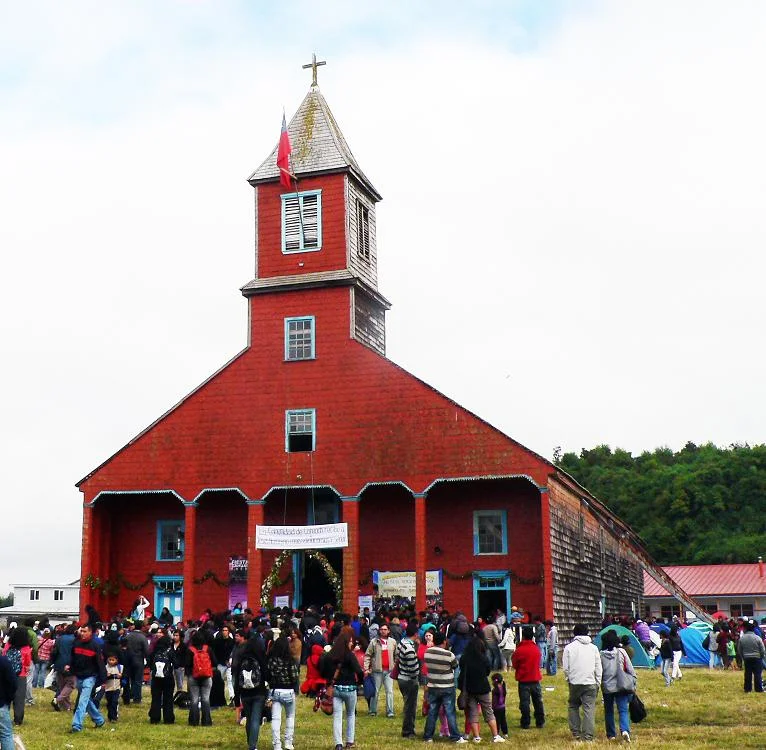

Churches of Chiloé
The carpenters who built these churches knew boats first. Look up inside any of them and the ceiling curves overhead like an upturned hull, the beams jointed and pegged the way a fishing vessel is framed, because the same hands shaped both. Scattered across the islands of the Chiloé Archipelago, some seventy wooden churches stand against a climate of near-constant rain, their walls and towers clad in small overlapping shingles. Sixteen of them carry UNESCO World Heritage status, and together they form something found nowhere else on Earth: a tradition of all-timber ecclesiastical architecture, invented at the foggy southern edge of the Spanish empire by farmers, fishermen, and sailors.
The Circular Mission
The story begins with the Jesuits, who reached Chiloé in 1608 and faced a problem of geography. Their flock was scattered across dozens of islands separated by cold, unpredictable water, far too dispersed for a parish priest in every village. Their answer was the misión circular, the circular mission: a small band of priests who sailed a fixed annual circuit around the archipelago, stopping a few days in each community to baptize, marry, and say Mass before moving on. In each place they left behind a church, built jointly with the local people, that the community itself would tend in the long months between visits. When the Jesuits were expelled in the eighteenth century, the Franciscans took up the same circuit, and the churches kept rising.
A Marriage of Two Cultures
What grew out of that arrangement was genuinely new. The Spanish missionaries brought European church forms, the basilica plan, the bell tower, the portico, but they had no European masons and no European stone. The building had to be done by the people of Chiloé in the only material the island offered in abundance: wood. The indigenous Huilliche and the mestizo population that followed brought their own deep knowledge of timber, and the two traditions fused. Scholars call the result an outstanding example of mestizo culture, a true blending rather than one culture imposed on another. The churches look European in outline and entirely Chilote in substance, down to the last shingle.
Built Like Ships
Metal was scarce and expensive on the islands, so the carpenters did what they did with their boats: they joined wood to wood. Reinforced wooden joints and pegs hold the great frames together, with iron nails used sparingly if at all, mimicking the techniques of shipbuilding. The vaulted ceilings echo the curve of a hull. The exteriors are sheathed in tejuelas, hand-split shingles cut from native alerce and larch, layered like scales to shed the rain and shaped along the eaves into patterns. These were not cathedrals raised by guild masons. They were raised by the men who, the rest of the year, framed fishing vessels and rowed the cold channels between the islands.
Sixteen Survivors
The World Heritage listing of 2000 singled out sixteen churches as the finest survivors, most of them clustered in the central-eastern zone of the archipelago: Achao and Quinchao, among the oldest; the towering yellow San Francisco in Castro; Rilán, Nercón, Aldachildo, Ichuac, Detif, Vilupulli, Chonchi, Tenaún, Colo, San Juan, Dalcahue, Chellín, and the remote island church of Caguach. Achao's church is generally reckoned the oldest still standing on the archipelago. Each has its own proportions and palette, but all share the same logic of construction, the same shingled skin, the same boat-builder's instinct for joining wood.
Keeping the Faith Standing
Wood is mortal, and so the churches demand constant care. Fire, earthquake, rot, and the simple weight of two or three centuries of rain are perpetual threats, and several of the sixteen have needed major restoration in living memory. The Fundación Cultural Iglesias de Chiloé, together with the University of Chile and other institutions, has led the long, patient work of preserving them, training carpenters in the old joinery and resplitting shingles by hand. The effort matters because these are not relics behind glass. They remain the spiritual centers of their villages, still hosting the festivals and patron-saint days that have ordered island life for four hundred years.
From the Air
The sixteen World Heritage churches are spread across the Chiloé Archipelago, concentrated in its central-eastern zone around latitude 42.5°S, 73.77°W. From the air they appear as bright wooden towers anchoring small bayside villages on Isla Grande and the smaller eastern islands such as Quinchao and Lemuy. Castro's San Francisco is the largest and most conspicuous; the others reward low, slow flying along the sheltered eastern coast. Mocopulli Airport (ICAO SCPQ) near Dalcahue is the archipelago's main airfield, central to the church cluster; Puerto Montt's El Tepual (SCTE) is the regional gateway. The maritime climate brings persistent low cloud and rain, so clear conditions for spotting the churches are best in the austral summer.
Nearby Stories
- Ancud 38 km away
- Chaitén Volcano 41 km away
- Pumalín Douglas Tompkins National Park 54 km away
- Parque Tantauco 55 km away
- Puerto Montt 81 km away
- Los Alerces National Park 144 km away
- 1687 Peru Earthquake 3004 km away
- The Nazca Lines: Art Made for the Sky 3083 km away