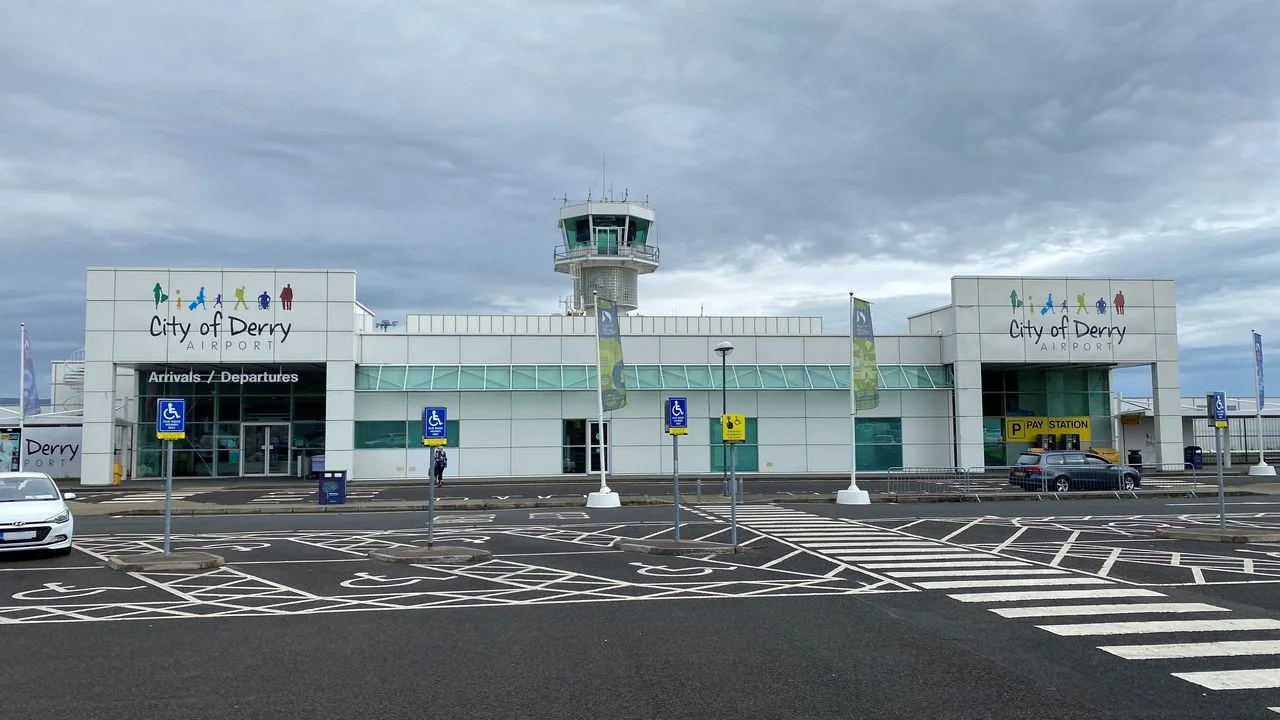

City of Derry Airport
There is a railway line that runs along the eastern shore of Lough Foyle, single track, from Belfast to Derry. At one point near Eglinton it skirts the end of a runway so closely that the airport has had to install a signalling system: no train can pass while an aircraft is taking off or landing. The aircraft are usually small - turboprops to Glasgow, occasionally a Ryanair 737 to Manchester or Birmingham. The trains are usually local. But the proximity is the airport in miniature: a working facility tucked into a tight corner of Ulster, running on slim margins, holding on year after year because losing it would cut off the entire northwest of Ireland from quick air travel.
From RNAS Eglinton to EGAE
The site was a Royal Naval Air Station during the Second World War, known as RNAS Eglinton, used in the Battle of the Atlantic to fly Fleet Air Arm fighters that escorted convoys from the deepwater port at Derry. After the war it became a NATO base during the Cold War's North Atlantic operations - a forward post for tracking Soviet submarines coming around Iceland into the Atlantic gap. The Royal Navy decommissioned the station in the 1960s. Derry City Council bought the airfield with the goal of improving transport for the northwest of Ireland. Scheduled flights began in 1979 when Loganair launched the Derry-Glasgow route - the only scheduled service for a decade. A Manchester route was added in 1989. The airport's ICAO code, EGAE, still encodes the original Eglinton name, and so does the official UK Aeronautical Information Publication; the marketing name City of Derry was adopted by the council in the early 1990s but the air-traffic-control name has lagged behind.
The £10 Million Upgrade
From 1989 to 1993 the council undertook a major redevelopment with European Regional Development Fund support, spending £10.5 million on runways, taxiways, access roads, navigation equipment, lighting, a purpose-built terminal, and a new fire station. The terminal opened in March 1994. The single serviceable runway is short by jet standards. Until safety zones at each end were extended in the late 2000s, Boeing 737 operators had to limit themselves to 80 percent of passenger capacity for takeoff. In May 2006 the European Commission approved a €15 million joint British-Irish investment to extend the safety zones - which required, before the work began, the compulsory purchase of several family homes at the runway ends. The capacity restriction was lifted in 2009. Ryanair launched its first international route from the airport that year, to Alicante.
The Carousel of Carriers
The story of City of Derry Airport since 2010 reads like an air-transport carousel: routes appear, disappear, return under different airline brands, vanish again. Ryanair axed Alicante and Birmingham in 2014, Faro in 2016, London Stansted in 2017. Flybmi took over Stansted with 13 weekly flights from 2017 to its collapse in February 2019. Ryanair replaced Glasgow with Edinburgh in October 2018, prompting Loganair to resume Glasgow after a decade away. After flybmi's collapse, Loganair added Manchester. Loganair dropped Manchester in early 2020, swapped Stansted for Southend then swapped back. In December 2020 the post-Brexit rules on UK-registered aircraft forced Ryanair to drop all UK-to-non-EU routes from the airport. Loganair launched Liverpool to replace what Ryanair had lost. Ryanair returned to Manchester in December 2021. Loganair dropped Edinburgh in January 2023, then Liverpool in October 2023. Ryanair returned to Birmingham in January 2024. easyJet arrived for the first time in November 2024 with Edinburgh and Liverpool, took over Birmingham from Ryanair in April 2025, and is now the largest carrier at the airport by destinations served. Through all of this the airport has stayed open.
Why It Survives
Derry is roughly 65 miles from Belfast International, 70 miles from Belfast City, and 130 miles by road from Dublin. For travellers in the northwest of Ireland - both Northern Ireland counties and the Republic's Donegal - City of Derry is by far the most convenient airport. The Northern Ireland Executive has agreed multimillion-pound funding packages on more than one occasion, including a successful 2017 public service obligation application that kept the London Stansted route alive when Ryanair pulled out. Derry City Council, which owns and operates the airport, began the process of privatisation in October 2009 but never completed it. In 2010 it discussed a management contract with Balfour Beatty. None of those plans converted into private ownership. The airport remains a council asset, periodically running at a loss, periodically rescued, and stubbornly indispensable. A small museum at the airport commemorates Amelia Earhart, who landed near Derry in 1932 to complete the first solo transatlantic flight by a woman - she had been aiming for Paris but came down in a field at Ballyarnett. Her name graces the airport's business lounge. Derry has been on the global aviation map, in one form or another, since she touched down.
From the Air
City of Derry Airport sits on the eastern shore of Lough Foyle at 55.043 N, 7.162 W, with the single runway oriented roughly 08/26. The ICAO code is EGAE, with the official Aeronautical Information Publication name still given as Londonderry/Eglinton. The airport is six miles north-northeast of Derry city centre. Belfast International Airport (EGAA) lies sixty miles east-southeast. The Belfast-Derry railway line of Northern Ireland Railways runs immediately past the northeastern end of the runway - a signalling interlock prevents trains from passing during aircraft operations. From altitude, look for the airport at the southern edge of Lough Foyle, immediately northeast of the village of Eglinton.
Nearby Stories
- Killowen Castle 2.7 km away
- Castledawson 11 km away
- Creeslough Explosion 11 km away
- German submarine U-218 12 km away
- Gortin 15 km away
- SS Devonian (1900) 22 km away
- St Patrick's Purgatory 28 km away
- Port Ellen Distillery 42 km away