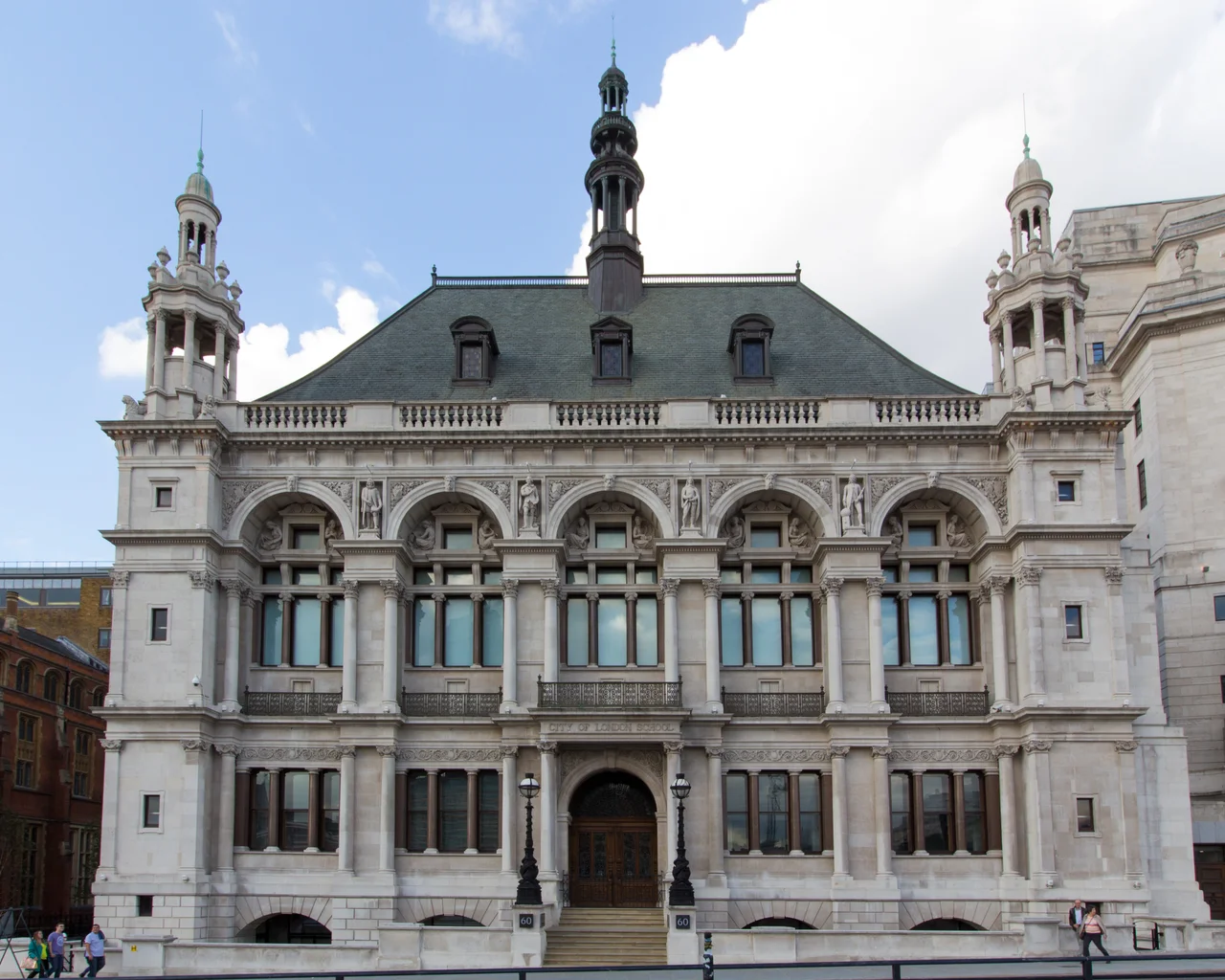

City of London School
John Carpenter died in 1442 leaving land to two trusted friends, and the instructions whispered between them changed centuries of London childhood. The Town Clerk of the City had not written formal directions to educate poor boys, but those friends knew his wishes. The land passed along, the words were copied into a new will, and four poor men's children were to be fed, clothed, and "learning at the schools, in the universities, etc., until they be preferred, and then others in their places for ever." Five hundred and eighty years later, that bequest still buys education on the banks of the Thames, in a red-brick building where Daniel Radcliffe once sat at a desk and stared across the river at Tate Modern.
Carpenter's Children
For three centuries the four scholars known as Carpenter's Children moved quietly through London's history. A small college was founded next to Guildhall Chapel around 1460. The Chantries Act of 1547 forfeited the chapel and ended their funding, but the Corporation of London kept the bequest alive, spending it on coats and bits of schooling. Nobody could find Carpenter's will, and his real intentions stayed buried in another man's testament. By 1823 the Charity Commission discovered that the income had vastly outgrown the costs of those four boys. The Corporation searched the archives, found nothing, and finally chose to spend the surplus the only sensible way: open a school for as many London boys as it could fit. An act of Parliament in 1834 made it formal. The City of London School was born from a centuries-old conversation that nobody quite remembered having.
Three Buildings, One Idea
The school moved three times, and each move told something about the city around it. The first home opened on Milk Street in 1837, a neo-Gothic Tudor design by J.B. Bunning. By 1883 it had outgrown that site, and the school crossed to the Victoria Embankment into a grand pile by Davis and Emanuel that cost more than £100,000, with a steep pitched roof more French chateau than Italian Renaissance. That building still stands, occupied later by JPMorgan, and London Underground audiences once saw it every evening as the leftmost building in the Thames Television ident. In 1986 the school made its boldest move yet, to a wholly modern building on Queen Victoria Street designed by Old Citizen Thomas Meddings. The architects had to design around a road tunnel running through the centre of the site, which is why a courtyard climbs up through five floors above the road below.
A Boy from Tottenham, A Wizard from Surrey
Old Citizens, as alumni are called, fill more than 140 entries in the Oxford Dictionary of National Biography. Prime Minister H.H. Asquith walked these halls. So did Nobel laureates Frederick Gowland Hopkins and Peter Higgs, the physicist who predicted the boson that bears his name. Booker Prize winners Kingsley Amis and Julian Barnes were taught here. England cricket captain Mike Brearley played his early games on Old Citizen turf. William Henry Perkin, the eighteen-year-old who accidentally invented synthetic mauve dye in 1856 and made the modern chemical industry possible, was a pupil. In the modern era the names skew toward film: Daniel Radcliffe arrived as Harry Potter casting was already underway; Skandar Keynes appeared in The Chronicles of Narnia; Joe Alwyn in The Favourite. The school's front view by the Thames shows up briefly in Half-Blood Prince, which feels like a small joke shared between building and pupil.
Boys in Marlborough
On 1 September 1939, after Germany invaded Poland, the headmaster F.R. Dale executed a plan he had quietly made the year before. The boys of City of London School were placed on trains and evacuated to Marlborough College in Wiltshire. The agreement had not included accommodation, so the headmaster of Marlborough wrote to the mayor begging for billets in town. Most lodgings were already full of soldiers and Ministry of Health workers. The first night the displaced London boys slept on the floor of the Marlborough gymnasium, in a town that was suddenly host to two schools. The next day, families took them in. The school spent the war years split between London and Wiltshire and returned to a city pocked with bomb craters.
A Million-Selling Chorister
In 1920 the school made an arrangement that quietly shaped twentieth-century English music. Every boy chorister of Temple Church would be given a scholarship to City of London School. In 1926 the same arrangement was extended to the choristers of the Chapel Royal at St James's Palace. One of those Temple Church boys, Ernest Lough, recorded Mendelssohn's "O for the Wings of a Dove" in 1927. By 1962 it had become the first classical record to sell over a million copies, his pure soprano carrying across phonographs in living rooms from Toronto to Sydney. The cellist Steven Isserlis came through the same chorister pipeline decades later. The Great Hall still houses a Walker organ moved from the Victoria Embankment building, three manuals, 43 stops, the same instrument that accompanied generations of those voices. On Queen Victoria Street, next to the Millennium Bridge, the music continues.
From the Air
Located at 51.5114 degrees N, 0.0989 degrees W on the north bank of the Thames, opposite Tate Modern. The school is the modern red-brick building immediately west of the Millennium Bridge, with St Paul's Cathedral dome rising just to the north. Nearest airports: London City (EGLC) about 7 nm east, Heathrow (EGLL) about 14 nm west. Best viewed from 2,000 to 4,000 feet on a southern approach over central London.
Nearby Stories
- Stevenage 5.7 km away
- Malling Abbey 5.7 km away
- 1952 Farnborough Airshow Crash 7.7 km away
- Ingatestone Hall 8.2 km away
- Hellfire Caves 9.1 km away
- The Carrington Event: The Solar Storm That Could Happen Again 9.8 km away
- Bletchley Park 16 km away
- Castle Hedingham 23 km away