
City of Norwich Aviation Museum
In October 2020, a crane lifted a 21-year-old Avro RJ85 regional jet over the new Northern Distributor Road and set it down on the museum side. The aircraft, registration EI-RJN, had flown until recently for CityJet, an Irish regional airline. Now it was retired, and the City of Norwich Aviation Museum wanted it, and the only way to get it past the ring road that had recently been cut across the area was to lift it. So they did. The RJ85 joined a collection that includes an Avro Vulcan B.2, an English Electric Lightning F.53 that once belonged to the Royal Saudi Air Force, and the recovered cockpit of a Supermarine Scimitar, all of them assembled in a corner of the former RAF Horsham St Faith airfield on the northern edge of what is now Norwich International Airport.
Horsham St Faith Heritage
The museum sits on the ground where Norfolk's most active wartime airfield once operated. RAF Horsham St Faith was home to the USAAF 458th Bombardment Group during the war and to RAF fighter squadrons in the early Cold War. After the RAF left, the runways became Norwich International Airport, the civilian gateway to the county. The aviation museum preserves not just the aircraft but the layered history of the site: the 458th Bomb Group exhibits commemorate the American crews who flew B-24 Liberators from here against Germany; the Norwich International Airport displays trace the postwar transition; the No. 68 Squadron RAF and RAF Horsham St Faith exhibits cover the years in between.
The Vulcan and the Lightning
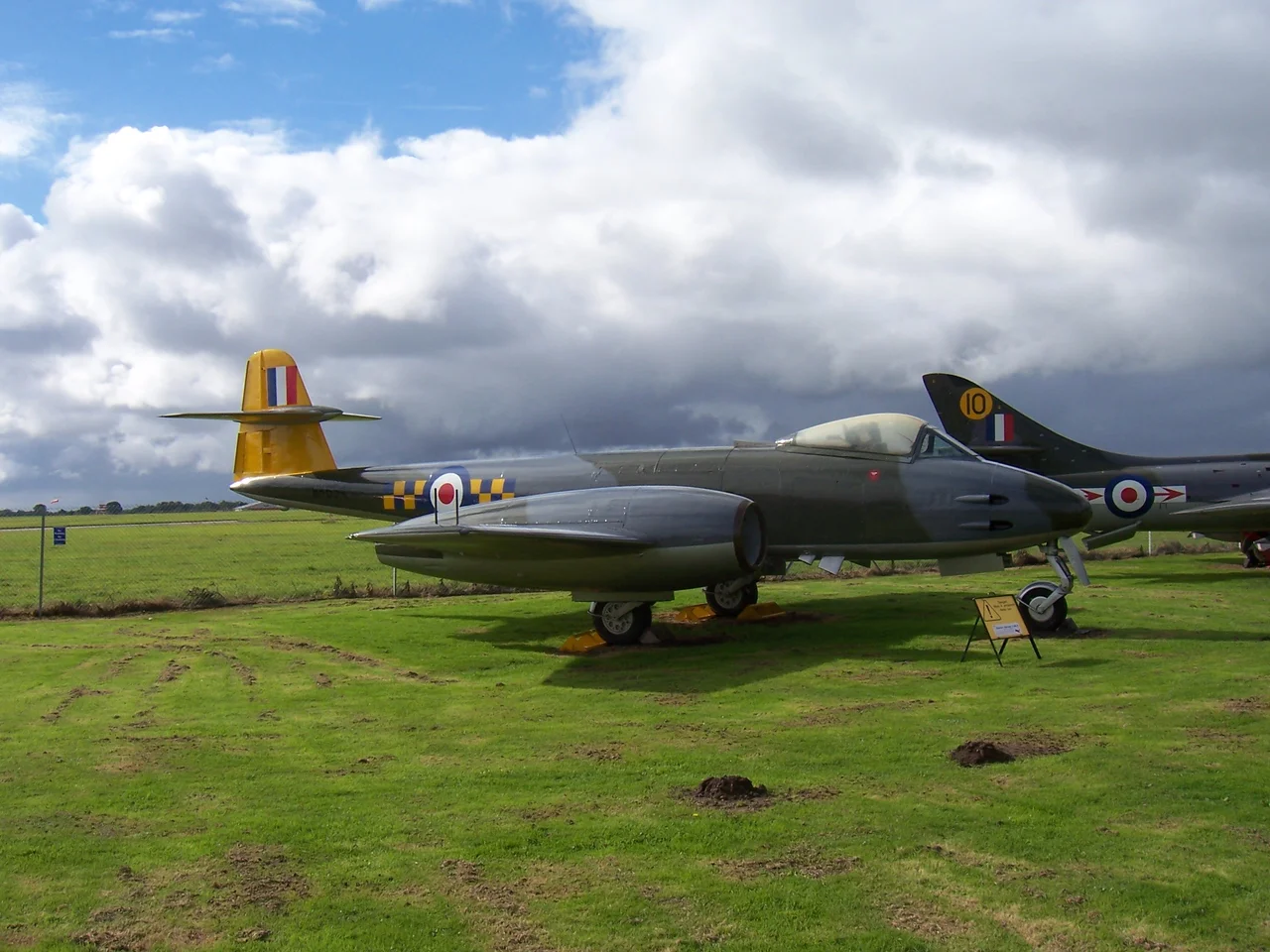
The Avro Vulcan B.2, registration XM612, is one of the most recognizable aircraft in British aviation history. The delta-winged strategic bomber, built to carry Britain's nuclear deterrent through the 1960s and 1970s, has a presence on display that few other aircraft can match. Beside it stands the English Electric Lightning F.53, the export version of Britain's supersonic interceptor, this one having served with the Royal Saudi Air Force as 53-686 before retirement. The Lightning was one of the few aircraft ever designed for vertical climb at intercept speeds. Other British Cold War types in the collection include the Blackburn Buccaneer S.1 (cockpit only), the Hawker Hunter F.6A, the Hawker Siddeley Harrier T.4N, the Hawker Siddeley Nimrod MRA.2, and the SEPECAT Jaguar GR.1.
The Fenland Rescue
In 2022 the Fenland and West Norfolk Aviation Museum closed. Its collection would have been scattered or lost. The City of Norwich Aviation Museum stepped in to absorb the entire collection, and began building a new 260-square-meter expansion called Fenland Hall to house it. The rescue is a familiar pattern in the world of small specialist museums: a closure here, an absorption there, the volunteers redistributing the work and the artefacts to keep the history visible. The new hall lets the rescued material be displayed properly rather than crammed into the existing buildings.
Engines Under Glass
Aircraft are the headline exhibits, but the museum's engine collection deserves its own tour. There is a sectioned Rolls-Royce Avon and an Allison 250-C20B turboshaft cut away to show its compressor stages. There are Rolls-Royce Derwents and Nenes from the early jet age, a Rolls-Royce Merlin, the V-12 piston engine that powered the Spitfire and the Mustang, a Rolls-Royce Pegasus, the vectored-thrust engine that made the Harrier jump jet possible, and a Turbo-Union RB199 from the Tornado. American power is represented by the Allison J33; German engineering legacy via the Hispano-Suiza license-built Rolls-Royce Nene. For visitors who want to understand why aircraft fly, the engine room may be more illuminating than the airframes outside.
The Volunteer Model
Like the Norfolk and Suffolk Aviation Museum across the county at Flixton, the City of Norwich Aviation Museum runs on volunteer labor. The aircraft outside need constant attention. British weather is hard on metal, paint, and rubber, and an airframe parked outside for a decade requires endless rust prevention, sealing, and touch-up. The exhibits inside need updating, the visitors need guiding, the events need running. There is no large institutional budget. The 458th Bombardment Group exhibit, the No. 100 Group Royal Air Force display, the various RAF station histories, all of it depends on enthusiasts choosing to spend their weekends here rather than somewhere else. The work shows.
From the Air
City of Norwich Aviation Museum sits at 52.6802 degrees north, 1.276 degrees east, on the northern edge of Norwich International Airport (EGSH), reached through the village of Horsham St Faith. The museum's airspace is constrained by the active commercial airport adjacent to it. Recommended viewing altitude is 2,000 to 3,000 feet AGL outside the controlled zone to identify the Vulcan, RJ85, and other outdoor exhibits arranged on the museum grounds. The former RAF Horsham St Faith runway layout is clearly visible as Norwich International Airport's modern runway.
Nearby Stories
- Sheringham 2.7 km away
- Wingfield Castle 4.4 km away
- Castle Acre Castle and Town Walls 6.3 km away
- Brancaster 7.1 km away
- West Stow Anglo-Saxon Village 9.3 km away
- Four Days' Battle 80 km away
- Battle of Lowestoft 80 km away
- SM U-97 110 km away