_13.jpg)
Clockmakers' Museum
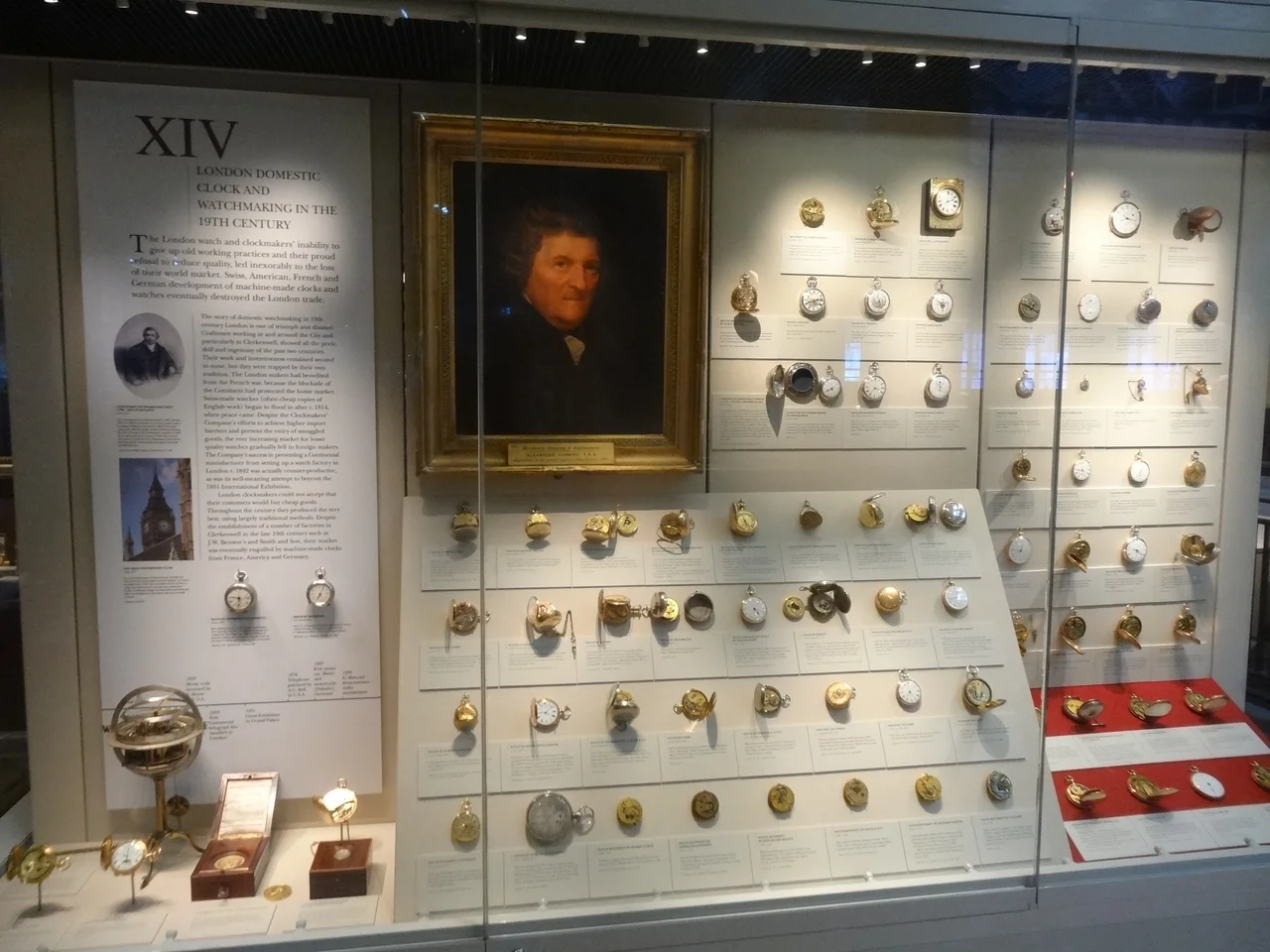
John Harrison spent forty years of his life trying to win a prize. The British government had offered a fortune in 1714 to anyone who could solve the longitude problem, the navigational riddle that had drowned sailors for centuries. Harrison's answer was a watch. His fifth and final timekeeper, H5, sits today in a hushed gallery on the second floor of the Science Museum in South Kensington, surrounded by 660 other watches and the curious tools that built them. This is the Clockmakers' Museum, the oldest collection of clocks and watches anywhere on Earth, and it began in 1814 when a London livery company decided to keep some books.
The Bureau and the Bookcase
The Worshipful Company of Clockmakers received its royal charter from Charles I in 1631, making it the oldest horological body in continuous existence. For nearly two centuries it was a trade guild rather than a museum. Then in 1814 the Company formed a library committee, and a quiet man named Benjamin Lewis Vulliamy emerged as its driving force. Early meetings happened in Vulliamy's premises on Pall Mall, but by 1817 the Company needed somewhere to put the books. They commissioned a mahogany bureau and bookcase from Gillows of Lancaster, placed it in an upper room of the King's Head Tavern in Poultry, and unwittingly started a museum. Within a year the bureau was holding more than books. Vulliamy bought a set of pallets from an Alexander Cumming escapement at auction. The shift had begun, from words about clocks to the clocks themselves.
Harrison's H5
The most important acquisition came in 1891, when the Reverend Harry Leonard Nelthropp persuaded the Company to buy John Harrison's fifth marine timekeeper. To understand why this matters, picture a ship pitching in the Atlantic in 1714, the captain knowing his latitude from the sun but having no reliable way to know how far east or west he had travelled. Ships ran aground because they could not place themselves on a map. Harrison, the son of a Yorkshire carpenter, devoted his life to a mechanical solution: a clock so precise that, set to Greenwich time and compared against local noon, it would reveal longitude. H1 through H4 had refined the design across decades. H5 was the final perfection, accurate to seconds across an ocean voyage, the kind of object that quietly redrew the world. Three years later Nelthropp donated his entire personal collection of watches, sundials, and seals to the museum.
Tompion, Graham, Breguet
The collection reads like a list of horology's greatest names. Thomas Tompion, the "father of English clockmaking," is here. So is his pupil George Graham, who invented the deadbeat escapement that made pendulum clocks accurate enough to time astronomical observations. David Ramsay's star watch from the early seventeenth century survives, along with clocks by Edward East and a table clock by Samuel Knibb. There is an astronomical clock by Samuel Watson that may have belonged to Isaac Newton. Marine chronometers by John Arnold and Thomas Earnshaw, who simplified Harrison's expensive design into something a captain could afford, sit in their cases. A watch by Abraham-Louis Breguet, the Swiss-French master whose name still defines fine watchmaking, is on display. The watches were largely the work of immigrant craftsmen who arrived in London in the seventeenth century and turned the city into Europe's horological capital.
Edmund Hillary's Wristwatch
Among the precision instruments sits a more modest object: a Smiths wristwatch. Sir Edmund Hillary wore it to the summit of Mount Everest on 29 May 1953. The watch worked at minus thirty degrees, in oxygen-thin air no clock had ever been asked to keep time in. Smiths, a British company, used the achievement in advertising for years afterward. Nearby, a more contemporary master watchmaker is represented: George Daniels, who reinvented the mechanical watch in the late twentieth century with his co-axial escapement and built every component of his masterpieces by hand. His Space Traveller watch, on loan, calculates sidereal time, the position of the sun, and the equation of time. Daniels was also a former Master of the Clockmakers' Company. Past and present touch each other through these cases.
Guildhall to South Kensington
For 141 years the collection lived in the Guildhall complex in the City, where it had opened to the public in 1874. In 2015 it moved across London. The Company's lease at Guildhall had expired, and Sir George White, who had served as Keeper since 1988, negotiated a new home with Ian Blatchford of the Science Museum. The collection was transported through 2014 and 2015, and the new gallery, more than twice the size of the old one, opened on 22 October 2015. Princess Anne cut the ribbon. The numbers tell the rest of the story. At Guildhall the museum had drawn about 13,000 visitors a year. The Science Museum receives over three million annually, and tucked between Zaha Hadid's Mathematics Gallery and the Science City exhibition is the world's oldest collection of clocks, free to visit, still ticking.
From the Air
Located at the Science Museum, Exhibition Road, South Kensington (51.5164 degrees N, 0.0931 degrees W). The museum sits within the Albertopolis museum cluster including the V&A and Natural History Museum. From the air, look for the dome-and-courtyard cluster south of Hyde Park and Kensington Gardens. Nearest airport: Heathrow (EGLL) about 12 nm west. Best viewed from 2,000 to 5,000 feet on a westerly approach.
Nearby Stories
- Stevenage 5.7 km away
- Malling Abbey 5.7 km away
- 1952 Farnborough Airshow Crash 7.7 km away
- Ingatestone Hall 8.2 km away
- Hellfire Caves 9.1 km away
- The Carrington Event: The Solar Storm That Could Happen Again 9.8 km away
- Bletchley Park 16 km away
- Castle Hedingham 23 km away