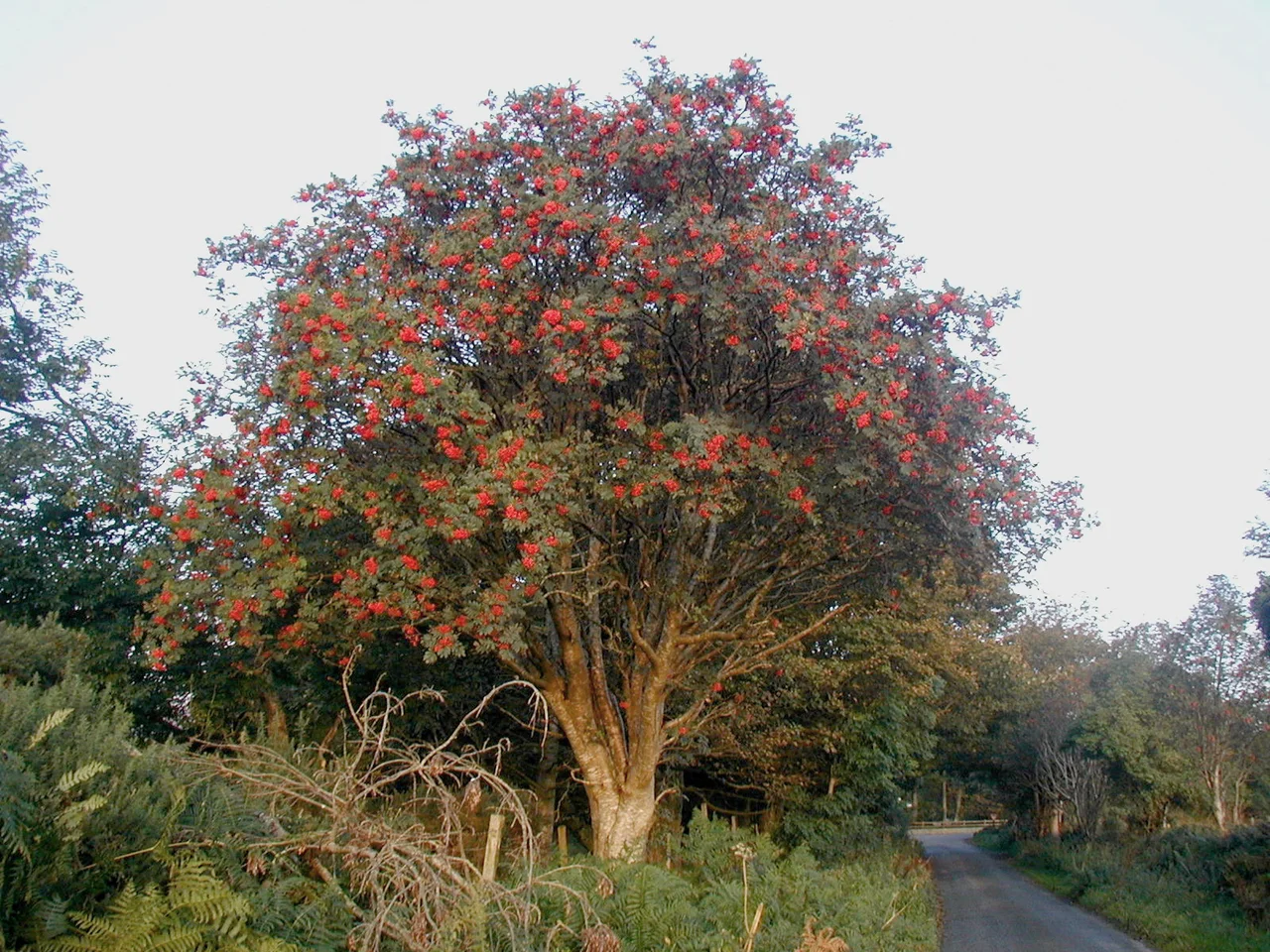

Cloghanecarhan
The inscription is in ogham - rows of straight lines cut across an edge of slate, each pattern of strokes standing for a letter in the earliest written form of Irish. The stone is just over two metres tall, the inscription scratched into it sometime around AD 600. It reads, when scholars decode the strokes: 'of Ec...án? son of Mac-Cáirthinn'. Underneath that, faintly visible, is an older inscription that someone tried to erase to make room for the newer one. The name Mac-Cáirthinn means 'devotee of the rowan tree', the small mountain tree the old Irish believed could ward off evil spirits. The stone leans against a ringfort that is itself older still, in a field at the western edge of the Iveragh Peninsula, 7.2 kilometres south-southeast of the town of Cahersiveen.
What Ogham Is
Ogham is one of the oldest written forms of any Celtic language, used in Ireland from roughly the 4th to the 7th centuries AD. The script uses groups of straight lines - one to five strokes - cut perpendicular to or angled across a central stem line, usually the edge of a standing stone. Each combination represents a letter of an alphabet developed specifically for Old Irish or Primitive Irish. Most surviving ogham inscriptions are short memorial texts: someone's name, often described as the son or descendant of someone else. About 400 ogham stones are known across Ireland and parts of western Britain, with the greatest concentration in counties Cork and Kerry. They mark the transition from a non-literate society into a literate one, just before the Christian church brought Latin and the round-backed Insular script to Ireland in earnest.
The Overwritten Stone
The Cloghanecarhan stone has something unusual: two inscriptions, one over the other. The visible inscription - the one most easily read - is EQQẸGGNỊ [MA]Q̣[I] ṂẠQI-CAṚATTỊNN. The cataloguers of the Corpus Inscriptionum Insularum Celticarum gave it the number CIIC 230. The grammar of the visible inscription suggests a late date, around AD 600, near the end of the active use of ogham as a memorial script. Beneath it, on the same edge, are traces of an earlier inscription, partly damaged and partly scraped away: D[... ]A[.C.] AVI DALAGNI [MAQI C--. Someone, sometime after the original was carved, decided that the stone was needed for a new memorial and worked over the old one. It is the closest thing the early Irish left us to a palimpsest - reused writing on stone, a fragment of one family's record erased to make room for another's.
The Devotee of the Rowan
The name Mac-Cáirthinn that appears in the inscription means literally 'son of the rowan'. The rowan tree - sorbus aucuparia, the mountain ash - was sacred in Irish folk tradition, believed to ward off witches and malevolent spirits. The early Irish often took names like this, ones that linked the person to a sacred tree or animal or natural feature. A version of the same name, MAQI-CAIRATINI, appears on another ogham stone in Painestown, County Meath, hundreds of kilometres away. This suggests the name was widespread among the early Irish elite. The man buried or commemorated at Cloghanecarhan was the descendant of a Mac-Cáirthinn - a member of a family that traced itself back to the rowan tree.
The Ringfort and Its Pieces
The ogham stone originally stood at the eastern entrance of the ringfort, the cashel, that it shares the site with. It has since been moved, and it now lies on the north side. The ringfort itself is circular, enclosed by an earthen bank with an entrance at the east and stone pillars at the western end. Inside the bank are the remains of a small circular hut, three leachta - low rectangular stone cairns of the kind used for early Christian devotional purposes - and a souterrain, an underground passage probably used for storage and refuge. There is also a cross slab, marking the transition from pagan to Christian use of the site. Cloghanecarhan was apparently used as a Christian burial ground after the ogham era, which is how the ogham stone came to be repurposed and overwritten with later inscriptions.
What the Townland Name Says
Even the name Cloghanecarhan carries layered meanings. The first element, cloghan, can mean either 'ford of stepping-stones' - a reference to crossing the small Direen stream that runs nearby - or 'stone beehive hut', the small corbelled stone shelters built by monks and herders in early medieval Ireland. The ringfort contains the remains of just such a hut. Both meanings could be right; this is how Irish placenames work. The ringfort was known locally as Keeldarragh, an older Irish name now slipped almost out of use. Cloghanecarhan is a place where multiple eras of Irish history have piled up on each other in a single field. The ogham stone is the oldest writing here. Everything else - the ringfort bank, the souterrain, the Christian burials, the rowan-tree name - either preceded it or followed it onto the same small patch of ground.
From the Air
Cloghanecarhan sits at 51.888°N, 10.184°W, on the western end of the Iveragh Peninsula 7.2 km south-southeast of Cahersiveen. The site is a small ringfort in pastureland and is difficult to spot from the air without prior reference - look for a low circular enclosure in fields just inland from the coast. Best visual approach at 1,500-2,000 ft AGL in clear conditions. The terrain rises gently east of the site toward the central peaks of the Iveragh. Nearest airfields: Kerry (EIKY) about 35 nm north-east, Cork (EICK) about 80 nm east. Atlantic weather builds in fast from the west - Valentia Observatory is 10 nm north-west and reports cover this area directly.
Nearby Stories
- Castleisland 3.2 km away
- Mountains of the Central Dingle Peninsula 4 km away
- Allihies Copper Mine Museum 4.9 km away
- Kilgarvan 5.8 km away
- Inishvickillane 12 km away
- Ballydehob 15 km away
- RMS Carinthia (1925) 113 km away
- Sao Miguel 1937 km away