.jpg)
Clontarf
On Good Friday, 23 April 1014, two armies met on a stretch of flat ground at the mouth of the Tolka river, two miles north of the centre of what would become Dublin. On one side stood Brian Boru, High King of Ireland, with the forces of Munster, Connacht, and South Leinster. On the other stood Sigtrygg Silkbeard, Norse king of Dublin, the rebellious northern Leinstermen under Mael Morda, and Norse mercenaries from Orkney and the Isle of Man. The battle that followed lasted from sunrise to sunset and is generally regarded as the end of Viking political power in Ireland. Brian Boru, by then in his early seventies, was killed in his tent in the moment of victory by a Danish Viking named Brodir. The Irish name of the place is Cluain Tarbh - the Meadow of the Bull. Modern Clontarf is a Dublin coastal suburb of about 30,000 people stretched along the curve of Dublin Bay. The battle is what most people know about it. The thousand years since are what give it everything else.
Brian Boru's Well
On Castle Avenue, near the coast, there is a small water outlet set into a wall. Local tradition holds that this is the mouth of Brian Boru's well - the spring where the High King's men refreshed themselves between the morning and afternoon phases of the battle. Whether or not the identification is correct, springs in this area certainly existed in 1014, and the location is plausible for the field of fighting. The actual battle is now thought to have extended across a wide area from Ballybough in the west to Kilbarrack in the east. The myth of a single battlefield centred on the Tolka mouth oversimplifies what was probably a series of engagements spread along the coast. What is not in dispute is the symbolic weight: Clontarf 1014 became the founding story Irish nationalists reached for whenever they needed an example of Irish forces uniting against an external aggressor. It is why, eight centuries later, Daniel O'Connell chose Clontarf as the site for his greatest political gamble.
The Monster Meeting That Never Was
By 1843, Daniel O'Connell - the Liberator, who had won Catholic Emancipation in 1829 - was running a mass campaign for repeal of the Acts of Union and restoration of an Irish parliament. He organised a series of vast open-air rallies, the so-called Monster Meetings, drawing crowds of hundreds of thousands. The eighth and final one was planned for Clontarf on Sunday 8 October 1843 - the symbolism deliberate, the date chosen to invoke Brian Boru. The British Prime Minister, Sir Robert Peel, banned it the day before. O'Connell, faced with the choice of defying the proclamation and risking bloodshed, called the meeting off. The decision to obey the authorities damaged his political momentum irreparably. Within months he had been arrested and tried for conspiracy. The campaign for repeal collapsed. The Great Famine began in 1845. By 1847 O'Connell was dead. The Monster Meeting at Clontarf that never happened was, in retrospect, the moment Irish constitutional nationalism gave up on persuading the British government to grant repeal, and the long arc that would eventually lead to the 1916 Rising began.
From Fishing Village to Dublin Suburb
Clontarf began as two settlements: a small village around the manor house and church on the rise where the Clontarf Castle Hotel now stands, and a separate fishing settlement called Clontarf Sheds at the foot of Vernon Avenue, about a kilometre east. The Sheds got its name from the drying sheds where the fishermen cured their catch - mainly cod and herring - for export. In 1659 the recorded population of the whole parish was just 79 people. The Sheds eventually outgrew the original village and was absorbed into nineteenth-century Catholic and Church of Ireland parishes that survive to this day. From around 1800 Clontarf became a seaside resort for Dubliners, with hot and cold seawater baths built by a Mr Brierly, a horse omnibus service from the city, and twenty-seven major houses occupied by the kind of gentry whose 1824 Confirmation list includes four titled ladies - Lady Charlemont, Lady Caroline Clements, Lady Maria Caulfield, and Lady Emily Caulfield. A tram line was laid along the coast in the late nineteenth century. The seaside resort gradually became the suburb.
The Bull Island
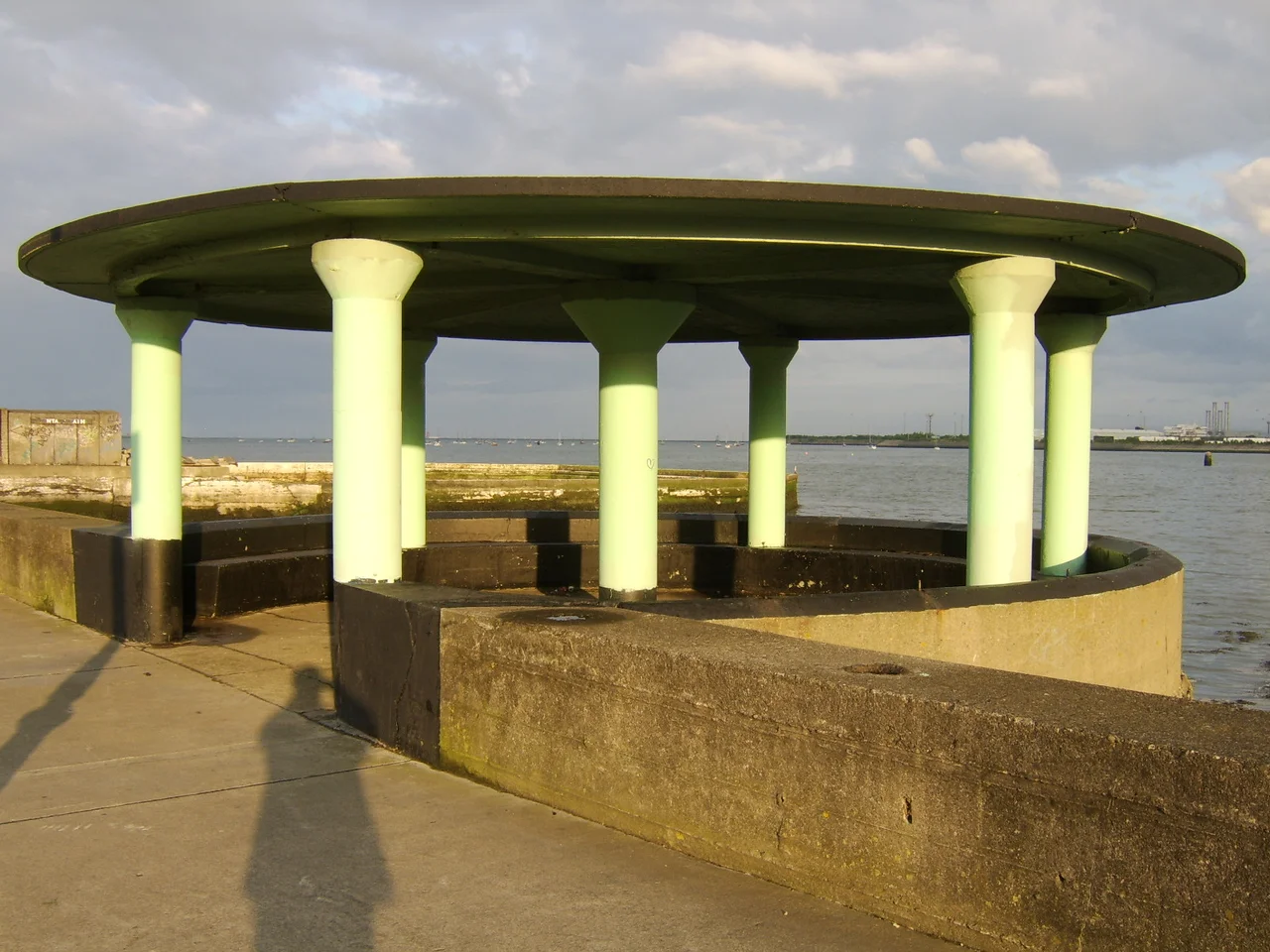
North Bull Island - usually just called the Bull - is a 5-kilometre-long sand dune system that runs parallel to the Clontarf shoreline, separated from the mainland by a tidal lagoon. It did not exist before 1825. The construction of the Bull Wall - a stone breakwater extending from the Clontarf shore into Dublin Bay, designed to deepen the shipping channel and keep Dublin Port viable - changed the way the bay's currents distributed sand. Within a few decades a new island had built itself up on the seaward side of the wall. The island has continued to grow ever since; it is presently around 800 metres wide and still expanding. In 1981 UNESCO designated North Bull Island a biosphere reserve, the only biosphere reserve in the world located entirely within a capital city. It now holds two golf courses, the long sandy stretch of Dollymount Strand, and lagoons and mudflats that are one of Europe's most important wintering grounds for migratory wading birds. It is connected to the mainland by a wooden bridge at Dollymount, owned by Dublin Port and ceremonially closed for one day each year to assert that ownership. At the seaward end of the Bull Wall, a statue of Our Lady, Star of the Sea, watches the bay.
Stoker, Lynott, Schrodinger
On 8 November 1847, in 15 Marino Crescent on the western edge of Clontarf, Bram Stoker was born. He grew up in this row of Georgian terraced houses overlooking what was then open coastline, the same street where the revolutionary brothers Harry and Gerald Boland would live in the early twentieth century. Stoker's Dracula was published fifty years later, in 1897. Down the road on Castle Avenue lived Phil Lynott, the singer and bassist of Thin Lizzy - the man who put the line 'the boys are back in town' into the global rock vocabulary. Maureen Potter, the great Dublin comic actress, lived nearby and is buried in the St John the Baptist cemetery on Castle Avenue; her gravestone reads 'In loving memory... Super Trouper.' Brian O'Driscoll, the Ireland rugby captain, grew up in Clontarf. So did the broadcaster Joe Duffy. Arthur Griffith, founder of Sinn Fein, lived on St Lawrence Road. Erwin Schrodinger - the Austrian physicist whose cat became the most famous thought experiment in quantum mechanics - moved to Dublin in 1939 to escape Nazi Europe and lived on Kincora Road in Clontarf for seventeen years, working at the Dublin Institute for Advanced Studies that Eamon de Valera had created for him. A commemorative plaque marks the house.
From the Air
Clontarf sits at approximately 53.365 degrees N, 6.210 degrees W on the north shore of Dublin Bay, immediately east of Dublin's North Wall and 4 km northeast of the city centre. The 4.5-kilometre coastal promenade from Alfie Byrne Road to the wooden bridge at Dollymount is one of Dublin's most recognisable features from the air. Dublin Airport (EIDW/DUB) lies 6 km northwest; aircraft on easterly approach to runway 28R often overfly Clontarf at low altitude. Best viewing altitude 2,500-4,000 ft. From altitude the curve of the bay, the line of the Bull Wall extending into the water, and the long sandy stretch of Dollymount Strand on North Bull Island are unmistakable. St Anne's Park forms a large green block at the eastern end of the suburb. Maritime climate, frequent low cloud, prevailing westerlies.
Nearby Stories
- Wicklow Mountains 12 km away
- Mornington 14 km away
- German submarine U-1051 16 km away
- Abbey of Kells 18 km away
- Irish Military Intelligence Service 20 km away
- HMS Manners (K568) 37 km away
- Templemore 42 km away
- Irish Sea Bridge 43 km away