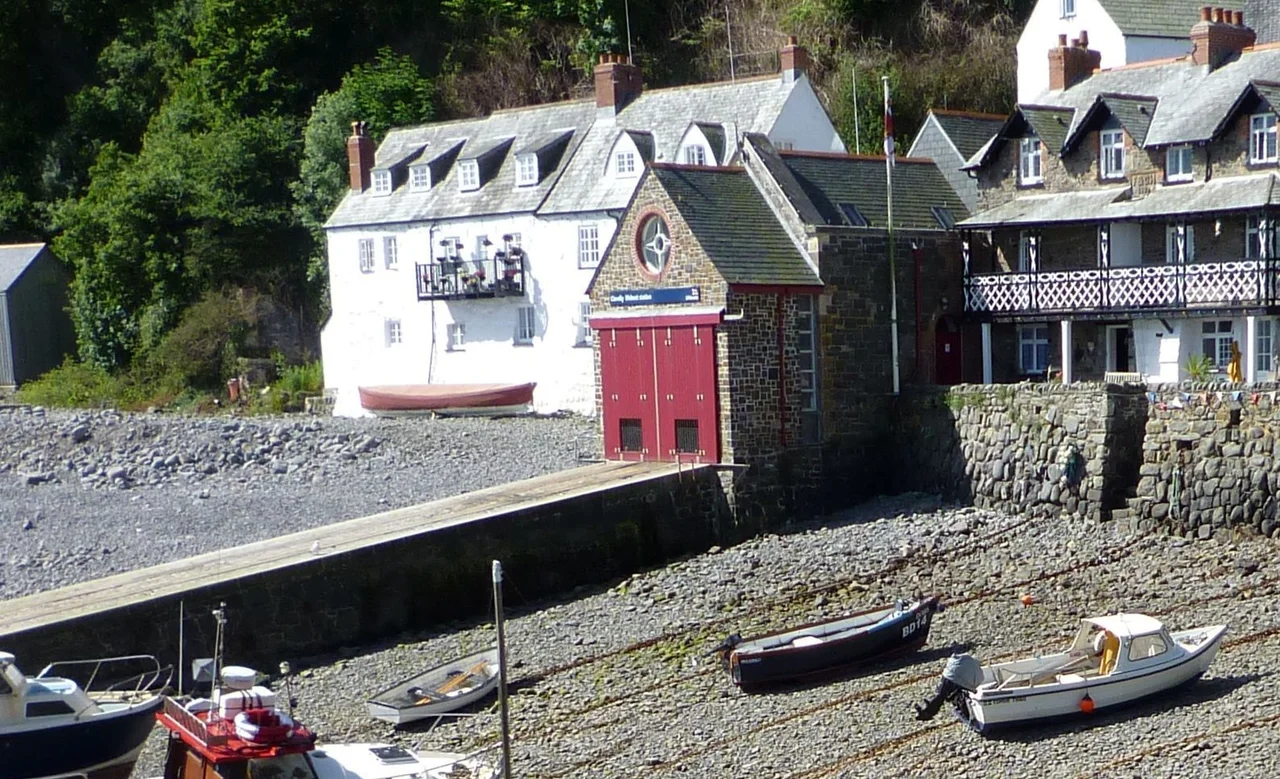

Clovelly Lifeboat Station
On the night of the 28th of October 1838, twelve fishing vessels left Clovelly Harbour for the fishing grounds in the Bristol Channel. Twenty-six men were aboard. A ferocious storm caught them at sea. One boat came back. The town lost more than twenty men in a single night — fathers, brothers, sons of a village whose entire population was perhaps four hundred people. The disaster prompted the founding, the following year, of the Shipwrecked Mariners' Society, which is still active today supporting the families of seafarers killed at work. It also began the long argument that ended with the building of Clovelly's first lifeboat station in 1870, after enough additional boats had been wrecked in the area to make the case impossible to ignore.
One Hundred and Seventy-Five Pounds
The first boathouse was built in 1870 for one hundred and seventy-five pounds — about twenty thousand pounds in modern terms, a sum scraped together from public subscription. The station was rebuilt in 1892 with a proper slipway, which made launching in heavy seas safer. By 1950, after eighty years of operation, the Clovelly lifeboats had saved three hundred and twenty-eight recorded lives. The Royal National Lifeboat Institution awarded eight medals to Clovelly crews over those decades — four Silver and four Bronze. John Bumby, the Chief Officer of Coastguard, received a Silver Medal in 1869 even before the station officially opened, for an earlier rescue. Most of the medal-bearers ended up as small entries in the church register or the parish memorial. Their names have not become famous. The lives they pulled out of the sea are largely also anonymous, which is the way RNLI history mostly works.
Coxswain Pengilly
John Pengilly served Clovelly Lifeboat for over forty-eight years. Fourteen years as Second Coxswain, twenty-four as Coxswain — almost half a century of being the man who decided when to launch into weather no sane person would launch into. In the thirty-two years from 1899, when Pengilly was running operations, the Clovelly lifeboat saved one hundred and fifty-eight lives. He retired in 1929 at an age most modern coxswains would have retired thirty years earlier. He was succeeded by Alfred Braund, then in 1932 by J. J. Headon, who retired in 1936 at sixty after his own forty years of service. The records of Clovelly read like a relay race. Each coxswain inherited the boat from a man who had given his career to it, and most of them gave their careers in turn. Helmsman Jonny Staines went missing in 1950; his body was later found at Hartland Quay. His name is on the station roll.
The Peruvian, The Mary Stewart
On the 16th of August 1903, the Clovelly lifeboat launched into a gale to two vessels in trouble — the schooner Mary Stewart and the yacht Gadfly — and rescued all eight people aboard between them. On the 12th of February 1906, in Bideford Bay, they stood by the five-thousand-ton steamer Peruvian for five hours through the night. Peruvian had lost her rudder, was rolling helpless in heavy seas with thirty crew aboard, and could not be towed until steam tugs arrived from Plymouth. Clovelly's open lifeboat stayed with her in the dark, in the wind, the entire time. In February 1913 they took the six-man crew off the schooner Ianthe in a strong gale. In 1962 they took the seven-man crew off the three-thousand-tonne tanker Green Ranger when she was wrecked off Hartland Point — the tow cable had parted, the tanker had been driven onto the rocks, and the lifeboat went in close enough to pull every man off before she broke up.
Women on the Slipway
A newspaper report from 1916 described something that would have been unremarkable in Clovelly and astonishing anywhere else: when the village's fishermen were unavailable to launch the lifeboat — at sea themselves, or away at war, or simply not at home — the women of Clovelly launched it. The slipway at the foot of the cliff is short and steep. Pushing a lifeboat down it requires brute force, applied at the right moment, in coordination with the swell. The women did it. The boat at the time was the Elinor Roget. The station was operating in the middle of the First World War, with most able-bodied men in the merchant or Royal Navy, and the rescue service did not pause because of it. The story is a single paragraph in the station history. It probably deserved more.
Closed, Then Reopened
In 1988 the RNLI closed the Clovelly station. The reasoning was economic — newer, faster lifeboats based further along the coast could cover the same waters more efficiently. The village refused to accept it. The community organised its own independent rescue service, manned and funded locally, and operated it for ten years. In 1998 the RNLI returned, reopened the station, and resumed official operations. In 2014 a new Atlantic 85-class inshore lifeboat was installed — the Toby Rundle, B-872, funded by the Rundle family of Williton in Somerset. The boat was named for Toby Rundle, an Oxford student who took his own life in 2010. The family chose to commemorate him by funding a lifeboat that would save other people. The Toby Rundle is still in service at the foot of Clovelly Harbour today, ready to launch into the same Bristol Channel that took twenty-six fishermen in a single night in 1838.
From the Air
Clovelly Lifeboat Station sits at the foot of Clovelly village at 51.00 degrees north, 4.40 degrees west, on the north Devon coast facing the Bristol Channel. Recommended viewing altitude is 1,500 to 2,500 feet. The slipway and stone harbour wall are visible directly below the cobbled village street that descends the cliff. Lundy lies eleven nautical miles north-west and is a useful navigation reference. Hartland Point lighthouse is six nautical miles west — many of the station's notable rescues took place off Hartland. Newquay (EGHQ) is approximately 50 nautical miles south. The North Devon coast generates squally weather quickly in autumn and winter; expect rapid changes in visibility on approach.
Nearby Stories
- HMHS Glenart Castle 11 km away
- Castle Drogo 12 km away
- Exmoor 13 km away
- North Cornwall Railway 14 km away
- Mumbles Lifeboat Disaster 21 km away
- Horton and Port Eynon Lifeboat Station 28 km away
- Padstow Lifeboat Station 29 km away
- Castlemartin Training Area 34 km away