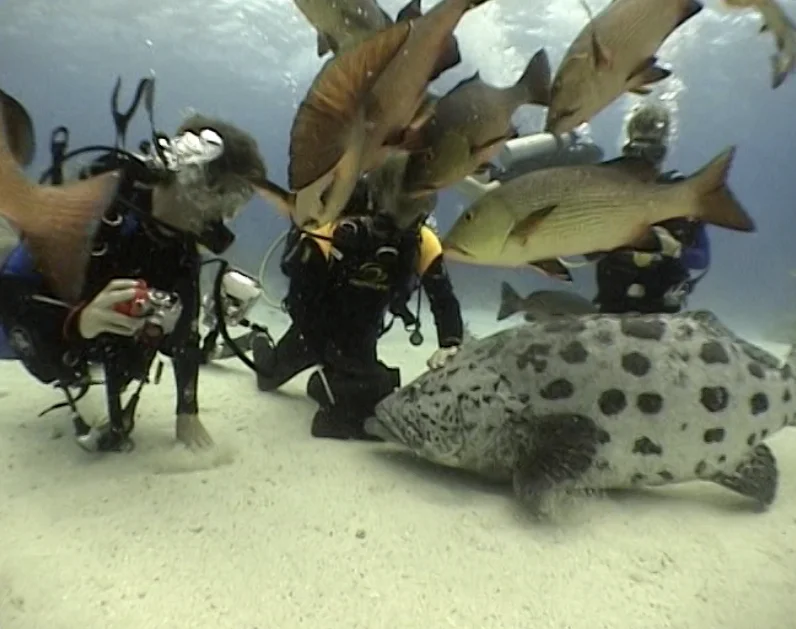

Cod Hole
It comes at you like a slow-moving boulder with eyes. A potato cod the length of a tall man, easily heavier than the diver it is approaching, cruises out from the coral and noses in close, utterly unafraid. There is nothing tame about it and nothing aggressive either, just an enormous fish that has decided you are worth investigating. This is the Cod Hole, a patch of reef near Lizard Island that has drawn divers from across the planet for one reason: here, the giants come to meet you.
Ribbon Reef Number Ten
The Cod Hole sits at the northern end of the Great Barrier Reef, on the outer edge of Ribbon Reef Number 10, near the channel once called Cormorant Pass. The ribbon reefs are a chain of long, narrow coral ridges that run along the edge of the continental shelf, walling the sheltered lagoon off from the open Coral Sea. The dive itself is a coral garden in clear blue water, with sandy lanes running between the formations where the cod rest and patrol. The reef wall drops away nearby into deep ocean, so the site sits at a meeting point of shallow coral and open sea, which is part of why the big fish gather here. Visibility is often superb and the water warm. Framed by the remote reefs of the far north, reachable only by liveaboard boat or a long day trip, it is about as wild and unspoiled as reef diving gets.
The Giants
Potato cod are a kind of grouper, and they grow to a startling size, reaching one and a half to two metres long and well over a hundred kilograms, roughly the dimensions of a household refrigerator with fins. They are named for the blotchy, potato-like markings scattered across their pale, heavy bodies. A dozen or so resident cod live around the site, each a recognisable individual to the dive guides who visit them year after year. They are extraordinarily bold. A cod will swim straight up to a diver, hover at eye level, and then follow along the reef with the frank, unhurried curiosity of an animal that has never learned to be afraid of people. Encountering one is the closest most divers come to meeting a large wild animal that simply does not flee. It can be unnerving for the first few seconds, when instinct insists that something this big should not be this close, and then it becomes the kind of memory that stays with you for the rest of your life.
Famous, and Fragile
The Cod Hole owes its fame to two people. The pioneering underwater filmmakers Ron and Valerie Taylor discovered the site in 1971 and began visiting regularly, and their footage of the great approachable cod made it world-renowned. Divers have hand-fed the fish for decades, which is exactly why the cod are so habituated, and exactly why the practice became controversial. As crowds grew, so did the worry. Researchers found that the average number of potato cod seen per dive nearly halved between 1992 and 1998, and the heavily visited, deliberately fed site became a flashpoint in the wider debate over how to manage tourism on the reef without loving it to death.
A Reef Under Pressure
That debate matters more now than ever. The same northern reefs that make the Cod Hole spectacular are on the front line of a warming ocean, hit by repeated mass coral-bleaching events that have damaged huge stretches of the Great Barrier Reef. The potato cod still cruise their sandy lanes, but the coral garden around them is part of an ecosystem under real strain. To dive the Cod Hole today is to witness something genuinely rare, a place where giant wild fish will swim up to greet you, and to feel, at the same time, how precarious such wonders have become. Few encounters in the ocean leave you so exhilarated and so determined that they should not be lost.
From the Air
The Cod Hole lies at roughly 14.664 degrees south, 145.664 degrees east, on the outer (eastern) edge of Ribbon Reef Number 10 in the northern Great Barrier Reef, about 20 km east of Lizard Island. From the air the ribbon reefs read as a long, broken chain of submerged and breaking coral separating the sheltered lagoon from the deep blue of the Coral Sea; the dive site sits at the seaward edge where reef meets open ocean. Recommended viewing altitude is 3,000 to 6,000 feet to take in the ribbon reef line and the colour change at the drop-off. The nearest airfield is Lizard Island Airport (ICAO YLZI), about 20 km west; Cooktown Airport (YCKN) is roughly 100 km to the southwest. Calm, clear dry-season conditions (May to October) show the reef colours best; summer brings haze, storms, and cyclone risk.
Nearby Stories
- Aboriginal Shire of Hope Vale 40 km away
- Guugu Yimithirr language 69 km away
- Cape Bedford Mission 73 km away
- Cape Melville 81 km away
- Bathurst Bay 146 km away
- HMS Mermaid (1817) 251 km away
- Cyclone Yasi 316 km away
- Kapa Kapa Trail 531 km away