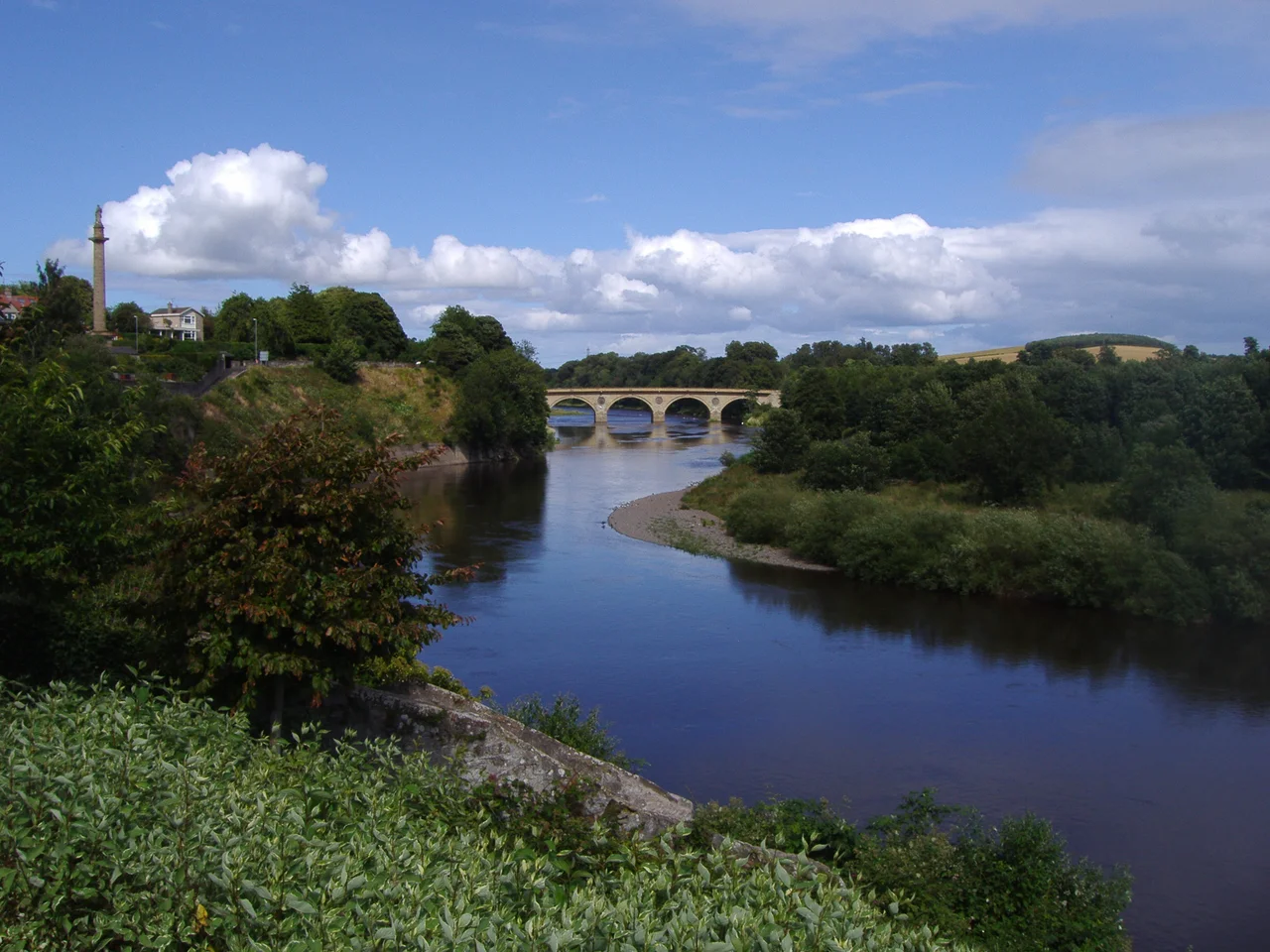

Coldstream
In 1660, a regiment of foot soldiers marched south from this stretch of the Tweed and helped restore a king. They are still marching. The Coldstream Guards, named after the modest Berwickshire town from which their founder General George Monck launched them toward London, are the oldest continuously serving regiment of the regular British Army, one of only two units of the Household Division able to trace its lineage directly to Oliver Cromwell's New Model Army. The town that gave them their name sits where the Tweed turns shallow enough to wade, which is exactly why Edward I forded the river here in 1296 to begin his invasion of Scotland. Coldstream's life has always been about who crosses the water, and in which direction, and for what.
A Town on a Wading Place
Coldstream lies on the north bank of the River Tweed in Berwickshire, with Northumberland across the water and the village of Cornhill-on-Tweed on the English side. The town's roughly two thousand people occupy the high ground above a riverbed that has been a strategic crossing since long before there was an England or a Scotland to argue about it. The Tweed here marks the border in name only; between Wark and Cornhill it dips south to enclose a small meadow of two or three acres known as the Ba Green. Local tradition holds that the men of Coldstream and the men of Wark used to play each other annually at ba, a kind of village football, to determine which country would own the patch for the year. Coldstream grew larger than Wark, won more often, and the meadow eventually settled into permanent Scottish hands by sheer demographic attrition.
The Regiment That Marched South
George Monck founded his regiment of foot at Coldstream in 1650, during the wars between Parliament and the late Stuart monarchy. A decade later, Monck found himself the most powerful soldier in a confused political landscape. From this town on the Tweed, he marched his men south to London and threw his weight behind the return of Charles II. The regiment that crossed the border with him absorbed the name of the place it had set out from. The Coldstream Guards still wear scarlet today and still stand watch at royal palaces. Their motto, Nulli Secundus, second to none, is a quiet jab at the Grenadier Guards, who outrank them in the order of precedence by accident of date rather than by length of service. The Coldstream Guards have been on continuous service since 1650. The Grenadiers, founded in 1656, take precedence anyway. The Coldstreams have not forgotten.
Runaway Marriages and the Marriage House
Scottish marriage law in the eighteenth and nineteenth centuries permitted weddings without parental consent at ages and on terms that English law did not. Coldstream, sitting on the main road from London to Edinburgh at the first bridge over the Tweed, became one of the favourite destinations for English couples in a hurry, much like its better-known rival Gretna Green further west. The town's marriage house still stands, where weddings were conducted by whoever could be roused to officiate. Sir Alec Douglas-Home, who served as Prime Minister of the United Kingdom from October 1963 to October 1964 in one of the shortest premierships in modern memory, is buried just outside the village in the churchyard of the ruined Lennel parish church. Coldstream Town Hall, plain and dignified, now serves as a library and registration office, marrying couples on rather more administrative terms.
The Priory and the Battle of Flodden
Coldstream Priory of St Mary was founded before 1166 by Gospatric III, Earl of Lothian, and never became wealthy or grand. Its survival was a matter of the prioress's diplomacy. The house sat astride the border and was used by both sides for gathering information, the prioress treading a tightrope to keep the monastery standing. After the Battle of Flodden in September 1513, when the Scottish army was annihilated and James IV killed, the prioress had the bodies of the Scottish dead brought to Coldstream for burial. James IV's own body was taken south to England. The priory is gone today, dissolved long ago and demolished, but Coldstream still commemorates Flodden each year during its Civic Week in the first week of August. A torchlight procession winds through the town, and horse-riders carry a cut sod of grass from the battlefield back across the river to be ceremonially buried on the Tweed Green. The men of Coldstream still go to Flodden every year. They have been doing it for over five centuries.
From the Air
Located at 55.654°N, 2.264°W on the north bank of the River Tweed, with Cornhill-on-Tweed and Northumberland across the river to the south. Best viewed at 1,500-3,000 ft AGL. The Coldstream Bridge carrying the A697 is a clear visual landmark. The Hirsel estate, family seat of the Earls of Home, lies just north-west of the town. Nearest major airports: Edinburgh (EGPH) approximately 42 nm north-west and Newcastle (EGNT) approximately 45 nm south-east. Berwick-upon-Tweed lies 14 nm to the east-north-east.
Nearby Stories
- Otterburn Training Area 1.3 km away
- Galashiels 1.6 km away
- Battle of Piperdean 2.7 km away
- Bamburgh Castle Lifeboat Station 3.7 km away
- Warkworth Hermitage 9.1 km away
- Seton Palace 11 km away
- Battle of Arkinholm 27 km away
- German submarine U-58 (1938) 260 km away