.JPG)
Colectiv nightclub fire
It was a Friday night in Bucharest. A metalcore band called Goodbye to Gravity was launching a new album with a free concert at a club called Colectiv, a converted shoe-factory workshop in Sector 4, three kilometers from the Palace of the Parliament. Somewhere between two and four hundred people were inside, most of them in their twenties. The band had announced pyrotechnics in the run-up to the show, sparkler firework candles meant to give a science-fiction feel to the album release. At about 10:30 in the evening one of those sparklers caught the polyurethane acoustic foam wrapping a pillar near the stage. The foam was not fire-rated. The club had only one working exit. By the time the fire was out, twenty-six people were dead at the scene. By March of the following year, that number had risen to sixty-four. Many of the survivors are still recovering. The youngest victim was eighteen.
The Stampede and the Door
When the foam ignited, the fire raced up the pillar and across the ceiling within seconds. Witnesses described an explosion. Investigators later concluded it was not an explosion but the rapid combustion of the foam's chemical insulation, which released a wave of toxic smoke as it burned. The crowd panicked. The club had two exit doors but only one was working, and that one was a two-part door with only half of it open. Several hundred people tried to push through a gap perhaps a meter wide. They climbed on top of one another. Many of the leg injuries treated that night came from being trampled. Concert-goers eventually broke down the second half of the door to escape, but most of the dying happened in the smoke before they could. The first 112 emergency call came in at 10:32 pm. Nurses and doctors from the Bucur Maternity Hospital across the street ran out in their robes and slippers to provide first aid. The first ambulance arrived eleven minutes after the call.
The Hospitals That Were Not Ready
The initial death toll of twenty-six made Colectiv the deadliest fire in modern Romanian history before the medical crisis even began. Then the medical crisis began. The injured were sent to twelve hospitals in and around Bucharest. The largest cluster, fifty-seven people, went to Floreasca Hospital. Twenty-nine went to the Burn Hospital. Hospitals ran out of beds and ventilators. Burn patients began dying in the days that followed, not from their wounds but from infections their hospitals could not control. Of the thirty-eight who eventually died after being admitted, at least thirteen were killed by hospital-acquired bacteria. A subsequent investigation revealed that the disinfectants used in Romanian hospitals had been diluted at the manufacturer to increase profit margins, leaving the wards with chemicals too weak to kill the resistant bacteria thriving in burn wards. By November 5, six days after the fire, Romania finally requested help through the EU Civil Protection Mechanism. Patients were flown to specialist burn units in the Netherlands, Belgium, Israel, the United Kingdom, Norway, Germany, France, and Austria. Some died in transit. Some died on arrival. Some made it through and are still alive.
The Band
Goodbye to Gravity had been together for several years and had built a following in the Romanian metal scene. Both guitarists, Vlad Telea and Mihai Alexandru, died at the scene. Drummer Bogdan Lavinius Enache died on November 8 after the medical aircraft transferring him to a clinic in Zurich turned back to Bucharest when he suffered cardiopulmonary arrest en route. Bassist Alex Pascu died at an airport in Paris on November 11, transferred too late and too injured. Vocalist Andrei Galut survived with burns over forty-five percent of his body and was transferred to the Red Cross Hospital in Beverwijk in the Netherlands. Two of the dead, Claudiu Petre and Adrian Rugina, were knighted posthumously to the Romanian National Order for Merit by President Klaus Iohannis for trying to help others escape. Among the badly injured was Viorel Andrei Bud, a teenager who had won bronze and silver at the International Mathematical Olympiads in 2013 and 2014. One survivor took his own life in July 2017, twenty-one months after the fire that killed his girlfriend.
Corruption Kills
Within seventy-two hours of the fire it was clear that Colectiv had been operating without a fire-department permit. The mayor of Sector 4, Cristian Popescu Piedone, had signed off on the operating license anyway. The club's owners had been warned about the foam. Inspections had been waived. On November 3, more than fifteen thousand people gathered in Victory Square in Bucharest, holding banners reading corruption kills. The protests grew through the week, reaching thirty-five thousand in Bucharest alone, with thousands more in cities across Romania. The chant was assassins. On November 4 the Ponta government resigned. The mayor resigned an hour later. The protests continued for days afterward, demanding not just political resignations but a wholesale change in how Romania did business. The civic movements that emerged from those weeks reshaped Romanian politics for the following decade. A 2019 documentary about the disaster, also called Colectiv, was nominated for two Academy Awards, the first Romanian film ever shortlisted in either of those categories.
What the Site Looks Like
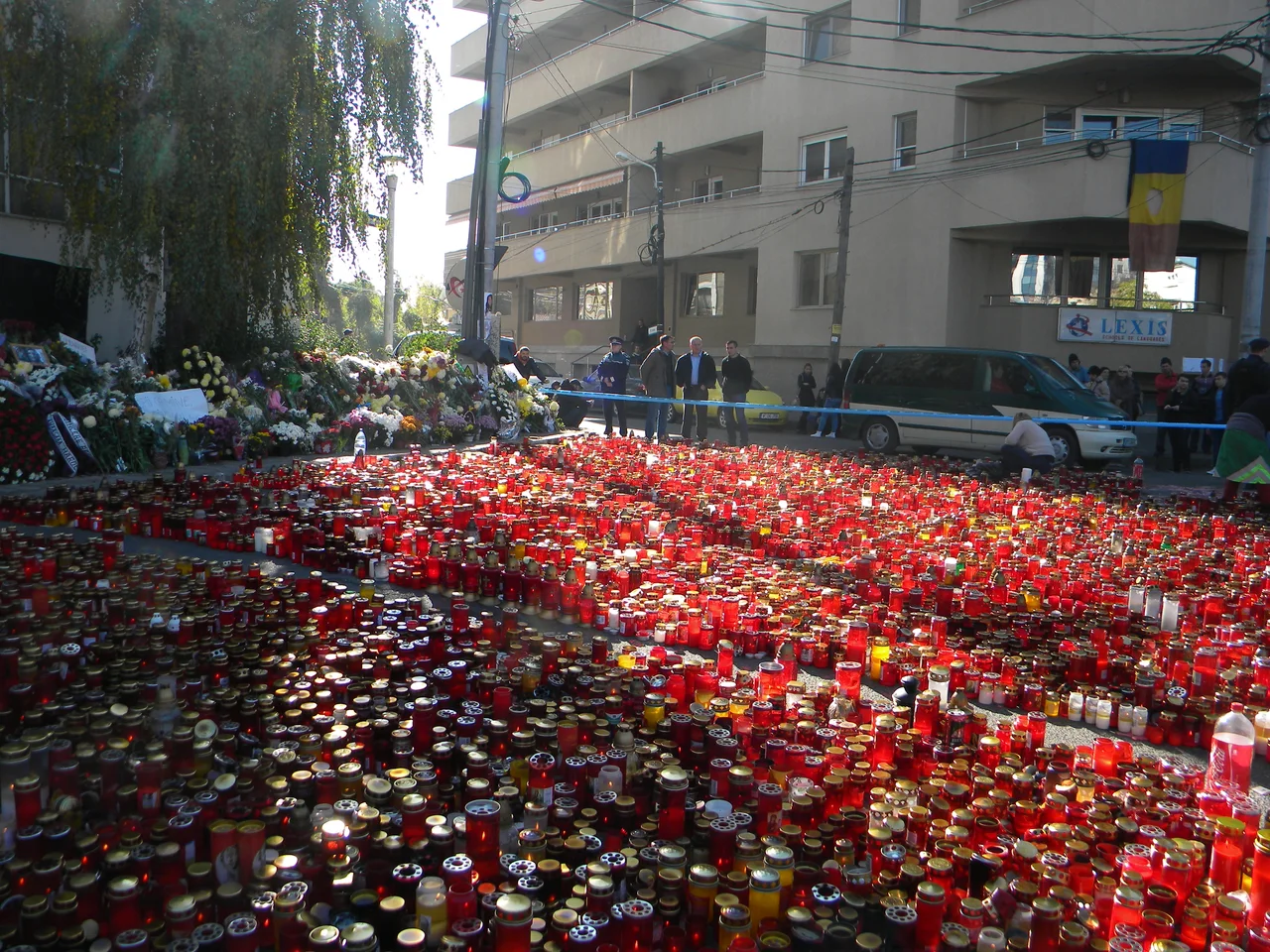
The Colectiv building still stands on Tabacarilor Street, sealed and unused. Memorials accumulate at the gate on each anniversary. The Pionierul shoe factory it occupied had been one of the largest in southeastern Europe in the interwar years, nationalized under communism, privatized clumsily after 1989, and converted into a venue by people whose financial connections were murky enough to attract their own investigation. Thirty-two of the dead are buried in cemeteries around Bucharest. Their families have spent years pursuing accountability through Romanian courts and the European Court of Human Rights. The club owners and city officials who issued the permits were eventually convicted, though the sentences were shorter and slower in coming than the families had asked for. Survivors are still being treated for the long-term consequences of inhalation injuries and burn complications. The wound the country took that night has not closed.
From the Air
Located at 44.4347 N, 26.1034 E in southern Bucharest, Sector 4, near the Tabacarilor neighborhood. Recommended viewing altitude: 2,000 to 3,000 feet AGL. The site is within three kilometers of the enormous Palace of the Parliament, the most prominent visual landmark in the city. The Dambovita River runs nearby. Nearest airport is Henri Coanda International (LROP), about 17 km north of central Bucharest. The site is not a tourist destination; it is a place of mourning.
Nearby Stories
- National Transport Museum, Bulgaria 34 km away
- Slanic Mine 68 km away
- Sinaia 79 km away
- Great Basilica, Pliska 87 km away
- Sinaia Monastery 108 km away
- Holy Forty Martyrs Church, Veliko Tarnovo 115 km away
- Shumen Fortress 126 km away
- Danube Delta 227 km away