.JPG)
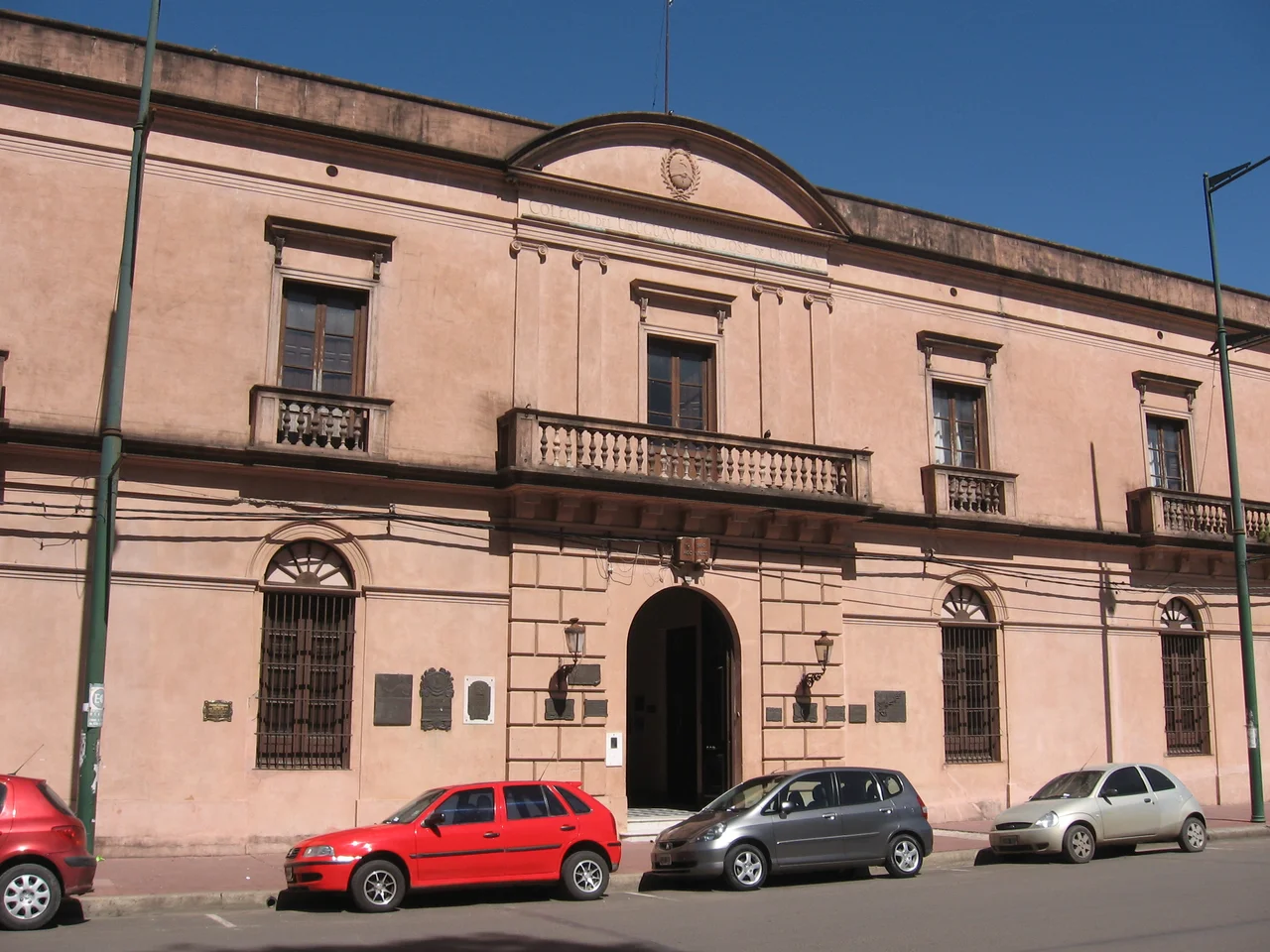
Colegio del Uruguay
Count the presidents who once sat at these desks and the arithmetic gets strange for a provincial school in a river town. Three Argentine heads of state. Two presidents of Paraguay. Governors, supreme court justices, poets, physicians, the second woman ever to earn a medical degree in Argentina. The Colegio del Uruguay, founded in 1849 in Concepción del Uruguay, was not built to be ordinary. It was built by a strongman who believed that an idea could reshape a nation faster than an army, and that the idea was education open to anyone, free of charge and free of the Church.
A Caudillo's Gamble on Schoolbooks
Justo José de Urquiza was a caudillo, a regional strongman who governed Entre Ríos and would later become Argentina's first constitutional president. On 28 July 1849 he created the Colegio del Uruguay, and in doing so made something Argentina had never had: a secondary school that was secular, public, and free. In a country where education had belonged to the Church and to those who could pay, this was close to radical. Urquiza was betting that the surest way to build a modern nation was to fill it with educated citizens, and he was willing to spend a governor's authority to make the bet.
The Frenchman and the Golden Age
In 1854 Urquiza handed the school to Alberto Larroque, a French republican who became the engine of its so-called golden age. Larroque came from a noble family; when his father's death made him a baron, he is said to have answered that the only nobility he accepted or envied was the nobility of the heart. He brought rigor and republican conviction to the classrooms, and under his direction the Colegio became a forge for the men who would run Argentina and beyond. The building itself, raised beginning in 1849 and dating in its historic form to 1851, gave the ambition a home worthy of it.
The Roll Call
The list of alumni reads like an index to a continent's history. Julio Argentino Roca, twice president of Argentina. Victorino de la Plaza and Arturo Frondizi, presidents as well. Juan Bautista Egusquiza and Benigno Ferreira, both presidents of Paraguay. Beyond the heads of state came governors of half a dozen provinces, justices of the Supreme Court, the writer Eduardo Wilde, the poet Olegario Víctor Andrade, and Teresa Ratto, the second woman to qualify as a doctor in Argentina. They did not all share politics or even nationality. What they shared was a desk in a river town and a school that took the unproven idea of free public education and proved it.
Scars and Second Lives
History did not leave the building untouched. In 1870, during the rebellion led by Ricardo López Jordán, the college was sacked. It endured, and in 1942 it was declared a national historical monument, its importance to the country formally recognized. For its 150th anniversary in 1999, the historic building was rebuilt and turned into a museum that tells its own story to visitors. The institution still teaches, now administered through the Autonomous University of Entre Ríos and serving around 1,200 students, generations removed from Roca and Larroque but seated in the same improbable experiment.
From the Air
The Colegio del Uruguay stands at 32.48°S, 58.23°W in the heart of Concepción del Uruguay, on the Argentine bank of the Uruguay River in Entre Ríos Province. From the air it is part of the dense urban core near the riverfront rather than a standalone landmark, so look for the historic city center inland from the river port. Best appreciated at low altitude (1,000-2,500 ft) over the city in clear conditions. Nearest airports are Comodoro Pierrestegui (SAAC) at Concordia upriver, Gualeguaychú (SAAG) downriver, and Tydeo Larre Borges (SUPU) across at Paysandú, Uruguay. The Uruguay River and the city's grid are the primary navigation references.
Nearby Stories
- Pueblo Liebig 1.8 km away
- Esteros de Farrapos 6.7 km away
- Abadía del Niño Dios 139 km away
- Battle of Vuelta de Obligado 143 km away
- Cisplatina 158 km away
- Tacuarembó 166 km away
- Cayastá 175 km away
- Battle of Sarandí 178 km away