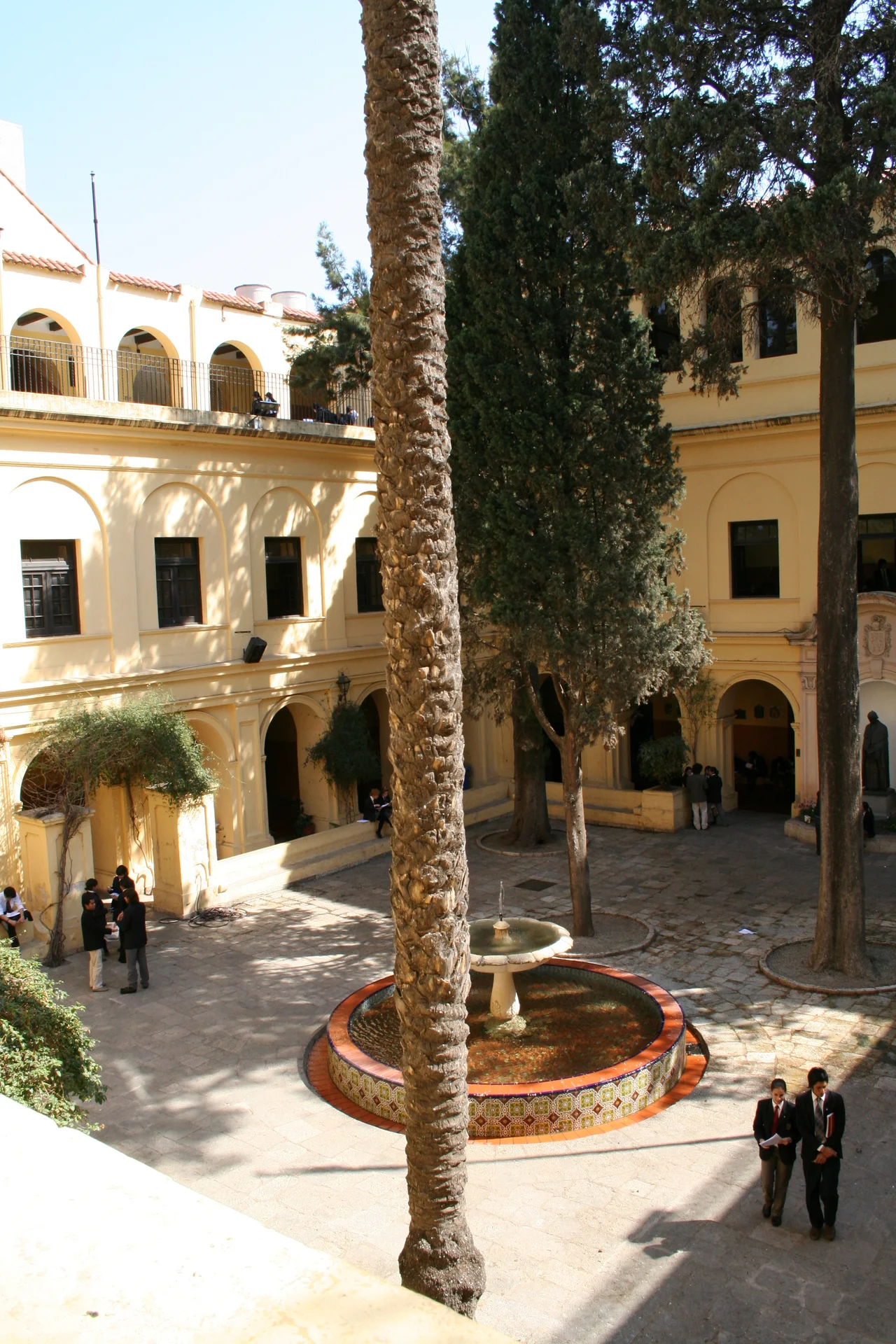

Colegio Nacional de Monserrat
More than eleven hundred children sit the entrance exam every year, and fewer than a quarter walk through the door. That is the reality of getting into the Colegio Nacional de Monserrat, a school in central Córdoba that has been selecting and shaping students since 1687. A priest founded it by giving away everything he owned. A Spanish king signed off on it. For its first three centuries it admitted only boys. The story of this school is, in miniature, the story of who Argentina decided its education was for, and the slow, contested widening of that circle.
The Priest Who Gave It All Away
On August 1, 1687, the Society of Jesus founded the Real Colegio Convictorio de Nuestra Señora de Monserrat, a royal boarding school in Córdoba. Its founder and first director was Father Ignacio Duarte Quirós, a local priest who volunteered for the work and donated all his property to make it real. The authorization came from the top: King Charles II of Spain signed the decree, and the task of carrying it out fell to the Governor of Córdoba, Captain Tomás Félix de Argandoña. The school opened its doors to boarders on April 10, 1695. Two decades later, on December 2, 1716, King Philip V granted it permanent certification, sealing its place in the colonial order. A monument to Duarte Quirós was raised in the central courtyard in 1937, two hundred and fifty years after he signed away his estate to educate other people's sons.
A Block the World Decided to Keep
Walk the streets around the Monserrat and you are inside the Jesuit Block of Córdoba, the Manzana Jesuítica, a single city block of seventeenth and eighteenth century buildings that UNESCO declared a World Heritage Site on November 28, 2000. The school stands alongside the old university, the church, and the residence the Jesuits built. The present school building was completed in 1864, commissioned decades earlier by Dr. Eusebio de Bedoya. In 1907 the school became an affiliate of the National University of Córdoba. Then in 1927, under Rector Rafael Bonet, the architect Jaime Roca dressed the façade in Spanish Colonial Revival doorways, windows, and fixtures, the ornate stonework that draws photographers today. The building you admire is genuinely old, but the most famous parts of its face are a romantic twentieth-century reimagining of what colonial Córdoba should have looked like.
The Pampero and the Politics of a School Paper
A school can carry uncomfortable history, and Monserrat carries some honestly. Its student newspaper, El Pampero, later renamed Pampero Cordubensis, was founded by the writer Enrique Osés, who became a prominent voice of the Argentine far right. Under his hand the paper grew into a leading nationalist and pro-fascist publication in the years before the 1943 coup d'état that reshaped Argentine politics. It is a reminder that elite institutions do not float above the currents of their era; they channel them. The Monserrat produced statesmen and scholars, and it also produced propaganda. Both belong to the record of a place that has sat at the center of Argentine intellectual life for so long that nearly every national argument has, at some point, passed through its classrooms.
The First Forty-Four
From its founding until 1998, the Monserrat was a school for boys only, full stop, for three hundred and eleven years. The change came against resistance. In May 1997 the National University of Córdoba's governing council ruled that students could enroll regardless of gender, and in 1998 the first official group of forty-four girls entered the institution. On November 12, 2004, the first mixed graduating class received their diplomas, and one of those young women graduated with honors. There were grumblings from older alumni, but the girls settled in. The shift was not symbolic for long: by 2010 the school enrolled more girls than boys for the first time, and by 2015 the student body was 55 percent female. A three-century tradition reversed itself in less than two decades, and the school is arguably stronger for it.
From the Air
The Colegio Nacional de Monserrat sits at 31.42°S, 64.19°W, within the Jesuit Block in the historic heart of Córdoba, just a few blocks southwest of Plaza San Martín and the cathedral. From the air the block reads as a tight cluster of colonial roofs and interior courtyards amid the city grid; the school's ornate courtyard is a useful close-in landmark. The nearest airport is Ingeniero Aeronáutico Ambrosio L.V. Taravella International (ICAO: SACO, known locally as Pajas Blancas, field elevation 1,604 ft), about 9 km north-northwest of the center. Best viewed at lower altitudes in clear daytime conditions.
Nearby Stories
- Jesús María, Argentina 16 km away
- Alta Gracia 26 km away
- Pampa de Achala 31 km away
- Mina Clavero 31 km away
- Mar Chiquita Lake 116 km away
- Battle of Quebracho Herrado 135 km away
- Villa San Agustín 271 km away
- Predelta National Park 289 km away