
Colonia Dignidad
From the air, it looks almost wholesome: tidy fields, a sawmill, a hydroelectric plant, neat houses with steep alpine roofs set against the foothills of the Andes near Parral. People here once wore Bavarian peasant clothes and sang German folk songs. But the bucolic scene was a costume. For nearly three decades, the place called Colonia Dignidad - "Colony of Dignity" - was one of the cruelest enclaves in South America, a sealed world where children were sexually abused, where families were torn apart, and where, after 1973, the Chilean secret police brought prisoners to be tortured. The name was a lie. Telling the truth about what happened here means keeping the people who suffered at the center of the story.
The Man Who Built the Walls
Paul Schäfer arrived in Chile in 1961, already a fugitive. He had fled West Germany while facing accusations of molesting children, and Chile's government granted his group permission to establish a charitable society on farmland outside Parral. What he built instead was a prison disguised as a refuge. Inside the colony, Schäfer held absolute control. Residents were forbidden to leave. Men and women were kept apart, calendars and telephones were banned, and a wall of secrecy was raised against the world outside. Schäfer told his followers that suffering was spiritually enriching - a doctrine that conveniently justified beatings, isolation, and the abuse he inflicted on children for decades. The hierarchy he created depended on fear, and fear kept the colony's secrets for far longer than it should have.
The First to Speak
The walls were never quite perfect. In 1966, a young man named Wolfgang Müller escaped. He had come to the colony at sixteen, and he told of forced labor, of regular beatings, and of being molested by Schäfer. For years his account was one of the few cracks in the facade, dismissed or buried by those who wanted the colony left alone. It would take decades, and the courage of many more survivors, before the world fully believed what people like Müller had been trying to say. Their persistence matters: every later prosecution rested on the testimony of people who risked everything to describe what had been done to them and to the children still trapped behind the gates.
When the Torturers Came
After the 1973 coup that brought Augusto Pinochet to power, the colony's isolation became useful to the new regime. Colonia Dignidad was turned into a clandestine detention and torture site for the DINA, Pinochet's secret police. According to Chile's National Commission for Truth and Reconciliation, political prisoners abducted by the regime were held here, interrogated under torture, and in some cases never seen again. Among the disappeared connected to this place was Boris Weisfeiler, a forty-three-year-old mathematics professor from Pennsylvania State University who vanished while hiking nearby in January 1985. Declassified United States documents suggest an army patrol seized him and brought him to the colony. His family has never learned what became of him. He was one person among many whose names deserve to be remembered, not reduced to a case file.
A Reckoning, Long Delayed
Justice came slowly and incompletely. Schäfer fled and hid for years before he was arrested in Argentina in 2005. A Chilean court sentenced him to twenty years for the sexual abuse of twenty-five German and Chilean children. Subsequent trials added further prison time for homicide, torture of former residents, and illegal weapons possession. He died in custody in April 2010, never having faced full accountability for everything that happened under his rule. Other leaders were tried; some served prison terms, while others escaped extradition by sheltering with sympathetic religious figures abroad. For survivors and for the relatives of the disappeared, the legal outcomes have often felt like half-answers. The Weisfeiler case was closed in 2016 when a judge ruled the kidnapping a common crime past its statute of limitations rather than a human rights violation - a decision that left his family, and many others, still waiting.
Villa Baviera
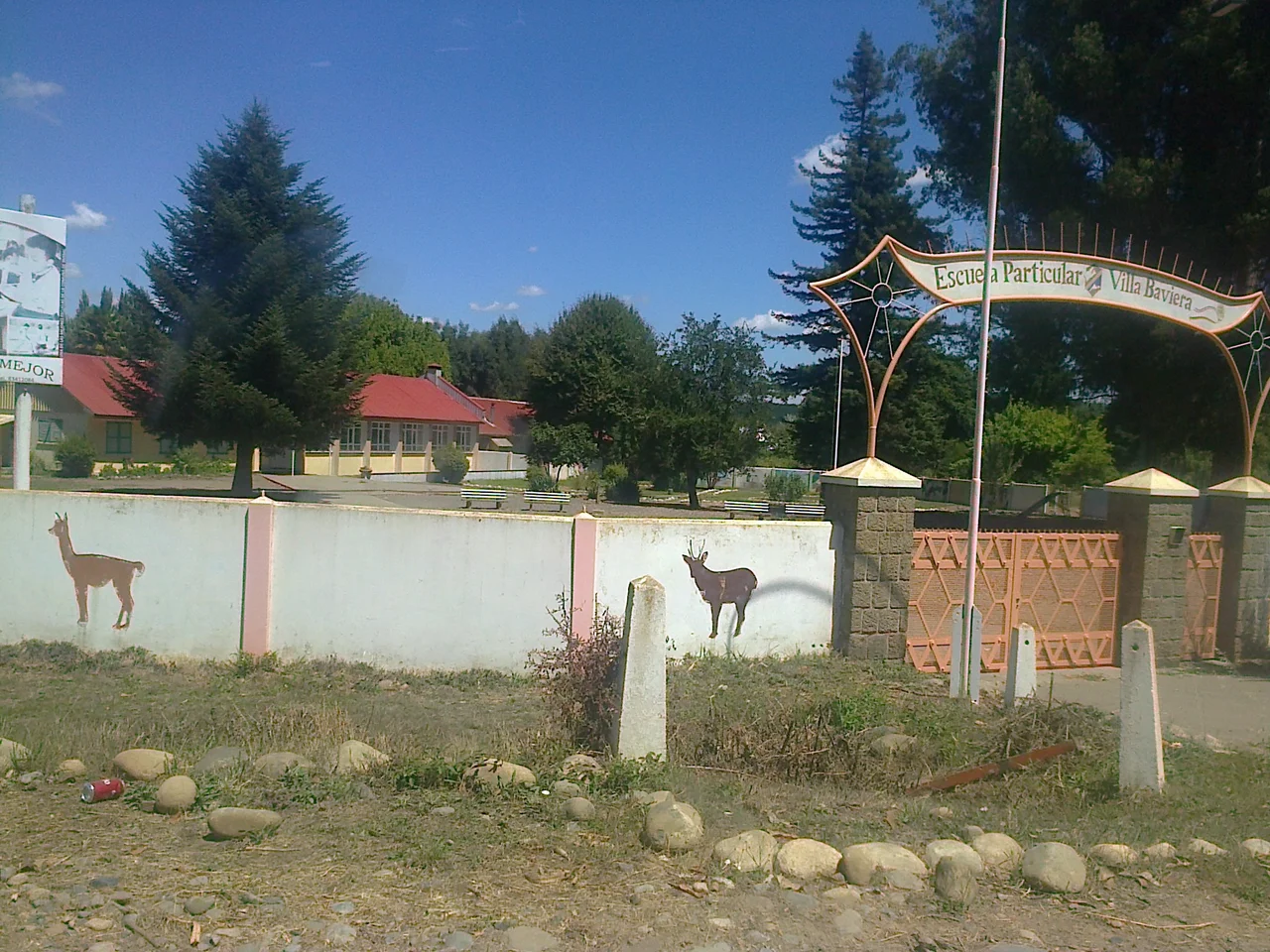
In 1991 the settlement was renamed Villa Baviera, and today its residents may come and go freely; some have gone on to study at university. Part of the property now operates as a tourist resort - a transformation that human rights advocates find deeply uncomfortable, given what the ground beneath it holds. Excavations have searched the site for the remains of the disappeared, offering relatives a fragile hope of finally bringing someone home. The fields look peaceful from above. They always did. Remembering this place honestly means refusing to let that calm scenery erase the people who were harmed here, and holding space for the survivors who carry the memory still.
From the Air
Colonia Dignidad / Villa Baviera sits at approximately 36.39 degrees south, 71.59 degrees west, in the Andean foothills of Linares Province east of Parral, in Chile's Maule Region. The setting is the eastern edge of the Central Valley, where farmland gives way to forested foothills climbing toward the high Andes. The nearest major airfield is Talca's Panguilemo (ICAO SCTL), roughly 70 km north; General Freire / Carriel Sur at Concepción (ICAO SCIE) lies well to the southwest. A respectful viewing altitude of 8,000-10,000 feet keeps the broader valley-to-mountains landscape in frame. Skies are typically clear and dry in the Mediterranean-climate summer (December-February); winters bring cloud and rain off the Pacific.
Nearby Stories
- Chillán 15 km away
- Nevados de Chillán 17 km away
- Parral, Chile 27 km away
- Battle of El Roble 31 km away
- Cobquecura 65 km away
- Altos de Lircay National Reserve 69 km away
- Chos Malal 98 km away
- Witches' Cave 131 km away