.JPG)
Coltea Church
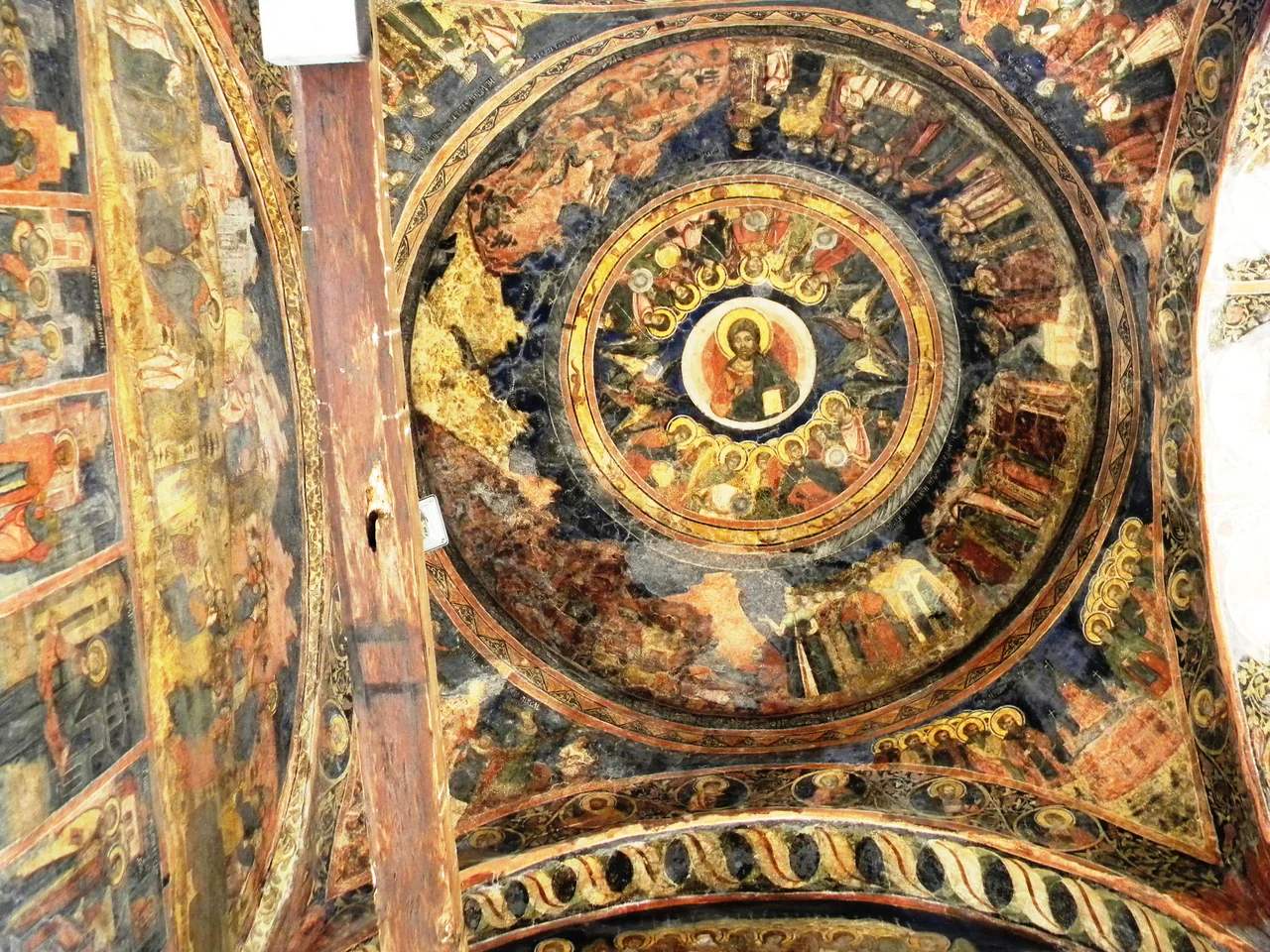
In Bucharest in the 1690s, a wealthy nobleman named Mihai Cantacuzino made an unusual decision. He commissioned a stone church and built a hospital next to it. Hospitals were not common in Wallachia at the time. Most of the sick were treated at home if they were lucky and at a monastery if they were not. Cantacuzino's foundation worked the other way around. The monastery existed to support the hospital, and the hospital existed to take care of anyone who walked through the gate, paying or not. The church he raised between 1695 and 1698 still stands at 1 I. C. Bratianu Boulevard, just off University Square, with a statue of its founder out front. Most of the rest of the complex is gone, but the church remains: small, lavishly decorated, the oldest surviving Brancovenesc-style church in Bucharest.
Before the Stone
A wooden church and a few monastic cells stood here first, built around 1641 or 1642 by a minor noble named Sluger Udrea and dedicated to Paraskeva of the Balkans. He left the property to his brother, a high-ranking court officer named Coltea Doicescu. By 1669, Coltea's name had spread across the surrounding district. People called the area Coltea, and the small wooden church the Coltea Church. When Mihai Cantacuzino acquired the land with the agreement of the Doicescu family and the Metropolitan of Wallachia, he tore the wooden buildings down and replaced them with the stone complex that survives in fragments today. The church was rededicated to the Three Holy Hierarchs, the joint feast of Basil the Great, Gregory the Theologian, and John Chrysostom, the three Cappadocian fathers whose theology shaped the Eastern Christian liturgy. The folk name for the dedication was Trisfetitele, the Three Holy Ones.
Brancovenesc Architecture
The style takes its name from Constantin Brancoveanu, the Wallachian prince who ruled from 1688 to 1714 and patronized a fusion of Byzantine, Ottoman, and Italian Renaissance architectural elements that became the signature visual language of late seventeenth and early eighteenth-century Romania. Coltea Church is a textbook example. The plan is cross-shaped, walls more than a meter thick, dimensions roughly 27.5 meters long by 8.5 to 11.5 meters wide. The narthex is slightly enlarged. Three central arches separate the nave from the narthex, resting on columns with twisted fluting, Corinthian capitals, carved bases, and tall pedestals. A dome originally crowned the nave; it was demolished and the building flattened in repairs over the centuries, but a network of double vaults preserved the structural memory of the dome, and a new one was built atop the church after the year 2000. The iconostasis is decorated with plant and geometric motifs, two rows of icons, and a row of medallions. The choir chairs are carved with the kind of detail that took a master carver years to finish.
The First Hospital
The Colțea Hospital was inaugurated in 1704 and served Bucharest until well into the modern era, going through several rebuildings as medicine evolved. Cantacuzino endowed it with estates and tax exemptions to ensure it could keep treating the poor. Three chapels stood within the complex: one north of the church dedicated to Paraskeva, one west among the hospital buildings dedicated to Saints Cosmas and Damian, the patron saints of physicians, and one east dedicated to All Saints, built specifically for the schoolboys at the attached school by Vornic Serban Cantacuzino. None of the chapels survives. A wall surrounded the entire compound, finished between 1714 and 1715 under Stefan Cantacuzino, and the entrance lay beneath the portal of Turnul Coltei, a tall tower that served as bell tower, clock, and fire watch. Earthquakes damaged the tower over the nineteenth century, and it was demolished in 1888 during a street widening, taking with it the most visible piece of the original ensemble.
What Remains
Among the church's old icons, four survive in particular condition: a Madonna and Child from 1786, a panel of the Three Holy Hierarchs, an image of Saints Cosmas and Damian attributed to the painter Parvu Mutu, and a silvered eighteenth-century icon of Saint Paraskeva painted in the Russian school. Mutu was the most accomplished Romanian icon painter of the Brancovenesc era, and his work in churches across Wallachia is one of the surviving threads connecting the visual world of seventeenth-century Romanian Orthodoxy to the present day. A statue of Mihai Cantacuzino stands in front of the church and the modern hospital that succeeded his original. The pedestrian traffic of University Square swirls past, students from the nearby university heading to class, tourists pausing to photograph the iconostasis through the open door. The church has been overlooked by Bucharest's grand modern boulevards, dwarfed by the buildings that grew up around it. It is still where it was. The patient is still being seen.
From the Air
Located at 44.4347 N, 26.1034 E in central Bucharest, just off University Square at the head of I. C. Bratianu Boulevard. Recommended viewing altitude: 2,000 to 3,000 feet AGL. Visual landmarks include University Square and the National Theatre nearby, the Romanian Athenaeum a short distance northwest, and the enormous Palace of the Parliament a couple of kilometers southwest. Nearest airport is Henri Coanda International (LROP), about 17 km north of the city.
Nearby Stories
- National Transport Museum, Bulgaria 34 km away
- Slanic Mine 68 km away
- Sinaia 79 km away
- Great Basilica, Pliska 87 km away
- Sinaia Monastery 108 km away
- Holy Forty Martyrs Church, Veliko Tarnovo 115 km away
- Shumen Fortress 126 km away
- Danube Delta 227 km away