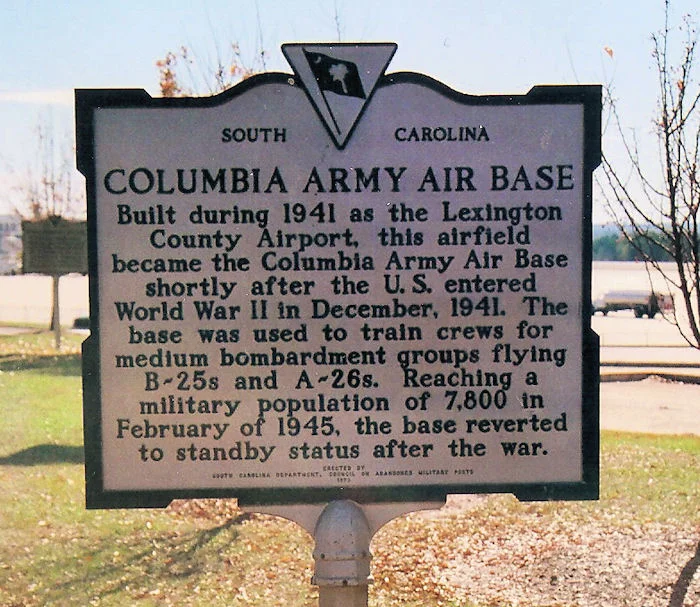

Columbia Army Air Base
On February 9, 1942 - sixty-three days after Pearl Harbor - the 17th Bombardment Group landed at Columbia Army Air Base with B-25 Mitchells flown across the country from Pendleton Field, Oregon. The crews thought they had come to South Carolina to fly antisubmarine patrols over the Atlantic. Within a week, a request circulated through the group: volunteers for an extremely hazardous mission, specifics not provided. Twenty-four full combat crews stepped forward without knowing what they were stepping into. On February 17 they were detached, transferred to Eglin Field in Florida for three weeks of carrier-deck takeoff practice, then to Alameda, then to the deck of USS Hornet. They were Jimmy Doolittle's Raiders, and the only piece of Columbia in their story is the moment they raised their hands.
From County Airport to Army Field
Before the war the field was Lexington County Airport, a modest civilian strip just outside Columbia. The Army Air Corps eyed it as early as 1940, and the 105th Observation Squadron began flying Douglas O-38s and North American O-47s out of the unfinished facility in September 1940. In 1941 the field came under formal military control. Three concrete runways, taxiways, a parking apron, a control tower, and a row of hangars went up at speed; most of the support buildings were plywood and tar paper on concrete pads, intended to last only as long as the war did. On December 8, 1941 - the day after Pearl Harbor - the base was activated under Lt. Colonel Dashe W. Reeves and assigned to Third Air Force, III Air Support Command. The 121st Observation Squadron moved over from Owens Field in Columbia and began flying anti-sub patrols along the Atlantic coast in O-47s and L-4 Grasshoppers. Within weeks the mission would change.
B-25 School
By spring 1942 the antisubmarine work had been transferred to Charleston, which sat directly on the coast and made more sense for it. Columbia's role became combat-crew training for the B-25 Mitchell, the twin-engine medium bomber that would serve in every theater of the war. The 21st Bombardment Group started the training mission in April 1942; the 309th Bombardment Group took it over in May and ran it for years, later redesignated as the 329th. Three other groups - the 310th, the 321st, and the 340th - rotated through Columbia in 1942 before deploying to North Africa, the Mediterranean, and the Pacific. From 1943 onward the base shifted from full-group training to individual replacement training, feeding crews into squadrons already deployed overseas. In February 1945 the mission shifted again, this time to A-26 Invader conversion training for the 319th Bombardment Group, which left for Okinawa that April.
Lake Murray
Twenty-three B-25s went into Lake Murray during the war. Most went in at night, with crews who had been in the cockpit of a Mitchell for only a few dozen hours, practicing the kind of low-altitude work the bomber demanded. Engines failed. Inexperienced pilots stalled in turns. Many of the airmen aboard those aircraft were killed; some bodies were never recovered from the lake's 100-foot depths. On April 4, 1943, B-25C serial 41-12634 lost an engine and ditched. Its crew made it out and were picked up by local fishermen as the bomber sank. The plane lay in 150 feet of water for sixty-two years before divers brought it up on September 19, 2005. Its starboard engine had been torn off in the crash; that, too, was recovered. The aircraft was shipped to the Southern Museum of Flight in Birmingham, Alabama, where its forward section went on display in December 2005. The other twenty-two aircraft, and the men aboard them, remain in the lake.
After the War
Columbia Army Air Base was inactivated on November 30, 1945, and turned over to civil authority. The runways and taxiways became Columbia Metropolitan Airport - airline code CAE, ICAO KCAE. A reserve squadron, the 350th Bombardment, was nominally based there from 1947 to 1949 but was never equipped or manned. The hangars built quickly out of plywood are long gone; most of the wartime infrastructure went with them. Historical markers along the airport perimeter remember the bombardment groups that passed through, the Doolittle Raiders who briefly volunteered there, and the 23 bombers in Lake Murray. The crews who trained at Columbia went on to fly missions over North Africa, Sicily, Italy, the South Pacific, and China. Many came home. Many did not. Every commercial flight that lands at KCAE today touches asphalt that was first poured for them.
From the Air
Columbia Army Air Base occupied the site of today's Columbia Metropolitan Airport (KCAE), centered near 33.939°N, 81.119°W, about ten miles southwest of downtown Columbia in Lexington County. Lake Murray - where 23 B-25s went down during training - lies about fifteen miles north-northwest, its 41 square miles of water clearly visible from cruising altitude. Columbia Owens Downtown (KCUB), the wartime Owens Field, sits about eleven miles east-northeast across the city. The Congaree River runs just east of the airport. Look for KCAE's two runways: 11/29 and 5/23, the latter with grooved concrete edges and an asphalt center.
Nearby Stories
- Shaw Air Force Base 5.5 km away
- Fairfield County, South Carolina 16 km away
- Newberry Opera House 30 km away
- Graniteville Train Crash: The Night Invisible Death Came to a Mill Town 31 km away
- Orangeburg Massacre 33 km away
- Battle of Hammond's Store 33 km away
- Hartsville, South Carolina 41 km away
- Middleton Place 101 km away