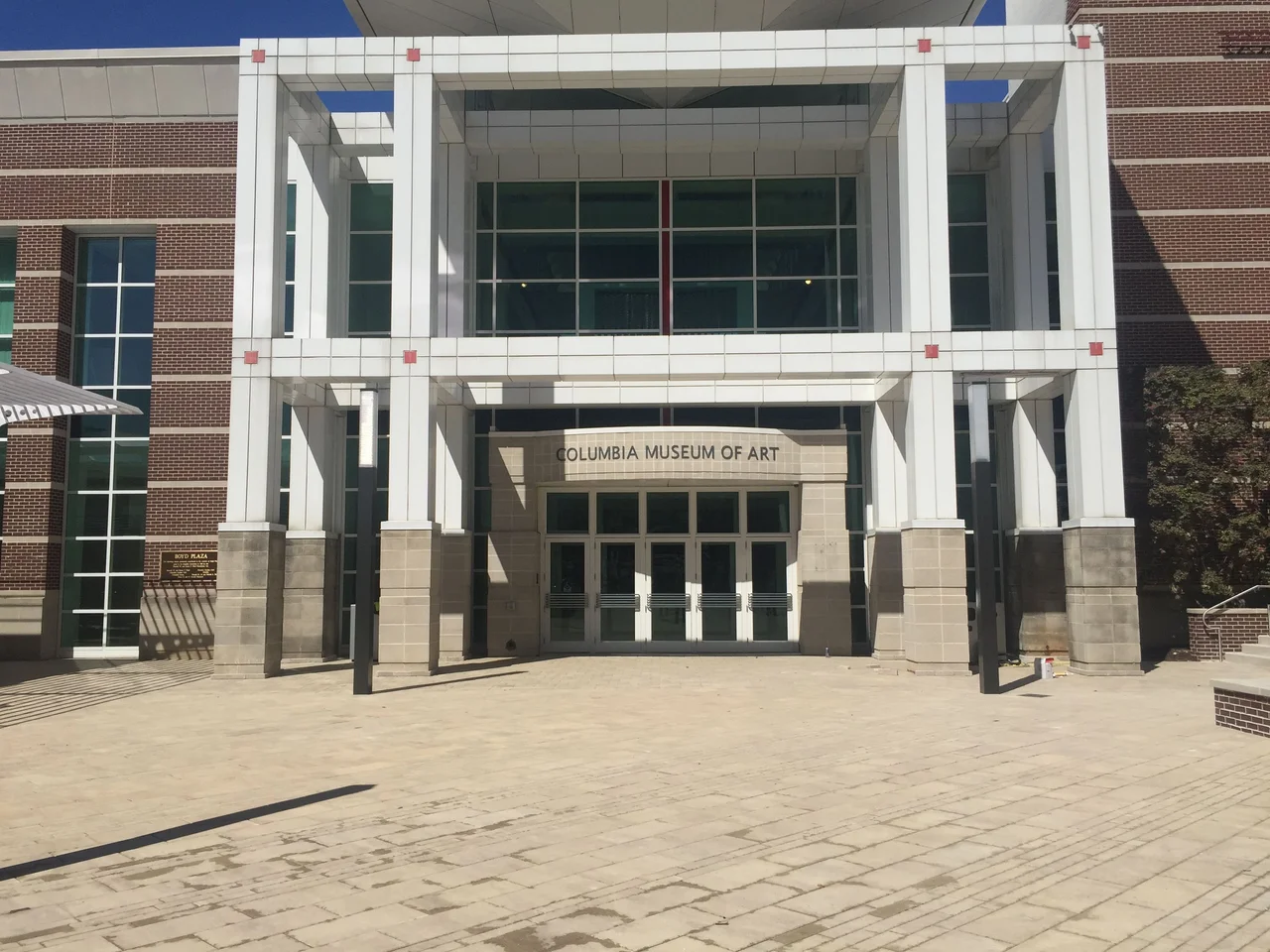

Columbia Museum of Art
It used to be a Macy's. Walk into the second-floor European galleries of the Columbia Museum of Art today, and the structural skeleton holding up the ceiling is the same steel framework that once held up the lighting in a downtown department store. When Belk and Macy's both abandoned the corner of Main and Hampton in the 1990s, the museum's trustees did something unusual: they bought the carcasses, demolished one to make a sculpture plaza, and built the new museum inside the bones of the other. The Old Master paintings now hang in galleries whose load-bearing columns once watched shoppers ride escalators to women's wear.
Begin with the Taylor House
The Columbia Museum of Art opened in 1950 in the 1908 private residence of the Taylor family, on Senate Street next to the University of South Carolina campus and three blocks from the State House. Local collectors donated the founding pieces - ten Old Master paintings including works by Joshua Reynolds, Scipione Pulzone, Juan de Pareja, and Artus Wolffort. Within a few years, gallery wings and a round planetarium had been bolted onto the house, turning the residence into the Columbia Museum of Art and Science. The Taylor House itself was added to the National Register of Historic Places in 1982. By the late 1980s, with the South Carolina State Museum absorbing the science collections, the museum could focus on art alone - but the Taylor House's 7,000 square feet had become impossibly small for what was now an internationally significant collection.
The Kress Gift
The collection became internationally significant in 1954, when the Columbia museum was chosen as one of 95 institutions across the United States to receive donations from the Samuel H. Kress Foundation. Kress, a five-and-dime retail magnate, had spent decades buying Italian and Northern European Renaissance and Baroque art in Europe and bringing it back to America with the explicit intention of distributing it to regional museums. Columbia was named a regional center. Over the following twenty years, 78 examples of fine and decorative art flowed in. Among them: a fresco by Sandro Botticelli - the only Botticelli fresco in an American collection. There are also panels by Bernardo Daddi, paintings by Tintoretto, Strozzi, Salvatore Rosa, Guido Cagnacci, Jusepe de Ribera, François Boucher, Canaletto, and Francesco Guardi. A small museum in a Southern state capital became, by gift, a stop on the Old Master pilgrimage.
The 1998 Building
The new home opened in 1998 at Main and Hampton Streets, designed by Bobby Lyles and Ashby Gressette of Stevens & Wilkinson, the Columbia firm that built it into the skeleton of the Macy's department store. The rear of the adjacent Belk building became scaffolding for the TD Bank tower next door; the front of Belk was demolished to create Boyd Plaza, a public square and sculpture garden that fronts the museum's entrance. The Boyd Foundation funded a renovation of the plaza in 2017. Inside, the first-floor galleries handle changing exhibitions and modern and contemporary work from the permanent collection. The second floor houses a twenty-gallery timeline of European and American art from antiquity to the present. Greek lekythoi, Roman portrait heads, a headless Hygeia, twelve Greco-Roman marbles from Dr. Robert Y. Turner's 2002 donation - the antiquity gallery is small but real.
Jasper Johns Slept Here
The American galleries hold work by Gilbert Stuart, Thomas Sully, William Merritt Chase, Washington Allston, and a single Claude Monet. There are furniture pieces by Duncan Phyfe, Gustav Stickley, and Louis Majorelle; stained glass by Tiffany Studios; ceramics from Newcomb College. The drawings collection includes works from the Dorothy and Herbert Vogel Collection. There is also Jasper Johns. Johns attended the University of South Carolina from 1947 to 1948 and spent stretches of his childhood living with his aunt Gladys on Lake Murray - which is why the museum's children's program is called Gladys's Gang. A 2019 exhibition gathered work by Johns alongside paintings by Andy Warhol and Roy Lichtenstein that Johns himself owned. Georgia O'Keeffe's charcoal drawings from 1915 - made the autumn she briefly taught at Columbia College across town - came home in 2016. A 20-foot Jackson Pollock mural arrived for a 2019 show. In a state capital that does not always announce itself as a destination, the museum is one of the things that quietly is.
From the Air
The Columbia Museum of Art occupies the corner of Main and Hampton Streets at 34.006°N, 81.036°W, in the heart of downtown Columbia. From the air look for Boyd Plaza, the public square with sculpture gardens immediately south of the museum building, three blocks north of the South Carolina State House dome. Columbia Owens Downtown Airport (KCUB) is about three miles east-southeast; Columbia Metropolitan (KCAE) is seven miles southwest. The Congaree River runs about a mile west of the museum. Best low-altitude photo passes are 1,500-2,500 feet AGL with the morning sun lighting the museum's front facade.
Nearby Stories
- Shaw Air Force Base 5.5 km away
- Fairfield County, South Carolina 16 km away
- Newberry Opera House 30 km away
- Graniteville Train Crash: The Night Invisible Death Came to a Mill Town 31 km away
- Orangeburg Massacre 33 km away
- Battle of Hammond's Store 33 km away
- Hartsville, South Carolina 41 km away
- Middleton Place 101 km away