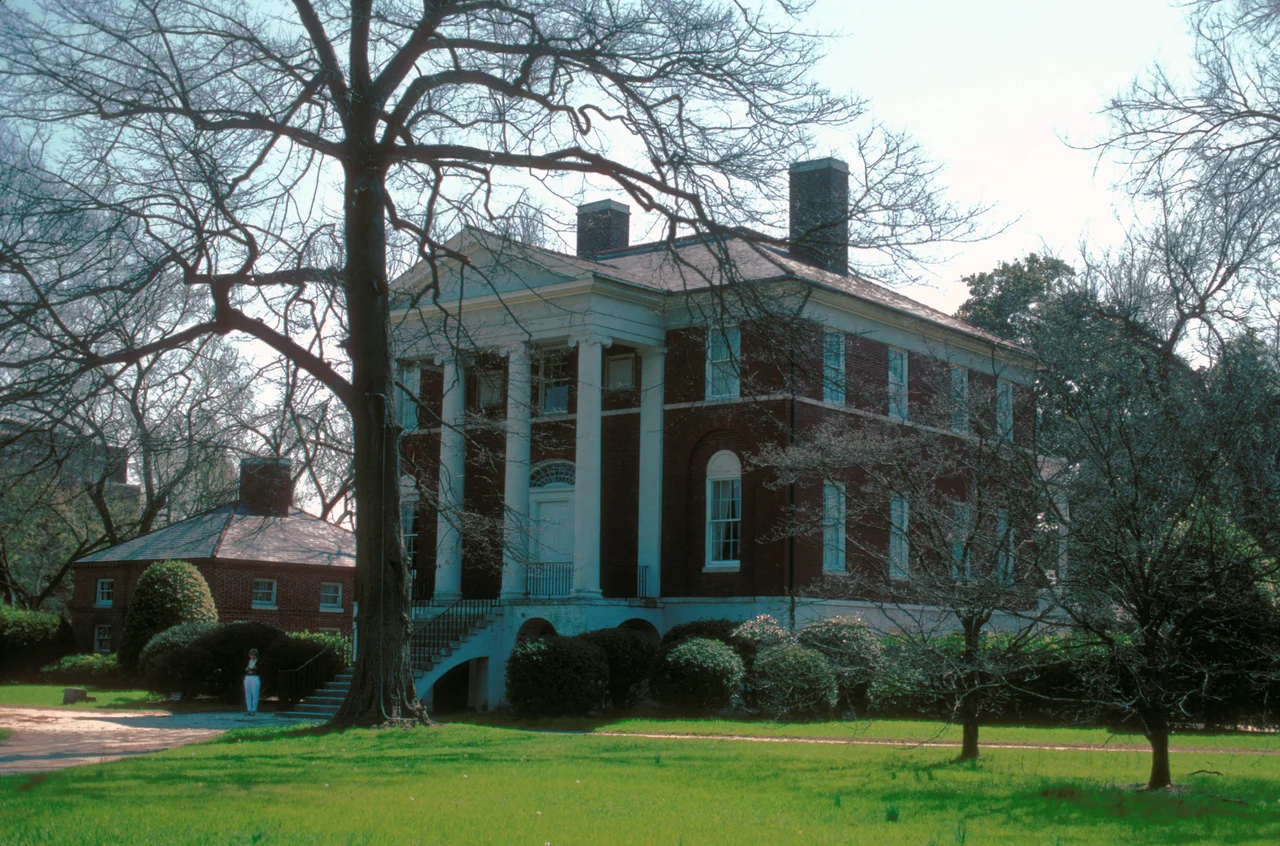

Columbia, South Carolina
The fire began the night of February 17, 1865, and by morning much of Columbia was charcoal. Sherman's army had marched in that afternoon after Confederate cavalry abandoned the city; whether the blaze was set by Union troops, by retreating Confederates burning cotton bales in the streets, or by some combination of soldiers, escaped Union prisoners, and a hard wind, was argued at the time and is argued still. What is not argued is what happened in the days around the fire: enslaved Black Carolinians from the surrounding plantations walked into Columbia in numbers nobody had ever counted, and they kept walking. They did not wait for emancipation to be granted. They claimed it. The city that rebuilt itself out of the ash spent the next century pretending the second event mattered less than the first, but both of them are how modern Columbia came to exist.
A Capital by Compromise
South Carolina founded Columbia in 1786 as a compromise capital, planted at the geographic center of the state to settle a long argument between the Lowcountry rice planters around Charleston and the upcountry yeoman farmers around the Saluda. A grid was laid out at the Fall Line, where the Broad and Saluda Rivers meet to form the Congaree and where the coastal plain ends. The University of South Carolina followed in 1801 as South Carolina College, then a finishing school for sons of the planter class - a class whose wealth was, in 1801 as in 1860, almost entirely built on enslaved Black labor. The state government, the college, and the city itself were funded by that labor, taught its principles to the next generation of slaveholders, and went to war in 1860 to preserve the system. South Carolina was the first state to secede. Columbia was the capital from which that decision was issued.
February 17, 1865
When General William Tecumseh Sherman's army arrived at the Congaree in February 1865 after burning a path through Georgia, the surrender of Columbia was negotiated by the mayor, Confederate troops withdrew to the north, and Union soldiers entered the city. By that night the downtown was burning. Roughly a third of the city was destroyed - houses, churches, the original State House under construction, the offices of the South Carolina state government, much of Main Street. Some Columbians lost everything they owned. The fire and its causes filled court testimony, memoirs, and political arguments for the next eighty years. What got less attention in those accounts was the parallel event: in the days surrounding the burning, thousands of enslaved people from plantations across the Midlands left those plantations, by foot, on their own decision, and entered Columbia. They were not waiting for a federal proclamation to take effect on paper. They walked into the city the day the slaveholders' army left, and many of them did not stop walking until they had reached families separated by sale, found work that paid them, or claimed land of their own.
Rebuilding, and What Was Built
Reconstruction gave Columbia, briefly, an interracial state government - the first in South Carolina's history, with Black legislators outnumbering white ones in the lower house. That government founded schools, including ones that would educate Black children for the first time at state expense. It did not last. When Reconstruction was crushed in 1877, the city's Black institutions had to sustain themselves without state support. They did. Allen University, founded by the AME Church in 1870, moved into Columbia in 1880; Benedict College, founded the same year, settled a few blocks away. Both still teach. Trinity Episcopal Cathedral rebuilt across from the State House. St. Peter's Catholic parish - whose Irish canal-digger members had built the city's first canal in the 1820s - eventually became the basilica that is now the only one in South Carolina. The State House itself, begun before the war and incomplete when it burned, was finally completed in 1907. The bronze stars on its western wall mark where Sherman's cannonballs struck.
Soda City Now
Modern Columbia calls itself Soda City after the old soda-fountain abbreviation Cola, and it is a city of around 144,000 with roughly 750,000 more in the surrounding metropolitan area. Fort Jackson, just east of town, is the US Army's largest initial entry training installation - tens of thousands of soldiers begin their service careers here every year. Prisma Health and Blue Cross Blue Shield of South Carolina anchor the private economy alongside the state government and the university. The Congaree Vista along the river, where freight warehouses once stored Civil War supplies for the Confederacy, now holds art galleries, restaurants, and the South Carolina State Museum in the old Columbia Mill. Riverbanks Zoo draws a million visitors a year. Segra Park hosts the Columbia Fireflies of the Carolina League. The Soda City Market closes Main Street to vehicles every Saturday morning. The Columbia Museum of Art's Botticelli hangs three blocks from the State House. And on Harden Street, Chappelle Auditorium still echoes with the speeches of Mary McLeod Bethune and Martin Luther King Jr., in a building paid for by people the state once forbade to read.
From the Air
Columbia sits at 34.006°N, 81.036°W in central South Carolina at the Fall Line, where the Broad and Saluda rivers join to form the Congaree. From cruising altitude look for the convergence of three rivers in a single sweeping Y - that is the heart of downtown, with the State House dome and the cluster of historic buildings on the east bank. Columbia Metropolitan Airport (KCAE) lies ten miles southwest in unincorporated Lexington County; Columbia Owens Downtown (KCUB) is three miles southeast of the State House. Lake Murray's 41-square-mile expanse is fifteen miles northwest, easily visible at any altitude. Best aerial photography light is morning eastbound passes that catch the white marble of the State House and the river surfaces below.
Nearby Stories
- Shaw Air Force Base 5.5 km away
- Fairfield County, South Carolina 16 km away
- Newberry Opera House 30 km away
- Graniteville Train Crash: The Night Invisible Death Came to a Mill Town 31 km away
- Orangeburg Massacre 33 km away
- Battle of Hammond's Store 33 km away
- Hartsville, South Carolina 41 km away
- Middleton Place 101 km away