
Concepción del Uruguay
They call it La Histórica, The Historical, and the nickname is not local boasting. In this city on the western shore of the Uruguay River, deputies declared independence a full year before the famous congress at Tucumán did. A short-lived republic crowned it as capital. The campaign that ended a dictatorship and gave Argentina its constitution began at the foot of a monument in its central plaza. Concepción del Uruguay wears 80,000 residents and a working river port lightly today, but underneath the ordinary rhythms of a provincial city runs a current of the moments when the whole country's future passed through here.
A Town Named for the Immaculate Conception
The story begins with an older, unofficial settlement called Arroyo de China, recorded around 1778 on a creek at what is now the city's southern edge, where the first chapel rose at a site later used as a cemetery. The formal founding came on 25 June 1783, when Tomás de Rocamora, acting on the viceroy's commission, established the town under the resonant name Our Lady of the Immaculate Conception of Uruguay. Rocamora pulled the population north to what became the administrative and commercial heart of the city. Even the full name has been argued over for two centuries, some insisting it was always simply Concepción del Uruguay.
The Capital, the Congress, the Republic
In 1814 the Supreme Director Gervasio Antonio Posadas named Concepción del Uruguay the capital of the newly created province of Entre Ríos. The following year it hosted something larger. On 29 June 1815, José Gervasio Artigas convened the Congress of Oriente, the assembly of the Free Peoples, here. Historians consider it the first declaration of independence in the Río de la Plata, preceding the Congress of Tucumán by a year. In 1820 General Francisco Ramírez went further still, proclaiming the Republic of Entre Ríos with Concepción as its capital, a sovereign experiment that dissolved when Ramírez died the next year.
Where the Constitution Was Set in Motion
The city's largest moment came in 1851. At the foot of the pyramid in its central plaza, Justo José de Urquiza issued his pronouncement against Juan Manuel de Rosas, the strongman who had ruled Argentina with an iron hand. That declaration set in motion the campaign that ended at the Battle of Caseros on 3 February 1852, where Urquiza prevailed and cleared the way for the National Constitution adopted the following year. Two years earlier, in 1849, Urquiza had also founded here the Colegio del Uruguay, the first secular secondary school in the country, the classroom that would produce a string of Argentine and Paraguayan presidents.
A City of Two Names for Its People
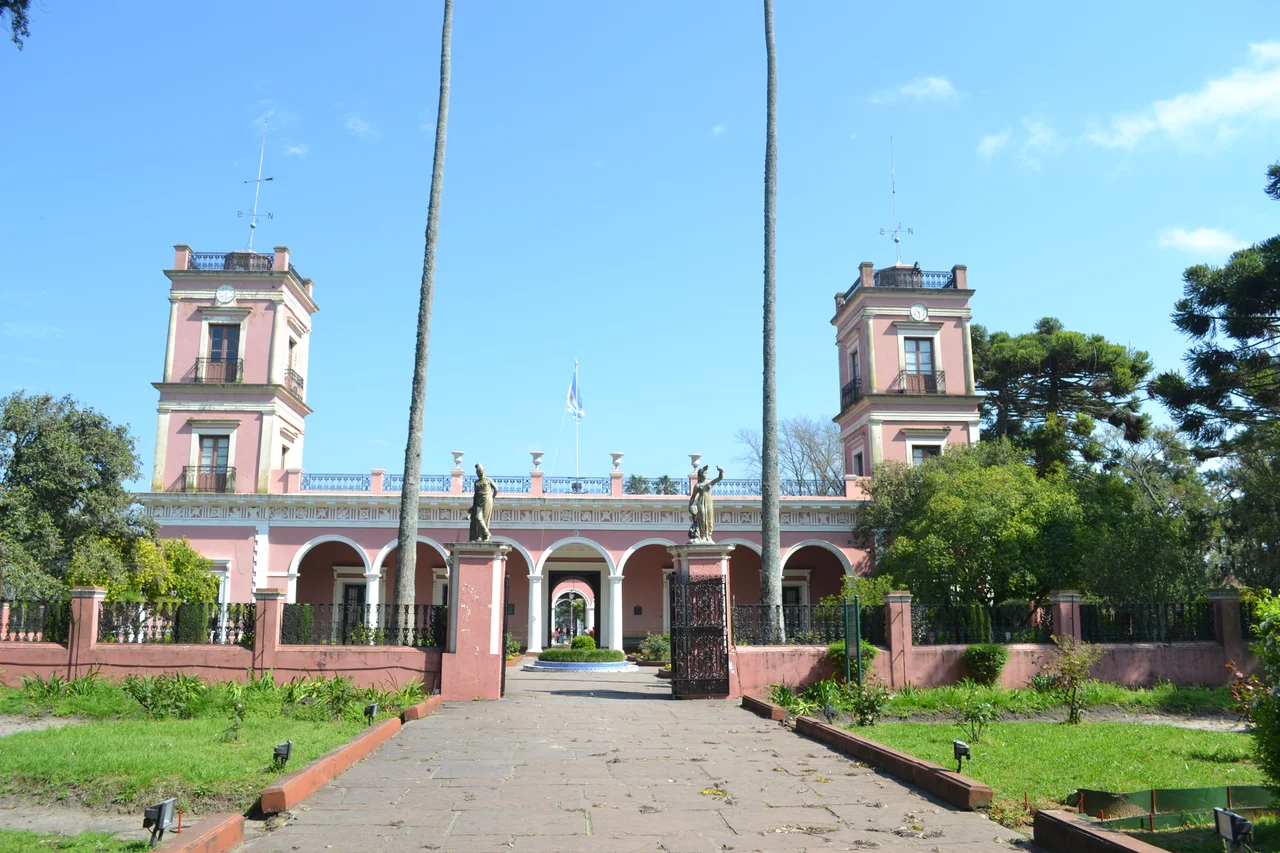
There is a charming problem of identity here. Because the river and the country next door share the name Uruguay, the people of Concepción del Uruguay are called uruguayenses, while citizens of the neighboring nation are uruguayos, a small linguistic fence to keep the two from being confused. The capital eventually moved to Paraná in 1883, but the city kept working. Today it anchors a region that, with nearby Gualeguay and Colón, accounts for the great majority of Argentina's chicken exports, and it has grown into the largest educational center in the area, home to several universities and the Palacio San José, Urquiza's grand residence, just outside town.
From the Air
Concepción del Uruguay lies at 32.48°S, 58.23°W on the western (Argentine) bank of the Uruguay River in Entre Ríos Province, about 320 km north of Buenos Aires. From the air it reads as a substantial riverside city with a working port and a regular grid; the river itself and the port facilities are the clearest navigation references. Urquiza's Palacio San José, a national monument, sits roughly 23 km west of the city and makes a distinctive rural landmark. Best viewed at 2,000-5,000 ft in clear conditions. Nearest airports are Comodoro Pierrestegui (SAAC) at Concordia upriver, Gualeguaychú (SAAG) downriver to the south, and Tydeo Larre Borges (SUPU) across the river at Paysandú, Uruguay.
Nearby Stories
- Pueblo Liebig 1.8 km away
- Esteros de Farrapos 6.7 km away
- Abadía del Niño Dios 139 km away
- Battle of Vuelta de Obligado 143 km away
- Cisplatina 158 km away
- Tacuarembó 166 km away
- Cayastá 175 km away
- Battle of Sarandí 178 km away