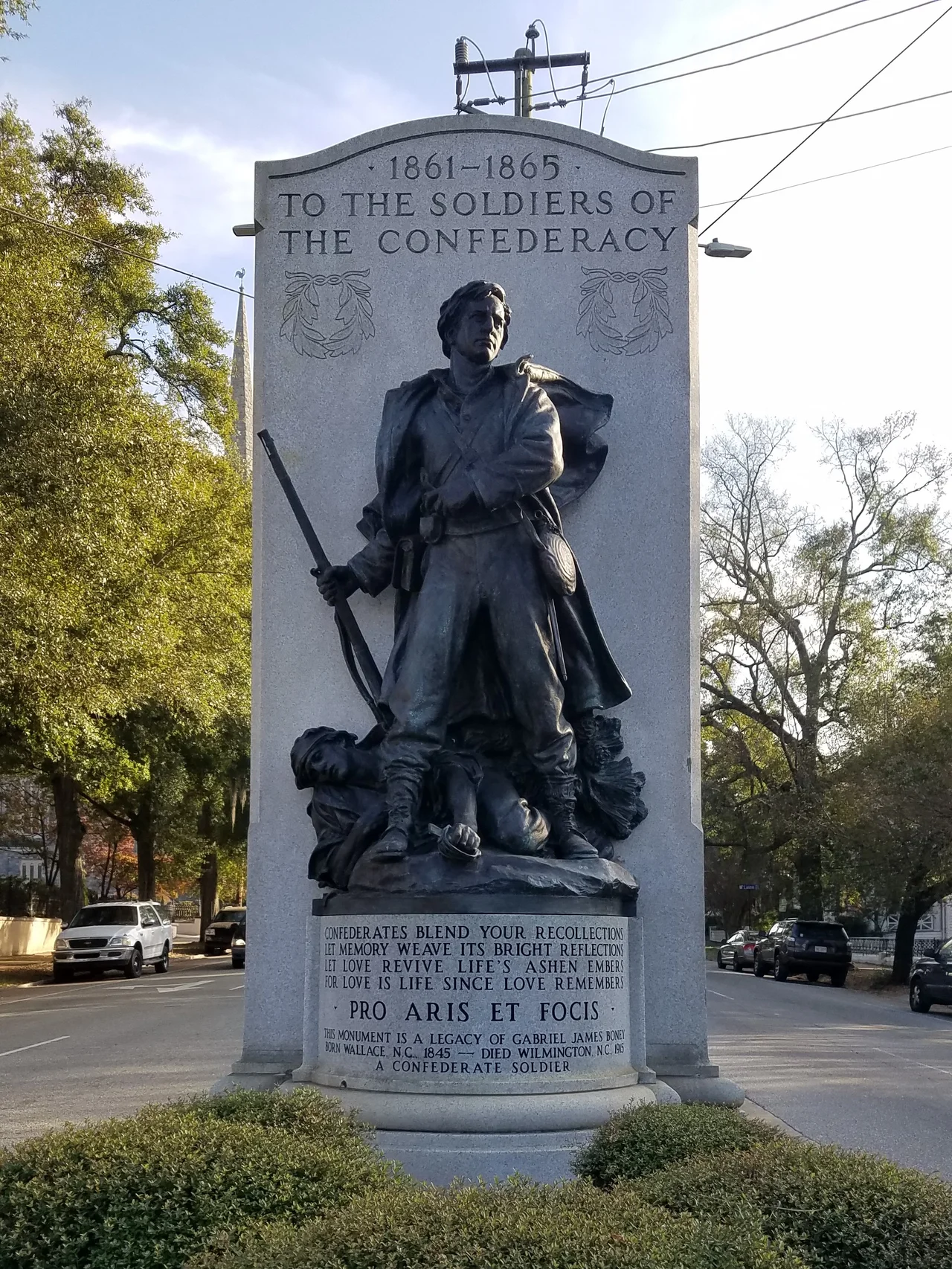

Confederate Memorial
The monument went up in 1924, fifty-nine years after Appomattox. By then the men who actually fought in the Civil War were old or dead. The Confederate Memorial in downtown Wilmington was not really about them. It was part of a coordinated, decades-long campaign by the United Daughters of the Confederacy and allied groups to install the Lost Cause narrative into the public memory of American cities, particularly Southern ones, particularly during the years when Jim Crow laws were hardening into permanence and the political achievements of Reconstruction were being systematically erased. The 40-foot granite stele, with its bronze statue of one Confederate soldier protecting a wounded comrade, stood on a median on South Third Street for ninety-seven years. In August 2021, after a year in storage following George Floyd protests, the City Council voted to remove it permanently.
Why It Was Built When It Was Built
Historians have spent decades documenting the pattern. The vast majority of Confederate monuments were not erected immediately after the war, when grief was raw and survivors lived on every block. They went up in two waves: a smaller wave around the 1900s, and a much larger wave in the 1910s and 1920s. Both waves coincide precisely with the consolidation of Jim Crow segregation, the disenfranchisement of Black voters, the spread of lynching, and the rise of the second Ku Klux Klan. The Lost Cause framework these monuments reinforced argued that the Confederacy fought for states' rights and Southern honor rather than for the preservation of chattel slavery, which was its actual primary cause as stated by the Confederate states themselves in their declarations of secession. The Wilmington monument was funded by the estate of Gabriel James Boney, a Confederate veteran who became a wealthy mill owner after the war and left $25,000 in his 1915 will for "a suitable memorial to the Confederate soldier." The UDC and a local veterans' association carried out his wish. The location they chose was the northern entrance to Wilmington's wealthiest white neighborhood.
The Artists
The monument's design pulled prominent talent. Henry Bacon, the principal architect of the Lincoln Memorial in Washington, designed the granite stele. Bacon had grown up in Wilmington and is buried there. He died in 1924, the same year the Wilmington memorial was dedicated. The bronze sculpture of the two soldiers was made by Francis Herman Packer, a German-born sculptor trained under Augustus Saint-Gaudens, working out of Long Island. Packer had also made the Confederate George Davis Monument, dedicated in 1911 one block north. The artistic skill is not in doubt. What the skill was deployed to do, and what the monument was meant to say to Black Wilmingtonians walking past it daily, is the harder question.
A Century of Damage
The monument stood in the median of a busy downtown street next to the nightlife district. Vehicles hit it. Repeatedly. In 1954 a car knocked it down and shattered the stele. The granite was replaced. In late 1999, another vehicle knocked the entire monument off its foundation and onto South Third Street, hospitalizing two people. The granite was replaced again. During the 1999-2000 restoration, a crane lifting the tablet back into place fell over, damaging power lines, parked cars, and a stone wall. The statue and pieces had to be removed and repaired a second time. The bayonet on the rifle was knocked off at unknown dates in the 1980s and again in 2003, when it went missing entirely. In 2019, someone threw orange paint on it. In March 2020, someone placed a white flag of surrender in the statue's hands.
2020 and After
After the murder of George Floyd in May 2020, the monument became the focal point of Wilmington's protests. "Black Lives Matter" was painted on the base in early June. The city closed off public access. In the early morning hours of June 25, 2020, the city removed the bronze statue and covered the remaining stele and pedestal with a black shroud, citing public safety. The decision came the same day the city announced it had fired three police officers for recorded racist conversations. The shroud was later replaced with khaki canvas, which a city official said was less distracting to drivers. The Cape Fear 3 chapter of the UDC asserted ownership and asked the city to hold the monument in storage while they made arrangements. In August 2021, the City Council voted to permanently transfer the monument out of public space. The empty median on South Third Street is now planted in grass, and the city has not announced what, if anything, will replace it.
From the Air
The former monument site sits at 34.234 N, 77.946 W in downtown Wilmington, in the median of South Third Street at Dock Street, one block south of the Third and Market intersection. From a low overflight (1,500-2,500 feet AGL) the empty median is visible as a narrow green strip between traffic lanes; the surrounding 19th-century streetscape of the Wilmington Historic District is intact around it. Wilmington International (KILM) lies about 5 miles north.
Nearby Stories
- Ocean Isle Beach house fire 4.7 km away
- Pender County, North Carolina 6.6 km away
- Bald Head Island 13 km away
- Marine Corps Base Camp Lejeune 16 km away
- Lake Waccamaw, North Carolina 17 km away
- The Robesonian Takeover 59 km away
- Swansboro 59 km away
- Mercury-Redstone 4 726 km away