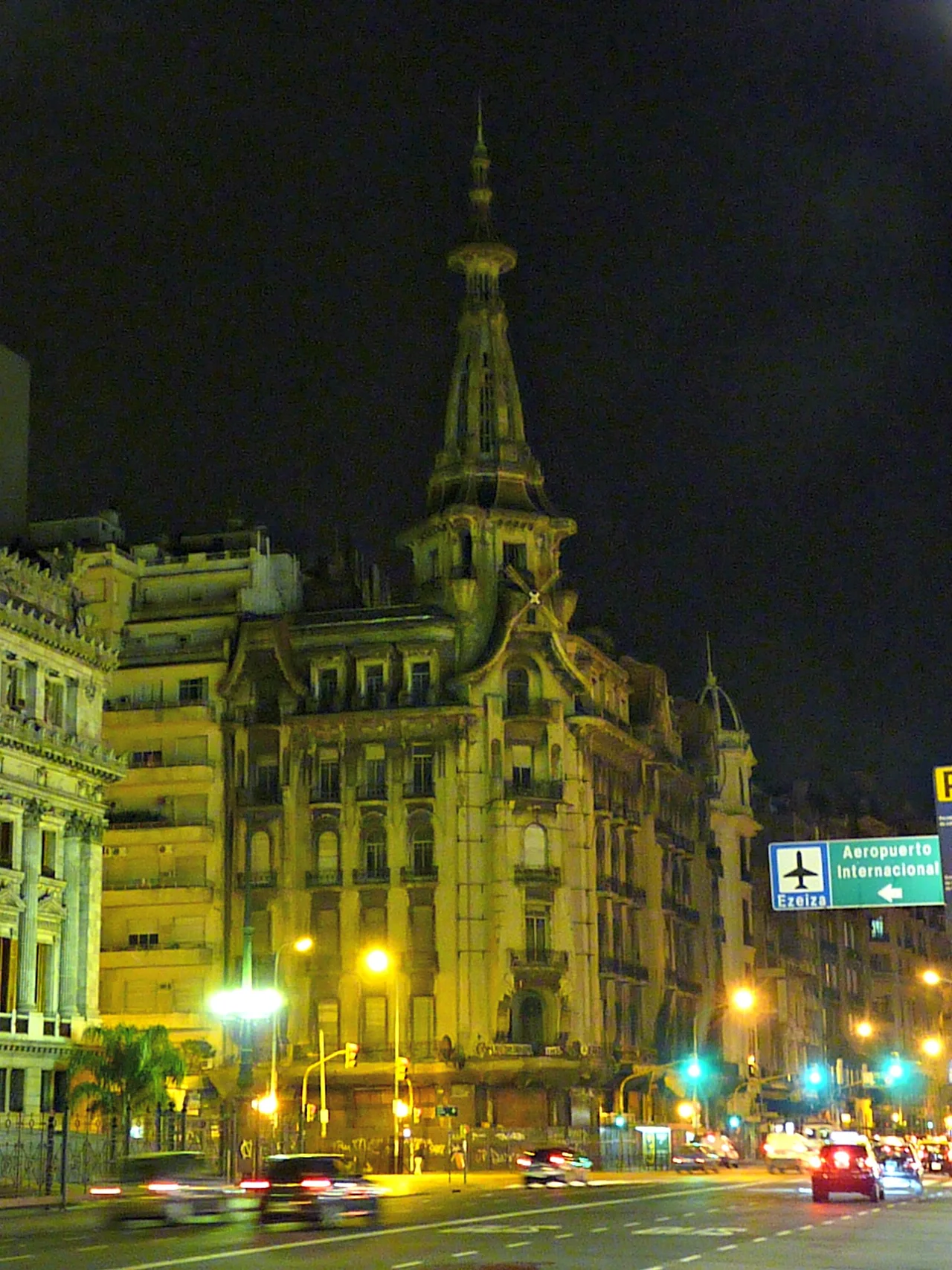

Confitería del Molino
For nearly a quarter of a century, the most beautiful café in Buenos Aires sat empty across the street from the seat of national power. Politicians filed into the Congress every day. Tourists photographed the dome of the legislature. And just opposite, behind boarded windows, the Confitería del Molino gathered dust and pigeon droppings, its stained glass cracking, its iron balconies rusting, its trademark windmill frozen against the sky. The lawmakers who passed it could not save it for the longest time. When they finally did, it took the work of dozens of restorers to bring back what neglect had nearly erased.
A Confectioner's Dream in Iron and Glass
The story begins with sugar. Cayetano Brenna, a celebrated confectioner, wanted a café worthy of his pastries, so in 1915 he hired the Italian architect Francisco Gianotti to build one on the corner of Callao and Rivadavia. The café opened its doors on 9 July 1916 - Argentina's Independence Day - and when the full building was finished in 1917, its corner turret rose 65 meters, roughly 213 feet, making it one of the tallest structures in the city. Gianotti gave it everything the Art Nouveau movement adored: curving metalwork, stained-glass windows lit from within by the new marvel of electricity, and decorative windmill sails turning above the street. The molino, the windmill, became its emblem and its name. Together with Gianotti's nearby Galería Güemes, the building stands as one of the finest expressions of the style anywhere in Buenos Aires.
The Café of Senators and Sweethearts
Sitting directly across from Congress, El Molino became something more than a confectionery. Senators crossed the avenue for coffee between sessions. Writers, businessmen, and political schemers settled into its halls beneath the painted ceilings, and deals both public and private were sealed over cups of cortado and trays of medialunas. For decades it was a stage on which the cultural and political life of the capital played out in miniature. The Brenna family ran it, then others, until ownership passed through hands that could not keep it afloat. In 1996, Madonna filmed the music video for her cover of 'Love Don't Live Here Anymore' in the main hall - a strange, fitting epitaph, because by then love really was about to leave. On 23 February 1997 the café served its last coffee and closed.
The Long Sleep
What followed was abandonment in slow motion. The same year it closed, the building was declared a National Historic Monument, but the designation protected its name more than its fabric. Decades of soot from the avenue's traffic blackened the facade. Iron and ceramic ornaments cracked and dropped away. The windmill stopped spinning. A building that ranked among the city's architectural treasures became a derelict shell that Argentines walked past with a kind of mournful familiarity. It took an act of Congress to break the impasse. On 12 November 2014, lawmakers voted unanimously to expropriate the building and fund its rescue, placing it under a special bicameral commission. Restoration finally began in 2016.
Light Through the Stained Glass Again
Bringing El Molino back was painstaking work. Restorers cleaned the soot-stained stone, replaced shattered ornamentation piece by piece, repaired the stained glass, and made the windmill turn once more. On 8 July 2022 - almost exactly 106 years after it first opened, and again on the eve of Independence Day - the building reopened to the public for guided tours. Visitors now climb from the ground floor through the upper salons to the basement and out onto the roof, ending with a coffee in the restored café space where senators once plotted. The plan reaches further still: a museum of early-twentieth-century Buenos Aires life, and a working café once more. After 25 years of silence, the windmill on Callao and Rivadavia is spinning, and the lights behind the glass are on.
From the Air
The Confitería del Molino stands at 34.609 degrees south, 58.392 degrees west, on the corner of Avenida Callao and Avenida Rivadavia in the Balvanera neighborhood, directly across from the green copper dome of the Argentine National Congress - one of the most recognizable landmarks in central Buenos Aires from the air. The Congress dome and the wide axis of Avenida de Mayo make excellent visual references. Best appreciated at low altitude in the clear, dry air of a Buenos Aires winter morning. The nearest airport is Aeroparque Jorge Newbery (ICAO: SABE) on the Río de la Plata waterfront, roughly 5 km northeast; Ministro Pistarini International Airport at Ezeiza (ICAO: SAEZ) lies about 25 km to the southwest.
Nearby Stories
- Ezeiza Massacre 1.9 km away
- Luján, Buenos Aires 5.1 km away
- Curutchet House 13 km away
- Colonia del Sacramento 17 km away
- Martín García Island 28 km away
- Atucha Nuclear Power Plant 37 km away
- Lobos 43 km away
- Cry of Asencio 87 km away