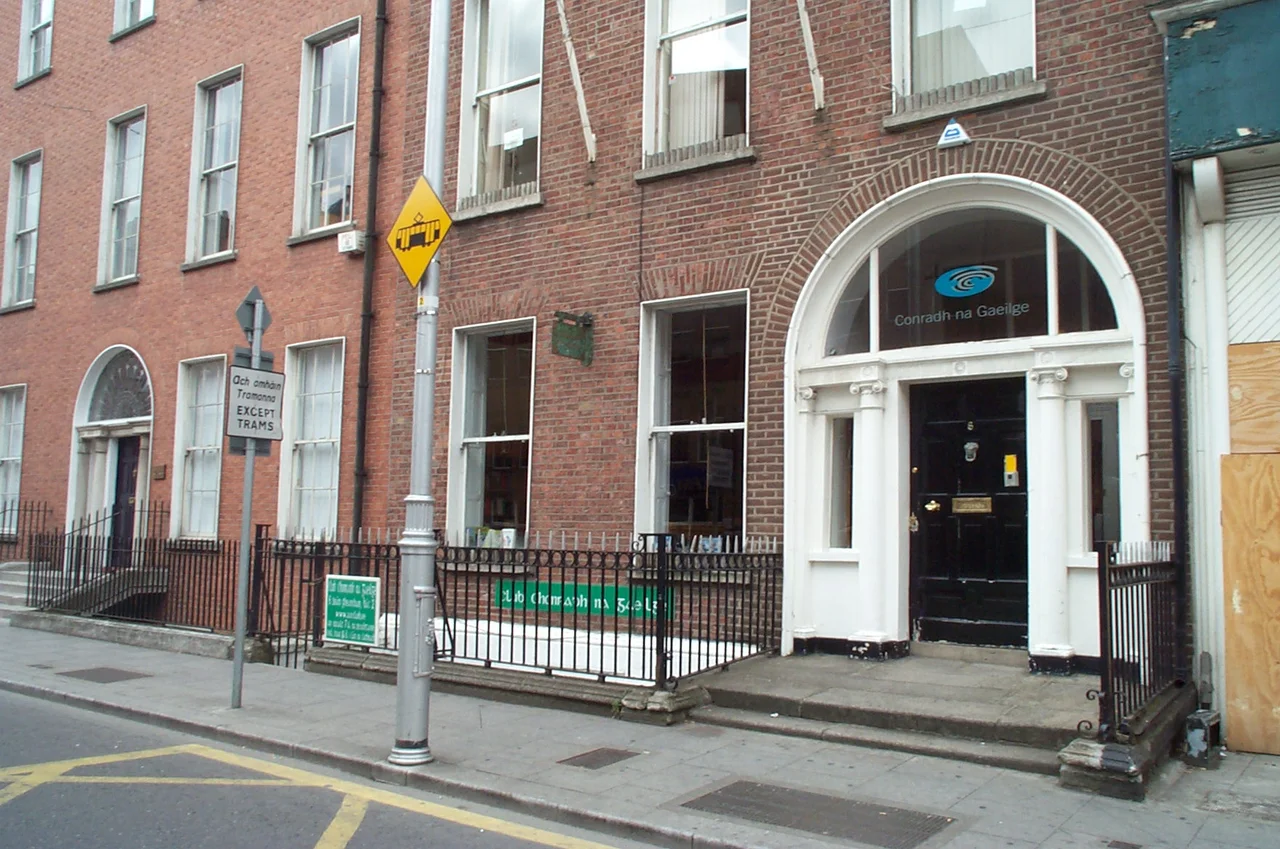

Conradh na Gaeilge
In 1881 the Irish census recorded that at least 45 percent of people born in Ireland in the first decade of the nineteenth century had been raised as Irish speakers. By 1891, the figure for children being raised speaking Irish had collapsed to about 3.5 percent. The famine, mass emigration, the national school system, the deliberate language shift of the Catholic Church, and the simple economic pressure of needing English to survive in the British Empire had reduced what had once been the everyday speech of the Irish people to a marginal tongue surviving mainly among peasants and farm labourers in the poorest districts of the west. Matthew Arnold called Irish 'the badge of a beaten race.' In 1893 a young man named Douglas Hyde, the son of a Church of Ireland rector from County Roscommon, founded an organisation in Dublin to save it. He called it Conradh na Gaeilge - the Gaelic League. One hundred and thirty-three years later it is still here, still campaigning, and Irish remains a living language thanks largely to what it did.
De-Anglicising Ireland
Hyde's 1892 lecture 'The Necessity for De-Anglicising the Irish People' had set out the founding argument. Modern Ireland, he said, had thrown away with a light heart the best claim it had to nationality - its own language. Citing the Italian nationalist Giuseppe Mazzini, who had inspired the Young Irelander Thomas Davis a generation earlier, Hyde argued for a cultural revival as the foundation of any real national revival. The Gaelic League was founded the following year as the institutional answer to that argument. It would teach Irish in classes across the country, organise summer immersions in the Gaeltacht - the Irish-speaking districts of the west - and publish in Irish. Its first newspaper, An Claidheamh Soluis (The Sword of Light), would be edited from 1903 onwards by a young schoolteacher and poet called Patrick Pearse, whose 1916 Easter Rising and subsequent execution would change Irish politics permanently. The League's motto was Sinn Fein, Sinn Fein amhain - Ourselves, Ourselves alone.
The Unionist Members
Hyde insisted from the start that the Irish language was 'neither Protestant nor Catholic, neither Unionist nor Separatist.' For a remarkable decade this was almost true. The early League drew Protestants and unionists into its ranks, including - most extraordinarily - the Reverend Richard Kane, Grand Master of the Belfast Orange Lodge and organiser of the 1892 Anti-Home Rule Convention. James Owen Hannay, better known as the novelist George A Birmingham, was a Church of Ireland rector in County Mayo when he joined the League's national executive in 1904. The Belfast branch was founded under the patronage of the Reverend John Baptiste Crozier - later Lord Bishop of Ossory - and the presidency of his parishioner Dr John St Clair Boyd, both unionists. By 1899 the League had nine branches in Belfast, including one in the unionist Shankill ward where, in the 1911 census, 106 people recorded themselves as Irish speakers. The northern Protestant interest in the Irish language is one of the great forgotten chapters of Irish cultural history.
The IRB Takes Over
Hyde's vision of a non-political language movement could not survive the politics of the 1910s. By 1903, Sean T O'Kelly - future president of Ireland - was using his travelling-manager job for An Claidheamh Soluis as cover for recruiting young men into the Irish Republican Brotherhood in every county in Ireland. The League's Annual General Meeting at Dundalk in 1915 became the moment of public rupture. John Redmond's Irish Parliamentary Party was rumoured to be trying to take over the organisation. Diarmuid Lynch of the IRB mobilised Brotherhood members positioned throughout the League to secure nominations and votes for a new executive that was 'safe from the IRB viewpoint.' They won. Hyde, the founding president, resigned in protest. From 1915 onwards the League was effectively a wing of the revolutionary movement; Unionists withdrew; the supra-sectarian project Hyde had built was over. Hyde would re-emerge in 1938 as the first president of Ireland under the new Constitution - an honour that recognised both his cultural achievement and his refusal to compromise on the non-political principle that had brought him into conflict with the IRB.
What the League Did
The League's early concrete victories were small but real: by 1900 the Post Office had agreed to accept parcels and letters addressed in Irish. St Patrick's Day was made a national holiday. In 1904 Irish was introduced into the national school curriculum. Membership grew from 43 branches in 1897 to 600 branches and 50,000 members by 1904. After the foundation of the Irish Free State in 1922, much of the League's energy transferred to the new state. Irish was declared the national language. It was made a compulsory school subject. Eoin MacNeill, the League's second president, became Minister for Education. Ernest Blythe, a League veteran who had joined the IRB while still a member of the Orange Order, became Minister for Finance. The 1925 Seanad election saw the entire slate of League-endorsed candidates - including Hyde - rejected by the electorate, a sign that even Irish-language enthusiasts no longer thought of the League itself as the main vehicle for the language. The work moved into the state.
The Irish Language Act
In 2008, during the presidency of Daithi Mac Carthaigh, the League adopted a new constitution that reverted to Hyde's original non-political stance, dropping post-1915 references to Irish freedom while restating the ambition 'to reinstate the Irish language as the everyday language of Ireland.' Throughout the 2010s and into the 2020s the organisation's main campaign was the Acht Anois drive for a stand-alone Irish Language Act in Northern Ireland, to protect Irish speakers in a jurisdiction where the language had long been associated with nationalism. The Democratic Unionist Party's refusal to agree to such an act became one of the principal sticking points in the three-year negotiation that eventually produced the New Decade, New Approach agreement in 2020. The 2022 Identity and Language (Northern Ireland) Act, passed by the Westminster Parliament during yet another suspension of the Stormont executive, incorporated many of the protections the League had been campaigning for. Paula Melvin, then president, called the Act 'not our final destination.' The League's headquarters on Harcourt Street in Dublin still hosts Irish-language classes, conversations, social events, and the long, patient work of keeping a language alive.
From the Air
Conradh na Gaeilge's headquarters at 6 Harcourt Street sits at approximately 53.337 degrees N, 6.263 degrees W in Dublin city centre, immediately south of St Stephen's Green and on the north side of the Iveagh Gardens. Dublin Airport (EIDW/DUB) lies 9 km north. From altitude the Harcourt Street area is identifiable as a distinct stretch of Georgian terraces running south from Stephen's Green to Charlemont, with the green block of the Iveagh Gardens immediately west. Best viewing altitude 2,500-4,000 ft. The organisation has 21 branches in County Dublin alone and dozens more across Ireland, but the Harcourt Street building is the symbolic centre of the language movement. Maritime climate, frequent low cloud, prevailing westerlies.
Nearby Stories
- Wicklow Mountains 12 km away
- Mornington 14 km away
- German submarine U-1051 16 km away
- Abbey of Kells 18 km away
- Irish Military Intelligence Service 20 km away
- HMS Manners (K568) 37 km away
- Templemore 42 km away
- Irish Sea Bridge 43 km away