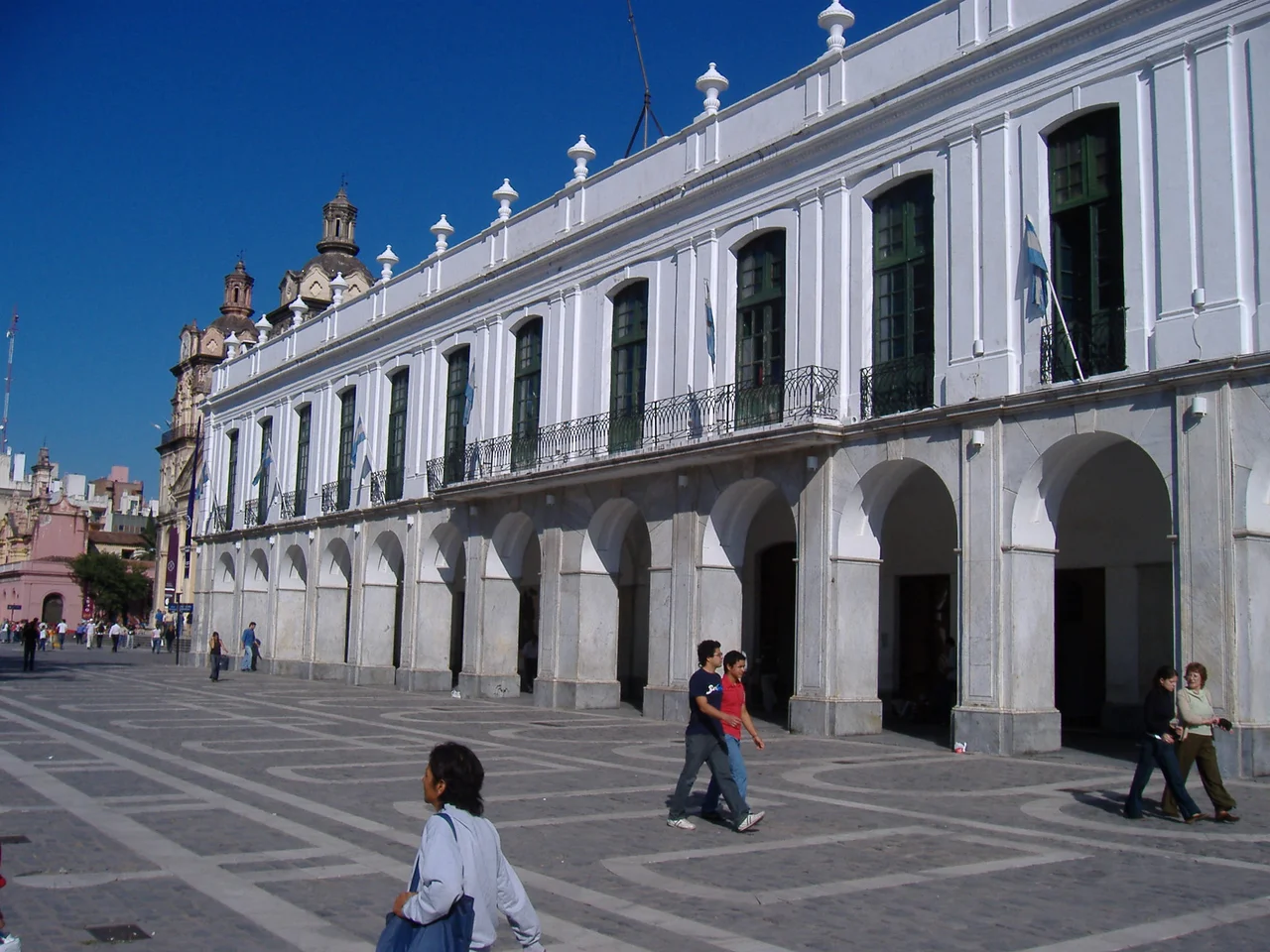

Córdoba Cabildo
Fifteen arches face the plaza, a covered arcade where merchants once kept their stalls and citizens once gathered to hear what their rulers had decided. For more than two centuries the Córdoba Cabildo was where power lived. It began as mud and thatch, grew into the elegant arcaded building that anchors Plaza San Martín today, and in the late twentieth century its rooms held a far grimmer purpose. Few buildings hold the whole arc of a city's history, the founding and the flourishing and the cruelty, quite as plainly as this one.
From Mud to Marble
Córdoba was founded in 1573, and at first its governing council simply met in members' private homes. The first dedicated structure went up in 1588, a modest building of adobe and thatch, the ordinary stuff of colonial Spanish America. A sturdier framed-wood town hall designed by Alonso de Encinas replaced it in 1610, holding little more than the mayor's office, some living quarters, and a small jail. The grand version came later. In 1783 the newly appointed governor, the Marquess of Sobremonte, pushed to finish a long-delayed replacement. He hired Juan Manuel López, and the accelerated work wrapped up in 1786: larger offices, grand steps, a chapel, a patio, and that distinctive façade of fifteen arched columns with a covered arcade for shops. The project also opened the Santa Catalina passage between the Cabildo and the freshly built cathedral next door. Marble cladding and a bell tower were added in 1885, then stripped away again in the late 1930s when Argentina restored many old buildings to their original lines.
The Seat That Kept Moving
Government, it turns out, rarely stays put. The Córdoba Cabildo held the city's administration through the colonial centuries and into the life of the republic, but the seat of power kept migrating. Late in the nineteenth century the city government moved into a Renaissance Revival building, and in the 1960s it shifted again, into a modernist structure that remains its home. The old Cabildo was declared a National Historic Monument in 1941, the same recognition granted to the cathedral beside it. By then the building had become a kind of relic, valued for what it had been rather than what it did. In 1980 the City Historical Museum opened within its walls, and today visitors wander the patios and arcades where colonial councilors once argued over taxes and town ordinances. The arches still frame the plaza exactly as they did in 1786.
A Wing That Remembers
Not every chapter of this building is gentle, and the honest telling matters. A section of the historic Cabildo stayed in use by the provincial police's Department of Information, and during Argentina's last military dictatorship that wing became part of one of more than three hundred clandestine detention centers the regime ran during the so-called Dirty War of the late 1970s and early 1980s. Known as the D2, the operation occupied the police premises in and around the Santa Catalina passage, in the very foundational heart of the city. People were brought here after being seized, interrogated under torture, and then moved on. By later estimates roughly two thousand political prisoners passed through, and many were never seen again, joining the ranks of Argentina's desaparecidos. These were students, workers, and ordinary citizens, not statistics, and the building stands as evidence of what the state did to them.
Turning the Site Toward Memory
Argentina chose not to bury this history but to face it. The colonial houses beside the Cabildo that once held the D2 were given over to the Archivo Provincial de la Memoria, the Provincial Memory Archive, established by a 2006 provincial law. Where interrogators once worked, researchers now preserve records and the public comes to learn what happened a few steps from the cathedral steps. It is an uncommon thing for a single block to hold a founding plaza, a colonial seat of government, a cathedral, and a site of remembrance for the disappeared, all within sight of one another. To stand in Plaza San Martín is to stand inside four centuries at once, and to understand that a beautiful arcade and a terrible secret can occupy the same address.
From the Air
The Córdoba Cabildo sits at 31.42°S, 64.18°W, on the north side of Plaza San Martín in the dense colonial core of central Córdoba. From the air, look for the long arcaded building flanking the plaza, immediately south of the green-domed cathedral and separated from it only by the narrow Santa Catalina passage. The pairing of plaza, cathedral, and Cabildo marks the historic center of the city. The nearest airport is Ingeniero Aeronáutico Ambrosio L.V. Taravella International (ICAO: SACO, locally Pajas Blancas, field elevation 1,604 ft), roughly 9 km north-northwest. Best viewed at lower altitudes in clear daytime conditions, when the regular grid of old streets makes the plaza easy to locate.
Nearby Stories
- Jesús María, Argentina 16 km away
- Alta Gracia 26 km away
- Pampa de Achala 31 km away
- Mina Clavero 31 km away
- Mar Chiquita Lake 116 km away
- Battle of Quebracho Herrado 135 km away
- Villa San Agustín 271 km away
- Predelta National Park 289 km away