.jpg)
Corumbá de Goiás
On weekends during the Festival of the Cavalhadas, the colonial streets of Corumbá de Goiás fill with horsemen in medieval costumes charging down dirt lanes in mock combat. The Cavalhadas - a Brazilian tradition descended from Iberian reenactments of the Reconquista - pits teams of riders in Christian and Moorish costume in a choreographed battle that ends, inevitably and ceremonially, with the conversion of the Moors. Corumbá and its larger neighbor Pirenopolis are two of the best places in Brazil to see the festival. The town was founded in 1731 by gold miners searching for ore at the confluence of two rivers, and almost three centuries later, its colonial houses, cobblestone streets, and baroque church still stand as they did when the tax collectors were counting nuggets.
Gold at the Confluence
The settlement of Corumbá de Goiás began in 1731 when Portuguese and Brazilian prospectors panned the waters where the Corumbá River meets the Bagagem River and found placer gold. The bandeirantes - slave-hunting and gold-seeking expeditions from Sao Paulo - had pushed into the Goiás interior searching for new deposits, and the confluence proved rich enough to hold a permanent camp. A chapel followed in 1734, dedicated to Nossa Senhora da Penha da Franca - Our Lady of the Rock of France - the same Marian title carried by Portuguese sailors and later venerated across the Atlantic. The chapel grew into the Igreja Matriz that still anchors the town square. Corumbá's first priest, Manoel Inocencio da Costa Campos, arrived in 1840, by which point the parish was established but the gold was thinning. Mining boomtowns fade with the ore, but Corumbá held on by slowly converting to cattle, corn, and the quiet rhythms of a river town at the edge of the Brasília hinterland.
The Status Game
Corumbá's administrative history reads like a ladder with loose rungs. Raised to the status of vila - roughly equivalent to a township - in 1849, the town lost that status in 1863, demoted to a district of Meia Ponte, which is today called Pirenopolis. For nearly forty years Corumbá was subordinate to its neighbor. In 1902 it was promoted again, this time to city status, and its residents adopted the name Corumbá de Goiás to distinguish itself from the better-known Corumbá in Mato Grosso state, a much larger Pantanal river port. The name change was less about civic identity than mail delivery - too much correspondence was ending up in the wrong Corumbá. By 1980 the town had 20,212 inhabitants, 17,765 of them living in the surrounding rural area. Then the population fell. Between 1991 and 1996, the count dropped 15 percent, with the rural population collapsing to 4,109. Farms consolidated, young people left for Brasília and Goiania, and the town stabilized smaller than it had once been.
The Pirineus Park
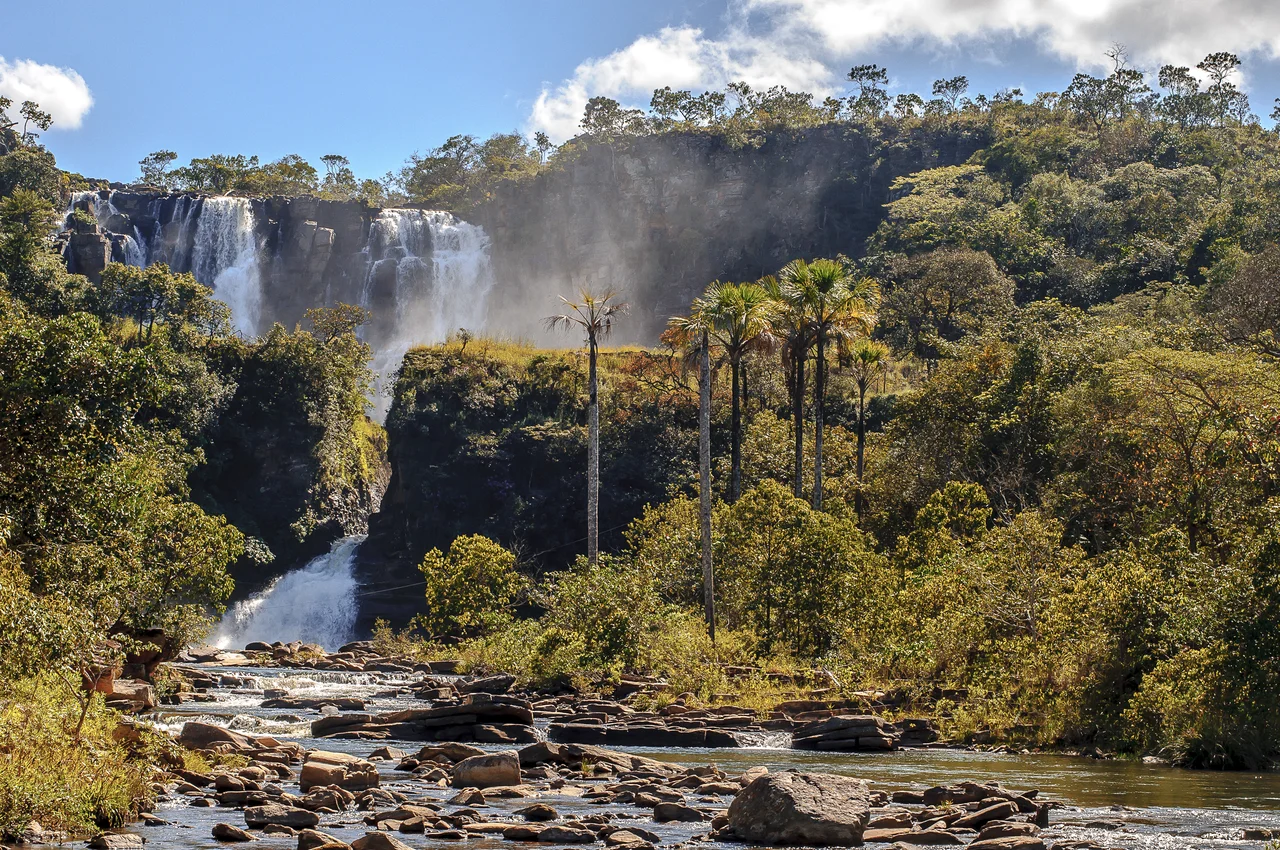
Part of the 2,833-hectare Pirineus State Park falls within Corumbá's municipal boundaries. The park was created in 1987 to protect the Serra dos Pirineus - a ridge named by early settlers who thought the three prominent rocky peaks resembled the European Pyrenees, though the resemblance is modest. The Pirineus offers the same dramatic cerrado topography that makes the region famous: waterfalls, caverns, rock formations, and rivers where swimmers find natural pools carved into the stone. The Salto de Corumbá - Corumbá Falls - is the most famous of these, a waterfall known throughout Goiás that draws weekend visitors from Brasília 130 kilometers to the east and Goiania 110 kilometers to the southwest. The Corumbá River itself crosses the municipality, offering beaches and rapids suitable for rafting in the wet season. Tourism, more than agriculture, is what sustains the town's modern economy.
Cavalhadas
The Cavalhadas festival is the reason outsiders who know Corumbá de Goiás know it at all. The tradition arrived in the eighteenth century with Portuguese settlers and has been performed in Goiás since at least the early 1800s. For three days each year - typically around Pentecost - teams of twelve Christian riders in blue and twelve Moorish riders in red enact the medieval battles of the Reconquista on horseback. Lances clash. Heralds read proclamations in archaic Portuguese. The Moors attempt to take a symbolic castle; the Christians defend. At the climax, after defeats on both sides, the Moors convert to Christianity and peace reigns. The spectacle blends Iberian pageantry with Brazilian carnivalesque flourishes - masked clowns called mascarados harass the crowd on horseback, children run through the streets, food stalls serve empadao goiano and pequi rice. Pirenopolis holds the larger, more famous festival, but Corumbá's version is intimate enough that visitors end up close enough to the horses to feel the ground tremble.
What the Town Kept
Modern Corumbá has 22 schools with 2,413 students, two hospitals with 29 beds, 59,000 head of cattle, and 841 farms totaling 55,844 hectares. Corn is the main crop, with 1,300 planted hectares producing 5,200 tons. A single dairy operates. Two financial institutions serve the town. The 2000 Municipal Human Development Index placed Corumbá 182nd out of 242 Goiás municipalities - a modest ranking that reflects its isolation rather than its history. The historic center endures in its original form. The Igreja Matriz de Nossa Senhora da Penha da Franca rises above the main square, its baroque facade largely unchanged since the eighteenth century. Houses with thick adobe walls, small windows, and clay tile roofs line the streets that the gold miners laid out around the confluence of the rivers. Corumbá is not wealthy and not famous, but it is intact - one of the oldest continuously inhabited settlements in Goiás, preserved less by intention than by distance from the forces that would have otherwise changed it.
From the Air
Located at 15.92 degrees south, 48.81 degrees west, in central Goiás state. The town sits in the Entorno do Distrito Federal microregion, 130 km west of Brasília, 110 km northeast of Goiania, 45 km from Anapolis. From the air, look for the Corumbá River valley and the Serra dos Pirineus ridge rising to the northwest. The town itself is compact, with the Igreja Matriz as the central landmark. Nearest airports: Brasília International (SBBR) to the east, Santa Genoveva/Goiania (SBGO) to the southwest. Dry season (May to September) offers best visibility.
Nearby Stories
- Ceilândia 12 km away
- Jaraguá, Goiás 21 km away
- Luziânia 25 km away
- Nerópolis 26 km away
- Contagem Biological Reserve 31 km away
- Anápolis 33 km away
- Ceres, Goiás 55 km away
- Planaltina, Federal District 111 km away