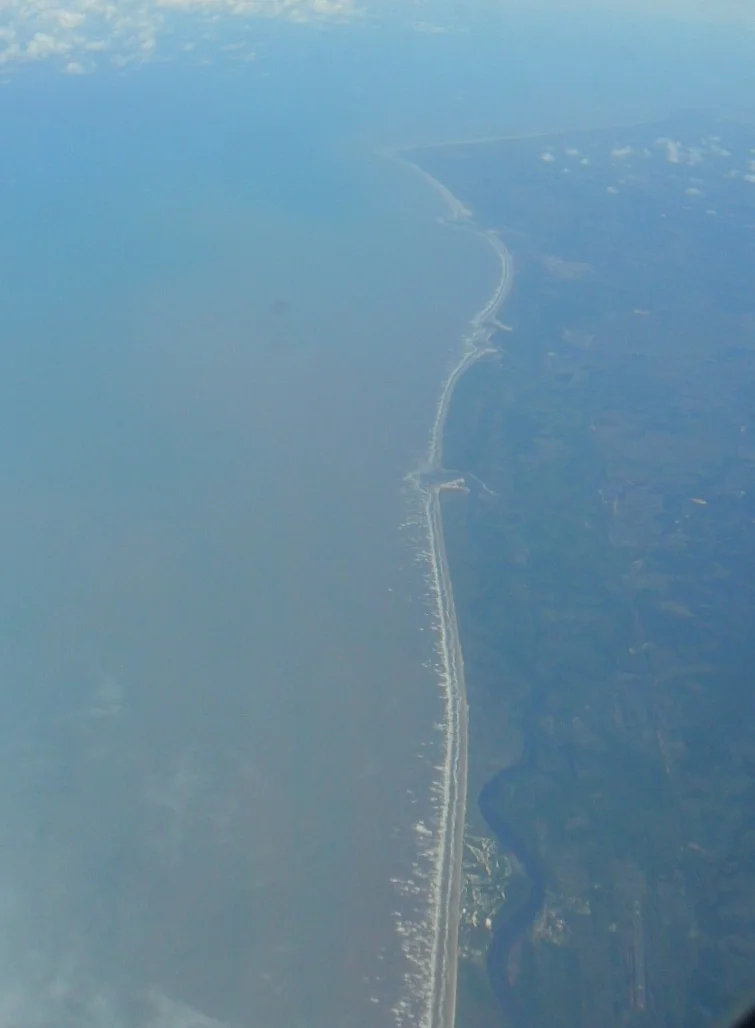

Corumbau Marine Extractive Reserve
This reserve exists because the fishers asked for it. Commercial trawlers had been scraping the shallows off southern Bahia for years by the late 1990s, and the people of Corumbau, Caraiva, Cumuruxatiba and Barra do Cahy - around 450 families whose lives depended on the fish in those waters - saw their catches collapsing in real time. They organized. They petitioned the federal government. On 21 September 2000, a decree created the Corumbau Marine Extractive Reserve: an 89,596-hectare belt of sea, eight nautical miles wide and 65 kilometers long, where industrial fishing was banned and the traditional economy came first. It is a conservation model inverted - protection generated from within.
A Strip of Ocean and Mangrove
The reserve runs from Praia das Ostras in the south to Praia do Espelho - the Mirror Beach - in the north, tracing the coasts of the municipalities of Prado and Porto Seguro. Offshore, the reserve sits within the Abrolhos reef system, which supports the highest marine biodiversity anywhere in the South Atlantic. Endemic corals with names like Mussismilia braziliensis and Favia leptophylla grow in shoals the fishers know by heart. Inshore, the reserve protects healthy mangroves at the mouths of the Caraiva, Corumbau and Cahy rivers - nursery grounds where fish begin their lives before heading out to the reefs. The Ministry of the Environment has classified this stretch as an area of Extreme Biological Importance for Brazilian coastal waters.
The Whales Come Through
Between July and October, humpback whales (Megaptera novaeangliae) arrive off this coast to breed and calve. They have come up from Antarctica, fasting for months, to give birth in warm water. Loggerhead sea turtles feed here year round and haul out on the region's beaches to nest. Small boats slip out from Cumuruxatiba before dawn in whale season, and when the blow of a mother and calf catches the first sun the encounter is closer and quieter than anything a cruise ship could arrange. The whale-watching tours - led by members of the fishing communities themselves - sit inside a category of Brazilian protected area (IUCN VI) explicitly designed to let traditional people continue using the land and sea around them while conserving its ecology. It is a useful counterweight to the conservation model that evicts human beings to save nature.
The Pataxo and the Fishing Villages
The reserve is used by communities including Curuipe, Caraiva, Barra Velha Indigenous Village, Corumbau, Veleiro, Barra do Cahy, Imbassuaba, Cumuruxatiba, and Japara. The Pataxo people, whose presence on this coast predates European contact by centuries, are a core part of the reserve's constituency; the Barra Velha village is one of their oldest communities. Life in these villages has long been isolated. Unpaved roads wash out in the rains. Bridges are precarious. Several settlements had no electricity well into the twenty-first century. Without cold storage, fishers must sell their catch the day it comes in, which means they are often beholden to middlemen with trucks and money - a structural disadvantage that the reserve's deliberative council, established in 2002, has been trying to address for more than two decades.
Success, Tourism, and Its Consequences
The fish came back. By most accounts, the reserve has worked. But its reputation also attracted something else: tourism. Praia do Espelho, at the northern boundary, is now listed among Brazil's most beautiful beaches and draws visitors in high season. Real estate prices have risen sharply. Developers have built pousadas and villas along a coast where, two decades ago, most houses were unlicensed and self-built. Residents - lacking capital and sometimes pressured by the prospect of the whole area being transferred to a Pataxo reservation - have sold their homes for low prices and moved inland. The paradox is a familiar one along the Brazilian Atlantic: a place made valuable by being protected becomes, by that same value, harder for its original inhabitants to hold. The deliberative council keeps meeting. The whales keep arriving. The fishers keep going out.
From the Air
Reserve centered at approximately 16.72 degrees south, 39.12 degrees west, along the southern Bahia coast (the Costa do Descobrimento). Extends roughly 65 km of coastline and 8 nautical miles (15 km) offshore. From 3,000-6,000 feet MSL, reef patterns appear as lighter patches in shallow blue water; mangrove mouths at the Caraíva, Corumbau and Cahy rivers are visible as dark green deltas. Nearest airports: Porto Seguro (SBPS/BPS) about 45 km north, and Caravelas (SBCV) about 100 km south. Weather generally good year-round; watch for afternoon sea-breeze cumulus in summer and offshore tropical systems Nov-Apr.
Nearby Stories
- Atlantic Forest 6 km away
- SS Principessa Mafalda 98 km away
- Nanuque 110 km away
- Mata Escura Biological Reserve 143 km away
- Itaúnas 162 km away
- São Mateus, Espírito Santo 215 km away
- Battle of 4 May 368 km away
- Roncador Field 725 km away