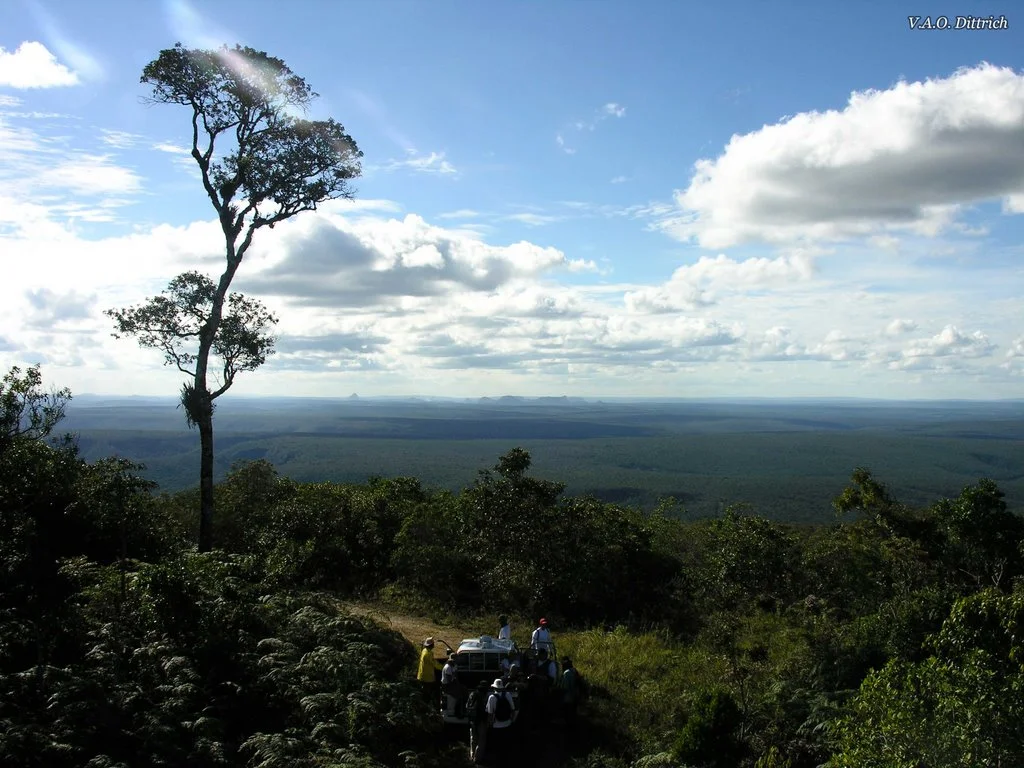

Mata Escura Biological Reserve
The decree came first; the people came long before. When Brazil's federal government created Mata Escura Biological Reserve in 2003 to protect one of the last remnants of Atlantic Forest in northeastern Minas Gerais, it drew lines on a map that sliced straight through Mumbuca - a quilombo, a community founded by descendants of enslaved Africans who escaped plantations generations ago. Roughly 75 percent of the reserve overlaps with Mumbuca's lands. About 81 families live inside what is now, on paper, one of the strictest conservation categories in Brazilian law. The trees, the hawk-eagles, the last wild tamarins - and the families who call this place home - now share a future that no one has quite figured out how to design.
A Forest Clinging On
The Atlantic Forest once stretched along Brazil's entire eastern coast, dense and humid, millions of years old. Most of it is gone now. What remains in northeastern Minas Gerais is fragmented, pressured, and precious. Mata Escura protects 50,890 hectares of these scattered survivors, perched on uplands cut by stream valleys that drain into the Jequitinhonha River. One stream, the Córrego Labirinto, still supplies drinking water to the city of Jequitinhonha itself. Altitudes climb above 850 meters, and on the flat hilltops something unusual happens: the vegetation changes. On sandy soils where ordinary forest cannot take hold, a peculiar meadow flora appears - dwarf trees interspersed with clumps of sedges, terrestrial orchids, and bromeliads that cling to rock and air alike. Botanists describe it as something between a coastal restinga and a highland campo, an ecological signature found almost nowhere else.
The Creatures That Remain
In 1999, researchers from the Federal University of Minas Gerais came looking for fragments that might still hold what the rest of the region had lost. They were hunting, in particular, for two primates: the golden-headed lion tamarin, with its startling orange mane, and the golden-bellied capuchin. Both teetered near extinction, and forest patches like Mata Escura were the thin margin between survival and memory. The researchers also found the northern muriqui - the largest primate in the Americas, a gentle woolly monkey whose population numbers in the few thousands. Pumas still move through these hills. Rare birds hunt the canopy: black hawk-eagles and ornate hawk-eagles, the striking mantled hawk, the ground-dwelling solitary tinamou. A reserve created almost by accident, through environmental compensation required by a distant hydroelectric project, turned out to be sheltering a roll call of Brazil's most threatened creatures.
Mumbuca
Quilombos were founded by people who refused to remain enslaved. They carved communities into remote landscapes - river valleys, forest interiors, highlands - where the reach of colonial authority thinned. Mumbuca is one of those communities. Its families plant, fish the streams, and tend forest that their ancestors already knew when Brazil was still an empire. The Brazilian constitution, since 1988, recognizes quilombolas' right to their traditional lands. But in 2003 the federal government classed Mata Escura as IUCN Category Ia - a strict nature reserve where, in principle, human habitation is not permitted. The contradiction was baked in from the start. In December 2006, the Ministry of the Environment opened a study to find a path forward. A working group followed in 2008. A consultative council was seated in 2014. Years passed. The families remained, and so did the forest, and the question of how to honor both has yet to find an answer.
The Slow Arithmetic of Conservation
The original proposal in 1999 called for a protected area of 20,500 hectares. What emerged in 2003 was more than twice that size - a victory for the forest, a deeper complication for the people inside it. The annual rainfall here averages just 1,000 millimeters, the temperature around 24 degrees. This is not lush rainforest; it is a drier, more fragile mosaic of semi-deciduous and deciduous woodland where a single bad fire season or a single bad decade of deforestation can unravel what took millennia to weave. The Chico Mendes Institute, named for the rubber-tapper murdered in 1988 for defending the Amazon, administers the reserve. The task ahead is harder than drawing lines on a map: to protect what is left, without erasing the people who have been protecting it in their own way all along.
From the Air
Located at 16.30°S, 41.04°W in the Jequitinhonha valley of northeastern Minas Gerais, Brazil. Terrain rises from around 250 m in the stream valleys to over 850 m on the sandy flat-topped hills where the unusual meadow vegetation grows. Recommended viewing altitude FL080-FL120 to follow the ridge system that channels the Jequitinhonha's tributaries eastward. Nearest airfields: Teófilo Otoni (SNTO) roughly 150 km south, and Salvador International (SBSV) about 450 km east-northeast for larger aircraft. Haze from dry-season burns can sharply reduce visibility August through October; afternoon convective buildups are common in the wet season, November through March.
Nearby Stories
- Araçuaí River 62 km away
- Araçuaí 91 km away
- Vargem Grande do Rio Pardo 110 km away
- Itaipé 124 km away
- Vitória da Conquista 126 km away
- Atlantic Forest 129 km away
- Central Atlantic Forest Ecological Corridor 133 km away
- Serra das Lontras National Park 149 km away